Is there such
a thing as karma? The case of Soviet composer Dmitry Kabalevsky
certainly makes one wonder. In life, Kabalevsky played
it safe, skillfully negotiating himself around the official
condemnations that cut deeply into the careers and souls
of his compatriots Shostakovich and Prokofiev. Such decrees
by the powers-that-be even touched Aram Khachaturian, hardly
anyone’s picture of a bold dissident. So, compared to them,
Kabalevsky led a much more serene and successful life.
But now that their struggles are known, Kabalevsky looks
like a craven opportunist, calculating his value to the
government and then sweetening it by writing ideologically
praiseworthy works.
Well, what
of it? If Kabalevsky committed the sin of not being a hero,
he’s certainly paying for it now, dismissed as a lightweight
laboring in the shadows of true geniuses. But doesn’t he
at least deserve credit for being as good as he was? It
seems to me that Kabalevsky figured himself out quite precisely:
He was a lucid, talented composer with a gift for melody,
and not a whole lot more. How many of us know ourselves
well enough to make such an honest assessment?
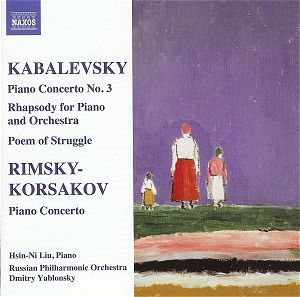
The main item
here is the winningly modest
Piano Concerto No. 3,
which Kabalevsky dedicated “to Soviet youth”. The three-movement
work is melodic and attractive, with simplified piano writing
to make it attractive for pedagogical purposes. Kabalevsky’s
lucid reserve makes it a classical take on the mid-twentieth-century
Russian style. Taiwanese pianist Hsin-Ni Liu plays the
work with grace and style, neither trying to over-hype
its modest dimensions nor underplaying its youthful high
spirits. As pedagogical music goes, this is first-class,
containing more than the passing echo of those Kabalevsky
works which still hang around the fringes of the repertory,
the
Colas Bruegnon Overture and the suite
The
Comedians. The recorded sound is a little studio-bound
here and throughout the program, but it is certainly passable.
As filler to
the general program of Kabalevsky works, we hear the
Piano
Concerto in C-sharp minor by Rimsky-Korsakov next,
a work I had never heard of, let alone heard, before this.
It is in one-movement, built on one theme, but the sections
give it a three-movement feel, with the first movement
having a slow introduction. Rimsky was not a pianist, but,
as his orchestrations show, he worked hard to master the
sort of figurations which make his writing sound idiomatic
for any instrument. And so it goes here, too. Though not
flashy merely for showing off, there are considerably more
virtuoso thrills here than in the Kabalevsky concerto,
integrating the bravura of Liszt and Chopin into Rimsky’s
familiar sound-world of fairy tales and exotic dreams.
Considering that there’s no other concerted piano work
that does this, it’s surprising that this piece isn’t more
well-known. Liu, Yablonsky and Naxos deserve credit for
drawing attention to it. Liu’s performance is broad and
attractive. She finds alternately charming and feisty passages
to show her mastery of the keyboard. The orchestral contribution
is, however, a touch thin and tentative in places, particularly
at the beginning. And when the violins play
en masse,
there is still a certain lack of body to their sound. Nonetheless,
the piano is balanced well against the orchestral body.
Returning to
Kabalevsky, we hear his piano and orchestra
Rhapsody on
the theme of his song “
School Years”. The piece,
written for use in a piano competition in 1964, is dedicated
to “young musicians of the Volga region”. The song was
evidently one of those best-years-of-our-lives, hail-the-alma-mater
type numbers, and Kabalevsky’s variations on it are largely
blue-skied and untroubled, eyeing the world from what the
composer perceived as a child’s perspective. It’s all a
bit too faux-naïve, really, if you think too much about
it. But, as is so often the case with this composer, the
work delights in the pure joy of melody, harmony and rhythm.
While the world was careening through cold war anxiety,
Kabalevsky chose to turn away from that vision and instead
work with children, trying to make their world happier.
One almost feels this undercurrent of seriousness emerge
in the coda to the
Rhapsody.
As further
filler, we get Kabalevsky’s first major work, the
Poem
of Struggle from 1930, for chorus and orchestra. This
is social-realist writing at its finest, which is to say
from the top of the bottom-drawer. In trying to give Kabalevsky
the benefit of the doubt, I’m willing to entertain the
thought that perhaps he sincerely believed in the Russian
Revolution, at least at this point in his life. But I suspect
I won’t be the only one to falter when I see that this
Naxos production, coming out of Vladimir Putin’s Russia,
with an all-Russian staff, chooses to close with a chorus
singing, “Today in Dresden gunfire will sound / From rusty
rooftops, and tomorrow / We will storm into Paris and Warsaw.
/ We will sail from London to New York / Under the banner
of storms!”
Maybe Kabalevsky’s
karma really has come home to roost.
Mark Sebastian Jordan
see also review by Rob Barnett
























 Hsin-Ni
Liu (piano)*
Hsin-Ni
Liu (piano)*
