Alexander
DARGOMÏZHSKY (1813–1869)
Rusalka:
1. Miller’s Aria [4:06]
Pyotr TCHAIKOVSKY
(1840–1893)
Yevgeny Onegin:
2. Prince Gremin’s Aria [5:22]
Alexander BORODIN
(1833–1887)
Prince Igor:
3. Prince Galitsky’s Aria: I hate
a dreary life [3:48]
Nicolai RIMSKY-KORSAKOV
(1844–1908)
Sadko:
4. Song of the Viking Guest [3:35]
Modest MUSSORGSKY
(1839–1881)
5. Song of the Flea [3:47]
Boris Godunov:
6. Introduction & Opening Chorus
[4:30]
7. Coronation Scene [8:46]
8. Varlaam’s Song: Once upon a time
… Come now comrades, fill up your
glass [8:12]
9. I have attained the highest power
[5:27]
10. Duologue between Boris and Shuysky
… Clock Scene: Give me air, I suffocate
[10:59]
11. Farewell & Death of Boris
[9:45]
The Ukrainian bass
Alexander Kipnis was certainly one
of the foremost singers in his voice
category for more than 35 years on
both sides of the Atlantic. He sang
all the great bass roles and was a
noted Wagnerian. He obviously had
a special affinity for the Russian
repertoire and Nimbus have here wisely
collected his Russian recordings from
the mid-1940s. This is the late Kipnis
– he was in his mid-fifties – but
basses tend to be long-lived. He had
preserved his magnificent voice admirably,
considering the strenuous roles he
had been singing since WW1. His was
a true bass: large, black and with
a powerful ring at the top. His only
real contemporaneous competitor, Ezio
Pinza, was a basso cantante (as was
Mark Reizen, but he sang primarily
in the Soviet Union*). Kipnis was
a dramatic bass – but with superb
ability to scale it down, sing softly,
and then the penetrating, almost brutal
edge was gone and replaced by warmth
and intimacy. Gremin’s aria from Yevgeny
Onegin is a wonderful example.
And this reminds us that he was also
a great Lieder-singer.
Several of the arias
here are ebullient or dramatic, like
the opening miller’s aria from Dargomïzhsky’s
Rusalka and Galitsky’s aria
from Prince Igor, where the
typical Slavonic hardness of tone
is noticeable. But he modulates it
expertly and basically it is a very
beautiful voice, slightly throaty
at times. Evgeny Nesterenko was a
worthy successor and before him, of
course, Boris Christoff – even though
he was Bulgarian.
The well-known Song
of the flea has been sung by so
many prominent basses but few have
made it so visually. He tells the
story and we can see his face expressions,
his gestures, his leaning forward
to include us in the story. And his
laugh is infectious.
The rest of the disc
– almost fifty minutes – occupies
excerpts from Boris Godunov,
which was one of his great roles,
and hearing him here it is easy to
understand why. The rather boxy recording
could be a bit of a nuisance but it
still manages to catch enough of Mussorgsky’s
bold orchestration and the chorus
seems well inside the music, though
I have heard more perfect ensemble
singing.
But it is for Kipnis
we want to hear these extracts and
he is formidable. I have been listening
through the years to most great basses
in this role, complete or in excerpts,
and many of them have been superb:
Kim Borg, Ivan Petrov, George London,
Nicolai Ghiaurov, Evgeny Nesterenko,
Matti Salminen, John Tomlinson and
Ruggero Raimondi to mention a few
that come to mind, but three singers
stand out: Chaliapin, Christoff and
between them – in time – Alexander
Kipnis. Like the others he gives a
full-size portrait of the tsar: the
ruler, the tyrant, but also the weak
and doubtful and finally caring and
resigned. His monologue (tr. 9) is
masterly, full of light and shade
and he has many voices, from roaring
to whispering, always singing off
the words. In the scene with Shuisky
(tr. 10) we also hear the lyrical
and sweet voiced Ilya Tamarin and
in the farewell and death scene Kipnis
is deeply moving, singing with restrained
beauty.
I hope Nimbus – or
for that matter some other adventurous
company – will give us more Kipnis:
his highly esteemed Lieder recordings
but also his earlier operatic recordings
– he recorded even before the advent
of the electrical process and I have
an exceptionally beautiful Philip
II monologue from around 1920. From
the electric era there is some Wagner
and also a magisterial Sarastro. In
the meantime this Russian recital
should be compulsory listening for
every lover of the bass voice.
Göran
Forsling
* Mark Reizen (1895–1992) was born
into a Jewish family of mine workers,
where every one learnt to play different
instruments. He studied to be an engineer,
was a soldier during WW1 and made
his professional debut as a singer
in 1921 as Pimen in Boris Godunov.
In 1925 he came to the Marinsky Theatre
in Leningrad and 1929-30 he toured
Western Europe, where he also made
some recordings in London. In 1930
he appeared as guest at the Bolshoi
Theatre in Moscow, where Stalin was
so enthusiastic when he heard him
as Mephistofeles in Faust that
he immediately arranged for Reizen
to move to Moscow, where he sang during
the rest of his career. He retired
in 1952 but his voice was still in
splendid shape and as late as 1985,
at the age of 90, he appeared at the
Bolshoi as Gremin in Yevgeny Onegin.
The occasion was filmed. Watch
and listen and I am sure you will
be as stunned as I was. GF
























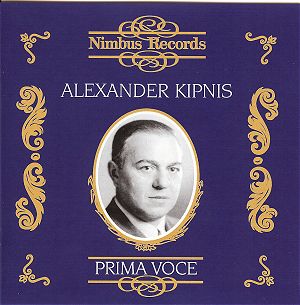
 Alexander Kipnis (bass); Anna Leskaya
(soprano)(8, 10), Ilya Tamarin (8, 10),
Orchestra and Chorus/Nicolai Berezowsky
Alexander Kipnis (bass); Anna Leskaya
(soprano)(8, 10), Ilya Tamarin (8, 10),
Orchestra and Chorus/Nicolai Berezowsky

