Editorial Board
MusicWeb International
Founding Editor Rob Barnett Editor in Chief
John Quinn Contributing Editor Ralph Moore Webmaster
David Barker Postmaster
Jonathan Woolf MusicWeb Founder Len Mullenger
Joseph
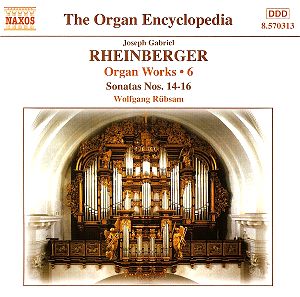
Gabriel RHEINBERGER (1839-1901) Organ Works - Volume 6
Sonata No.14 in C, Op.165 (1890) [25:59]
Sonata No.15 in D, Op.168 (1891) [29:18]
Sonata No.16 in G-sharp minor, Op.175 (1893) [23:13] Wolfgang Rübsam
(Rieger-Sauer Organ of Fulda Cathedral)
rec. Fulda Cathedral, German, April 2007. DDD.
Booklet with notes in English and German NAXOS 8.570313 [78:31]
The Naxos series of Rheinberger’s
Organ Works, performed by Wolfgang Rübsam, is proceeding
sporadically. The first volume was issued in 2000 and Volume
5 (not Volume 13, pace the Penguin Guide) was
reviewed here on Musicweb as long ago as March 2004, when
it received a general welcome (see review).
There must still be two volumes to go before the series of
twenty Organ Sonatas is completed. The slowness of the enterprise
cannot be laid at the door of reviewers, since all the volumes
to date have received generally encouraging reviews.
Perhaps there just isn’t
much of a market for Rheinberger: the Naxos headnote describes
his organ music as ‘demanding’, an epithet which might apply
to the listener as much as to the performer. The Musicweb
review of Volume 5 aptly describes the sonatas as “works
that may need several plays before they reveal their treasures
to the listener”. That may not sound amenable to a generation
conditioned by the short-term attention span of television,
which has made the music and literature of the 19th Century
and even later seem almost as alien as the medieval, but
it is worth making the effort.
I hesitate to use such
terms as ‘heavyweight’ and ‘cerebral’ for fear of putting
readers off. Rheinberger’s music may not be as overtly exciting
as the warhorses of some of his French contemporaries, but
it certainly has its exciting moments – which is what the
headnote presumably means by ‘virtuosic’. To take the first
movement of Sonata No.14 as an example, both the music and
the playing may seem rather tame at first, with Rübsam scrupulously
maintaining what the notes describe as the important rhythmic
figure in the opening maestoso. Even the fugue which
follows is comparatively restrained, with Rübsam carefully
following the poco in the direction poco più mosso,
but when the opening theme and maestoso tempo reappear
in the coda, he grasps with both hands and feet the opportunity
which Rheinberger and the Fulda organ offer him to let rip.
The second movement, a
charming Idyll, receives an appropriately delicate
performance, dream-like at times, though with moments when
Rübsam takes the opportunity to open up in mid-movement.
As the movement dies away to near-inaudibility, one could
not ask for greater delicacy. The Toccata Finale offers
opportunities both for some delicate playing and for a blazing
climax; organ and organist are again fully up to the task.
I defy anyone other than positive organ-haters not to be
moved by the music and the performance of this movement.
The sonata as a whole runs through a variety of moods, from
the truly affecting to the grandiose.
Like all the works on
this recording, it may seem to take a long time to make its
point but all these sonatas are well worth hearing. Though
nothing here is as instantly memorable as, say, Widor, that
is due at least in part to the limited opportunities to hear
Rheinberger’s music. I cannot endorse the comments of one
reviewer of volume 1 (not Musicweb) who characterised Rheinberger’s
music as dreary and turgid.
That reviewer candidly
admitted that Rheinberger’s music is not to his liking, whereas
I must declare the opposite: it may not be grist to my mill
in all moods – only Bach can claim to do that – but it offers
plenty of variety and it certainly has its appeal. I’m as
bored as the next person by the truly turgid – I have long
failed to see why Schoenberg’s Gurrelieder receives
such adulation when I would rather rename them the Drearylieder – but
I don’t find that quality in Rheinberger.
Nor can I endorse the
same reviewer’s comment on the Fulda organ as emphasising
the dreary qualities in the music. The organ is indeed weighty
as the full specification given in the booklet, albeit in
German only, makes plain. No history of the organ is given – presumably
this was included in the notes to earlier volumes – but it
is clear that the instrument is well suited to the whole,
wide range of Rheinberger’s music. First built in 1713 by
Adam Öhninger, it was reconstructed in 1877 by Sauer. The
rebuild by Rieger Orgelbau, 1994-96, has enhanced its capabilities – more
than half of the stops in the specification are listed as
new – but left it as basically a splendid example of a ‘romantic
organ’.
Rübsam is not a showy
organist; like his former doctoral student Julia Brown in
her contributions to Naxos’s complete Buxtehude organ music,
he is content to take his time and let the music breathe
in a way more appropriate to Rheinberger than to Buxtehude.
His playing is always in tune with the varied moods of the
music.
The recording is good
throughout, impressively wide-ranging, with the ambience
of the building well captured, but never allowed to muddy
the sound. On earlier volumes Rübsam is credited as producer,
engineer and editor, as he is on the Naxos Buxtehude recordings;
I believe the ‘RMC Classical Music Inc., USA’ credited with
those tasks on this CD to be none other than Rübsam himself
again – quite an achievement.
The notes, by Keith Anderson,
are brief but informative. I could have dispensed with the
biographical material, repeated from earlier volumes and
taking up over half the space, in favour of greater analysis
of the music.
Brian Wilson
Please support our advertisers below by clicking on the logos for further information.

























 Wolfgang Rübsam
(Rieger-Sauer Organ of Fulda Cathedral)
Wolfgang Rübsam
(Rieger-Sauer Organ of Fulda Cathedral) 