Editorial Board
MusicWeb International
Founding Editor Rob Barnett Editor in Chief
John Quinn Contributing Editor Ralph Moore Webmaster
David Barker Postmaster
Jonathan Woolf MusicWeb Founder Len Mullenger
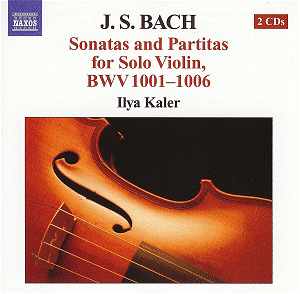
Johann
Sebastian BACH (1685-1750)
Sonata No. 1 in G minor, BWV 1001 [17:19]
Partita No. 1 in B minor, BWV 1002 [30:40]
Sonata No. 2 in A minor, BWV 1003 [25:19]
Partita No. 2 in D minor, BWV 1004 [30:32]
Sonata No. 3 in C major, BWV 1005 [24:32]
Partita No. 3 in E major, BWV 1006 [19:34] Ilya Kaler
(violin)
rec. St John Chrysostom Church, Newmarket, Canada, 19-22
July 2006 (Sonatas); 1-4 February 2007 (Partitas). DDD NAXOS 8.570277-78 [73:29
+ 74:55]
Is this the most astonishing
music ever composed? I sometimes think that if I could choose
some music to represent the most that the human race is capable
of achieving then it would be the jaw-dropping works on these
discs. Do I exaggerate? See below …
Bach’s works for solo
violin are breathtaking in terms of virtuosity and technical
accomplishment, but predominantly in the sound he is capable
of conjuring from the violin. Each movement has a flowing
sense of line and a clear melody, but what is most astonishing
is the way he creates the illusion of harmony and base-line
coming from one instrument that is only capable of playing
two notes at once. It genuinely does not feel like you are
listening to only one instrument. This is most exceptional
in the second movement in each sonata, where Bach produces
a fully realised Fugue. The most famous movement is also
the longest: the Chaconne from the Second Partita.
Theories surrounding it differ widely: some say it represents
Christ’s journey to the cross, while others suggest it as
a profound funeral meditation for Bach’s first wife. Whatever
you think, this movement alone will leave you breathless.
It is the Everest of the
violin repertoire and has attracted the best of performers,
such as Grumiaux, Milstein and Perlman. This new set from
Ilya Kaler doesn’t quite live up to them, but he stands up
for himself well. Kalyer plays a modern instrument. Contrast
this with Jaap Schröder’s performance on a Baroque violin,
also available on Naxos.
The church acoustic (St John Chrysostom’s, Newmarket, Canada)
suits the music surprisingly well, creating a rich sense
of space. While the echo is perhaps a little too pronounced,
the sound of the disc as a whole is very appropriate.
Kaler’s musicianship rises
to the works’ many challenges. He is wistful and melancholic
for the first Partita, jolly and lithe for the third, and
his technical accomplishments are all that they should be
for the Fugues and the Chaconne. His tempi are predictable
- and, it must be said, fitting - and his control of volume
avoids extremes. All of this is altogether suitable, and
this is certainly a set I’ll return to frequently. However,
as you might guess from this, this means that his playing
is dependable rather than inspired. He doesn’t reach the
heights of inspiration you hear in Kremer or Perlman. That
does mean, however, that if you want to get to know these
works for the first time then this is a very good place to
start. There is no “concept” and he certainly isn’t trying
to make a particular interpretative point. I found this disc
thoroughly enjoyable and it only reaffirmed my high opinion
of this extraordinary music rather than drawing my attention
to the performer himself, which is praise enough. The documentation
for the set is adequate, but nothing special. If you want
to hear how this music sounds in the hands of a real genius
then look to Grumiaux
on Philips. Currently remastered in the Originals series
you can pick this up surprisingly cheaply at the moment.
In an article for Gramophone (January
2008) Armando Ianucci pointed out that when scientists were
sending the Voyager space probe into the outer reaches
of the universe, far beyond our solar system, they chose
certain works of art to sum up the greatest achievements
of the human race in case any passing extra-terrestrials
picked it up, and among these works they included the Second
Partita. The most astonishing music ever composed? At the
Naxos budget price you can afford to find out.
Simon Thompson
Please support our advertisers below by clicking on the logos for further information.

























 Ilya Kaler
(violin)
Ilya Kaler
(violin) 
