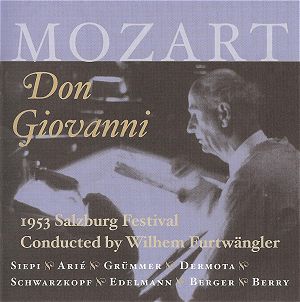
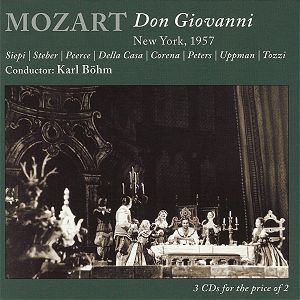
Comparison between these two sets is illuminating as both of these
1950s live recordings feature Cesare Siepi in probably his most
celebrated role. Each production is representative of a golden
age for their respective houses.
It is initially
tempting to fall into glib generalisations about each conductor:
Fürtwängler will be grand, magisterial, monolithic; Böhm, fleet,
alert, more alive to dramatic nuance. Comparison of the overtures
seems to reinforce that impression: a timing of 6:54 for Fürtwängler
confirms his preference for “grandiose solemnity”, while Böhm,
at 5:35, opts for a lither, more sprung pace, the strings scampering
breathlessly. Yet ultimately Fürtwängler’s apparent slowness
results in a performance a mere three minutes slower than Böhm
overall, so that first impression is clearly deceptive. Nonetheless,
Böhm’s interpretation conforms to what might be termed an American
stereotype: direct, immediate, and unpretentious, whereas Fürtwängler’s
prevailing tone is essentially that of an epic morality play:
stern and Germanic. Neither is especially redolent of the “drama
giocoso” Mozart and Da Ponte apparently had in mind, but perhaps
that was just an ironic false trail. In any case, both interpretations
are successful, convincing and balanced. Despite his essential
seriousness, Fürtwängler achieves considerable lightness of
touch in more comical scenes, such as the Don’s serenade and
his exchanges with Leporello, and conversely there is no lack
of weight in Böhm’s handling of the darker moments. Böhm creates
more of the sense of an integrated musical drama; Fürtwängler
is more authoritative but also a little enervated; his “Don
Giovanni” has more of the mood of “Fidelio” about it and is
more static in quality.
Sound might be an
issue for the collector but both sets have been expertly restored
and are eminently listenable. The Salzburg performance conveys
more sense of the stage; the voices have much more space around
them than those at the Metropolitan, and are more often distant,
a little muffled and off-mike. This ambience accords with Fürtwängler’s
darker, more mysterious interpretation but the echo blurs individual
lines in ensembles. The Metropolitan radio broadcast features
clearer, brighter, slightly edgier sound which, again, suits
the conductor’s approach but is marginally less atmospheric
and theatrical, with the singers more immediate and present.
If you can accept
a bass in the eponymous role, Siepi is without equal; smooth,
dangerous and burnished of tone. He reproduces the same striking
portrayal in both performances and is as seductive as one could
wish: predatory yet oleaginously charming in his scenes with
Zerlina; saturnine and violent when he despatches the Commendatore
with a blood-curdling snarl. He is interpretation remains remarkably
consistent between 1953 and 1957 and just as Fürtwängler’s conducting
is closer to that of Klemperer, Siepi’s Don most resembles that
of Nicolai Ghiaurov. If you prefer a baritone Don, look elsewhere;
otherwise this assumption approaches the ideal.
Both casts are as
fine as could be mustered at that time – and that, it has to
be said is very fine. The delight of the Metropolitan recording
is Eleanor Steber in her prime: febrile, vibrant, and gloriously
unhinged as Donna Anna. Elisabeth Grümmer shares those qualities
with Steber but is marginally over-parted and the top of her
voice can be a little shrill. Both are infinitely touching upon
discovering their murdered father, but Steber exhibits a fundamentally
richer, fuller tone than Grümmer can muster - and a hint of
the Germanic “v” occasionally creeps in to Grümmer’s Italian
in lines such as “Quello sangue”. Conversely, Della Casa’s beautifully
vocalised but placid Elvira is wholly outclassed by Schwarzkopf’s
febrile “grande dame”; Schwarzkopf brings real temperament to
the role. Both Zerlinas are lovely little minxes, Berger being
especially pleasing and sounding quite the faux-ingénue even
at 53 years old. The Masettos are as pointedly characterised
as one would wish (the young Walter Berry already shining) and
there is little to choose between Corena and Edelmann as Leporello;
both are splendid vocal actors although Edelmann is a little
dour and has pitch problems in his “Madamina”. Both Commendatores
are suitably terrifying and redoubtable, Tozzi more cutting
and focused of tone, Arie providing a louder, coarser wall of
sound. As for the Don Ottavio – a relatively small but crucial
role, especially as he so often comes across as a real stuffed
shirt – reactions to both tenors will be mixed. Dermota sings
elegantly, if a little nasally, deploying his mezza voce tastefully
but clearly lacking the breath to “do a McCormack” with his
arias, whereas the under-rated and prodigiously versatile Jan
Peerce demonstrates that he has the diaphragmatic control to
tackle those fiendish runs in one long breath. The voice itself
is a little large and effortful for Mozart but he has all the
notes - including the low ones that Dermota lacks – and manages
to infuse the milksop Ottavio with real virility. I find his
characterisation to be a refreshing change – and clearly the
audience loved it, too. However, it is only fair to point out
that the applause of the Salzburg audience equally demonstrates
its approval of Dermota’s refinement.
If you want Fürtwängler’s
“Don”, this is, by all accounts, the best of his three live
recordings both in terms of sound and performance; otherwise,
for me, the Metropolitan performance just has the edge - although
I regret the absence of Schwarzkopf’s Elvira, despite my not
usually being an admirer. There are so many recordings of this
masterpiece that to make an outright recommendation would be
foolhardy. My favourite studio recording remains the 1973 Colin
Davis set on Philips, which has a wonderful sense of ensemble
– and a beautifully vocalised, baritone Don in Ingvar Wixell
- but I am equally drawn to the live 1970 Karajan performance
in Vienna. If you are tolerant of mono sound, you cannot go
wrong with either of the versions reviewed here.
Ralph Moore
see also Review
of the West Hill discs by Robert Hugill

























 MUSIC & ARTS
CD1129 [3 CDs: 59.13 + 57:23 + 62.41]
MUSIC & ARTS
CD1129 [3 CDs: 59.13 + 57:23 + 62.41] 
