Editorial Board
MusicWeb International
Founding Editor Rob Barnett Editor in Chief
John Quinn Contributing Editor Ralph Moore Webmaster
David Barker Postmaster
Jonathan Woolf MusicWeb Founder Len Mullenger
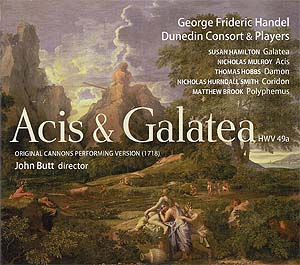
George Frideric HANDEL (1685-1759) Acis and Galatea, HWV49a - (Original Cannons
performing version, 1718) Galatea -
Susan Hamilton (soprano)
Acis - Nicholas Mulroy (tenor)
Damon - Thomas Hobbs (tenor)
Coridon - Nicholas Hurndall Smith (tenor)
Polyphemus - Matthew Brook (bass)
Dunedin Consort and Players/John Butt
rec. Greyfriars Kirk, Edinburgh, UK, 29 April-2 May 2008. DSD.
Booklet with notes and libretto included
Hybrid SACD or Download LINN CKD319 [41:19
+ 53:59]
If you thought that we
were unlikely to have any new Handel recordings to challenge
existing recommendations, the recent Hyperion première version
of Parnasso in Festa (see review) and this new account
of Acis
and Galatea should make you think again. My former version
of choice for Acis, the King’s Consort, on Hyperion
CDA66361/2, now becomes an honourable also-ran and has already
found a new home.
I obtained the new Acis via
a download from Linn’s website and my original intention
was simply to include it in my January 2009 Download Roundup. Two
considerations persuaded me otherwise: it’s too good just
to receive a paragraph in a roundup which some of you may
not yet have discovered – scroll down the page, past the
concert reviews, to find it each month – and, as I downloaded
it in CD-quality sound, it’s fully comparable with the published
article.
In fact, like other recent
Linn and Gimell recordings, it can even be obtained in better-than-CD
quality as a 24-bit studio-quality download. This involves
downloading a very large file and listening to the result
other than via CD – the file is too large to burn to CD – and
I’m perfectly happy with the quality of both Linn’s and Gimell’s
wma and flac 16-bit files. Though the two companies are
not linked, they both value sound and musical quality and
their download arrangements are very similar; both offer
the booklet of notes and other disc liners and inserts as
pdf files. Chandos also do this for their own and some
other recordings on their theclassicalshop.net website and
classicsonline.com for their own label, Naxos.
One other
user-friendly aspect of Linn’s website is that it never seems
to suffer from traffic congestion – whatever your broadband
speed, some sites will download only at about 50k when they
are busy; Acis downloaded at over 800k.
Acis and Galatea was originally
performed at Cannons, the home of the Earl of Caernarvon,
later Duke of Chandos, for whose chapel Handel also composed
the Chandos Anthems. The grand house is long gone
but the chapel is still there, serving as the parish church,
and its baroque splendours indicate how grand the house must
have been. Grand though the house was, this first version
of Acis was composed on a small scale, which makes
it well suited to recording. William Christie (Erato 3984-25505-2,
also part of a budget-price 6-CD collection on 2564-695641)
has already offered us a chamber-sized performance of the
later version, HWV49b, but this is the first attempt to reproduce
the original and it is wholly successful. An inexpensive
version on Brilliant Classics claimed to employ the original
version, but actually uses larger forces – see Robert Hugill’s
unenthusiastic review.
John Butt’s superb scholarship
would have gone for naught if the end result had not been
so convincing, with all concerned giving of their best. The
Dunedin Consort and Players repeat the success of their earlier
award-winning Messiah and St Matthew Passion. Right
from the opening Sinfonia the orchestral playing is
a delight – always the right ‘size’ to match the smaller
vocal forces.
There isn’t a weak link
in those vocal performers, whether performing as a small
chorus in O the pleasure of the plains (CD1, tr.2)
and elsewhere, or as soloists. Not only do they sing very
well, their voices are also in the right proportion for the
music. Traditionalists may hanker after Joan Sutherland
as Galatea on the recent Chandos reissue of ‘Scenes from Acis
and Galatea’(CHAN3147, with Sir Adrian Boult,
the Decca recording from which I first got to know the work)
but Susan Hamilton is a soprano much more in tune with the
music’s smaller scale; after all, if you want Handel opera,
there’s plenty to choose from, including Sutherland’s own
version of Alcina.
I thought Nicholas Mulroy’s
Acis marginally less impressive than Hamilton’s Galatea,
especially when their duet The flocks shall leave the
mountains (CD2, tr.11) becomes a trio with Polyphemus
breaking in. The slight disappointment is more a measure
of the excellence of Hamilton and of Matthew Brook as Polyphemus
than any reflection on Mulroy himself.
Handel reserves some of
his best music for Polyphemus – the villain of the piece
getting the best lines, as so often in Milton’s Paradise
Lost. Memories of Owen Brannigan in O ruddier than
the cherry (CD2, tr.3) are not dispelled but, as with
the Sutherland comparison, Brook’s is a performance for a
chamber performance, not for an opera. When he sings I
rage - I melt - I burn (CD2, tr.2), he evokes real sympathy
for a character who can take no more of his burning passion.
The words of the closing
section, from Cease, Galatea, cease to grieve (CD2,
tr.14) may be somewhat banal, but Handel sets them to wonderful
music and the performance here allows the music to win hands
down over the libretto. Even the trite rhyme in Galatea,
dry thy tears,/Acis now a god appears (CD2, tr.17) fails
to jar; many of us, in any case, first encountered Ovid in
English via the rhyming couplets of the translation by ‘various
eminent hands’ which appeared a year before the Cannons performance
of Acis, in 1717.
Elsewhere the libretto
(by Gay and Pope?) rather improves on the 1717 translation – this
section by Dryden – and even on Ovid himself:
For oh, I burn with love,
and thy disdain
Augments at once my passion
and my pain.
Translated Etna burns
within my heart,
And thou, inhuman, wilt
not ease my smart.
Loses the reference to
Mount Etna and becomes
I rage – I melt – I
burn!
The feeble god [Love]
has stabb’d me to the heart.
with its post-Petrarchan
contrasting opposites.
The recording, as I have
already indicated, is of CD quality. I shall be very surprised
if the physical discs are any better than the wma download
though, of course, aficionados of surround sound will want
the SACDs.
The notes in the booklet
are scholarly and detailed. Try to print them on thin paper
or they won’t fit inside a slim-line 2-CD case.
I recently indicated that
the Binchois Consort’s recording of Dufay’s Missa Se la
face ay pale (Hyperion CDA67715) was already featuring
in my thoughts as a possible Recording of the Year for 2009,
less than two weeks after choosing this year’s favourites. This
new Acis and Galatea is an even more likely candidate
for that honour.
Reviews
from previous months Join the mailing list and receive a hyperlinked weekly update on the
discs reviewed. details We welcome feedback on our reviews. Please use the Bulletin
Board
Please paste in the first line of your comments the URL of the review to
which you refer.













 Galatea -
Susan Hamilton (soprano)
Galatea -
Susan Hamilton (soprano)