Heinrich Schütz (1585-1672), Charles Gounod (1818-1893), César
Franck (1822-1890), Théodore Dubois (1837-1924), Charles Tournemire
(1870-1939), Ruth Zechlin (1926-2007), Sofia Gubaidulina (*1931),
and James Macmillan (b.1959) all composed works based on The
Seven Last Words of Christ. The most famous version is clearly
that by Haydn.
Or
perhaps versions would be more appropriate, since
Haydn wrote “Les sept dernières paroles de notre Rédempteur
sur la Croix” for orchestra first (1786/97), then later appended
to it a choral part (after 1791). Presumably – though not certainly
– from Haydn’s pen comes the transcription for string quartet,
which has entered the Haydn String Quartet canon without controversy.
There is also a version for keyboard which isn’t Haydn’s own,
but was proof-read and approved by him.
The
“Seven Last Words”, taken from the Gospels
of Mark, Luke, and John and put into presumed chronological
order, form a sort of shorthand interpretation of the crucifixion
for Catholics. They are:
- Pater, dimitte illis; quia
nesciunt, quid faciunt – “Father forgive them, for they know
not what they do” (Luke 23:34)
- Hodie mecum eris in paradise
– “Verily, I say to you, today you will be with me in paradise”
(Luke 23:43)
- Mulier, ecce filius tuus
– “Woman, behold your son. (Behold your mother)” (John 19:26-27)
- Deus meus, Deus meus, utquid
dereliquisti me? – “Eli Eli lama sabachthani” [My
God, my God, why hast Thou forsaken me?] (Mark 15:34 and Matthew
27:46)
- Sitio – “I thirst” (John 19:28)
- Consumatum est! – “It has
been done!” [It has been completed] (John 19:30)
- In manus tuas, Domine,
commendo Spiritum meum – “Into Thy hands I command my spirit”
(Luke 23:46)
Haydn’s
challenge was to compose seven meditative instrumental movements
for the bishop of Cádiz, each to follow one of his contemplations
on one of these words on Good Friday. Seven Adagios of just
under 10 minutes each in a row – eight, if you count the Maestoso
ed Adagio introduction – could make for some very turgid
listening. Haydn was well aware of that and he was a master
of the slow movement. The result was one of Haydn’s proudest
achievements and the enduring popularity especially of the ‘naked’
string quartet version proves him right. He created a work that
defies convention and strikes one as modern yet old-fashioned
at once. Or neither – and instead as timeless.
No
wonder a fair number of string quartets flock to this work.
The Griller, Talich, Fitzwilliam, Lindsay and Guarneri string
quartets have recorded it over their careers. In 2001 the Emerson
Quartet threw its hat in the ring with a slightly ‘enhanced’
version - the only Haydn recording of them that I like – perhaps
because humor isn’t terribly important in this work. The Ysaÿe
Quartet put out a wonderful, slightly romantic, version interpolated
spoken meditations (in French), and my favorite quartet in Haydn,
the Quatuor Mosaïque, has recorded them, too. Most recently,
the Klenke Quartet(t) added their version, a live recording,
for Berlin Classics.
I first noted the all-female Klenke Quartet
when I came across their terrific Mozart cycle of the “Haydn-Quartets”
on Profil; next to the Quatuor Mosaïque’s cycle now my favorite
recordings thereof. It shouldn’t surprise that their latest offering
convinces wholly as well, even as it will not be everyone’s preferred
version. Direct comparison to a favorite version of mine – the
Rosamunde Quartet’s on ECM – is telling.
Where the Klenke’s tone is flexible,
offering a good amount of vibrato, the Rosamunde Quartet is
more matter-of-fact, with a straightforward and unsentimental
reading. The latter’s is a true lament, the Klenke’s subversively
romantic. With a rounder, more luxurious sound and a touch more
reverb, the live Klenke recording offers a gentler view and
a bit more humanity.
Annegret
Klenke’s first violin sounds more nasal than Andreas Reiner’s,
and she floats above her colleagues; whereas the Rosamunde remains
a tight cohesive whole, even where the melodic material is unevenly
distributed. And - perhaps a matter of live recording vs. studio
recording, perhaps a matter of style - the Rosamunde Quartet’s
intonation is dead-on whereas the Klenke Quartet bends the sound
here and there, sometimes dropping slightly flat in a flexible,
bungee-like way. Interestingly, many of the qualities that made
their Mozart so irresistible are better represented by the Rosamunde
Quartet in this work.
The
Klenke Quartet might not ‘indulge’ per se, but its slow
tempos remind me a little of the Emerson without achieving their
rhythmic rigor but offering a broader flow. This is particularly
notable with “Sitio”, the fifth sonata, where the Klenke Quartet
takes 11:31 to the Rosamunde’s 7:57. The concluding movement
depicting the earthquake – “Il terremoto” – starts out nice
and dark but then fails to be, well, earth-shattering. Alas,
that is a problem shared with most, if not all, versions for
string quartet. It’s recommended for their flexible tone, and
to those who like breath in already broad movements. Those who
prefer something that lets the music speak more plainly – less
an interpretation rather than musical excavation – will find
more satisfaction from the way of playing epitomized by the
Rosamunde Quartet.
Jens F. Laurson
























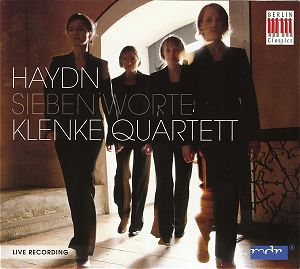

 Klenke Quartett
