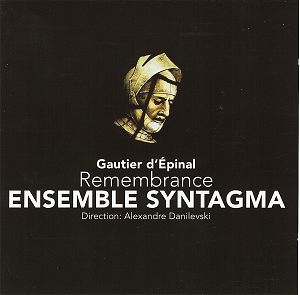
This is a CD as historically fascinating as it is extraordinarily
beautiful and moving.
There has been a
good deal of musicological toing-and-froing as to the precise
identity of the French poet and composer Gaultier d’Épinal.
The traditional view was that he was a chevalier, born between
1205 and 1230, who died in 1272, and who belonged to the ruling
family of Épinal, being related to important aristocrats, such
as the Counts of Savoy. More recently (in a book published in
2007) Robert Lug has suggested that the artist was actually
a cleric, a nephew of the Bishop of Metz, and that he died as
early as 1232. The difference of opinion may never be satisfactorily
resolved. In one sense, the identity of Gaultier is relatively
clear – he is the author/composer of a group of songs which
seem to have a coherent personality. In the booklet notes to
this CD Emilia Danievski observes that he writes “as if he lived
at the end of a civilization rather than at its beginning. His
poetry, like his music, is permeated by the nostalgia of a modern
man who knows that the Golden Age never existed and never will.
All his writings possess a grave tone: even the joy and triumph
of love … have a character of lamentation on human limitations”.
His texts have a dense, syntactically ambiguous character -
partly because his French seems influenced by German habits.
Naturally enough, his work has general similarities with that
of other trouvères, but to read the texts of his poems and to
hear them performed by Syntagma is to have the sense that –
more than with most of the trouvères – one is actually making
contact with the sensibility of an individual. The music is
inventive and often unexpected in its rejection of symmetry
and repetition and the results are often very beautiful.
While the dominant
tone of Gaultier’s songs is one of almost meditative melancholy,
there is a good deal of variety on this well planned CD. The
emphasis here is on a delicacy that seems well suited to Gautier’s
prevailing sentiments. The interleaving of more robust compositions
by his contemporaries and the use of a variety of instrumental
combinations and vocal resources ensures that the danger of
excessive sameness, with its risk of blunting the listener’s
sharpness of attention is kept comprehensively at bay. Thus
a ravishingly gentle and introspectively thoughtful love song
such as ‘Outrecuidiers et ma fole pensee’:
Presumptuousness
and my foolish thoughts
Cause me to sing, and I do not know why
Except that I have looked at her;
But does she belong to me, just because
I have looked at her?
Will I have found my paradise
If everything becomes mine as soon as I see it?
It is not true, but I am disturbed by a
Sweet hope, which I enjoy singing about
(beautifully sung
by Akira Tachikawa and Annemarie Cantor) is followed by an anonymous
Estampie, performed by organetto and percussion. ‘Par son dolz
commandement’ is sung very slowly (by the excellent Akira Tachikawa)
to a decidedly basic accompaniment of fiddles and creates a
mood of seemingly timeless stasis. It is succeeded by the purely
instrumental ‘Commencement de douce saison bele’, which broadly
sustains the mood and an Estampie by Jehannot de l’Escurel which
begins in much the same fashion, before evolving into a rhythmically
seductive dance. The sense is of a CD which has a real shape
and design of its own.
In an area full
of uncertainties, Alexandre Danilevski refuses dogmatism. Unwilling
to claim that he knows all the answers, he is happy to demonstrate
alternate possibilities. So, for example, we get two versions
of ‘Aÿmans fins et verais’, one instrumental and one vocal,
the two rhythmically very different from one another.
This is rare repertoire
and is played and sung with great persuasiveness. It is a long
time since I enjoyed a CD of early medieval secular music quite
so much.
Glyn Pursglove

























 Ensemble Syntagma:
Akira Tachikawa (countertenor), Annemieke Cantor (mezzo), Emilia
Danilevski (narrator), Bernhard Stilz (recorders), Anna Danilevski
(recorders, bowed fiddle), Markus Wesche (medieval lute), Benoît
Stasiaczyck, Peng Xiaobo (percussion), Sophia Danilevski (tromba
marina), Pascale Van Coppenolle (organetto), Alexandre Danilevski
(medieval lutes, gittern, bowed fiddle, director)
Ensemble Syntagma:
Akira Tachikawa (countertenor), Annemieke Cantor (mezzo), Emilia
Danilevski (narrator), Bernhard Stilz (recorders), Anna Danilevski
(recorders, bowed fiddle), Markus Wesche (medieval lute), Benoît
Stasiaczyck, Peng Xiaobo (percussion), Sophia Danilevski (tromba
marina), Pascale Van Coppenolle (organetto), Alexandre Danilevski
(medieval lutes, gittern, bowed fiddle, director) 
