This is a smash and
grab hit in more ways than one! When
it was first released, single-minded
thieves broke into the distributor’s
warehouse in Vienna and stole 1000
copies. Since only 2000 copies were
made in the first place, that’s half
the world’s stock! This disc was deliberately
targeted as the thieves had to move
away crates of other, more popular
recordings to get to it. They also
took 200 copies of another Nono rarity.
Why go to such trouble when they could
have made so much more money with,
say, Mozart’s Greatest Hits?
It’s true that secondhand,
the first recording of Prometeo
costs £50 at least, and the far
rarer recording of Il canto sospeso,
conducted by Abbado, costs £75 upwards,
if you can find it. Col Legno certainly
doesn’t benefit from the theft, though,
as the 1000 recordings legally available
retail at £25. This is remarkably
good value indeed, as Prometeo
requires vast forces – four orchestral
ensembles, a choir, vocal and instrumental
soloists, two conductors and a team
of sound artists. This recording,
too, has Andre Richard as artistic
director. Richard worked closely with
Nono as the piece was developed, so
his insights are extremely valuable.
No one interested in Nono should miss
this. As always, good recordings are
better value because you’ll listen
to them far longer than inferior but
cheaper cover versions. This is the
real thing. Hopefully, it will be
a success and Col Legno can press
extra copies. Why should the black
market benefit?
Prometeo is
a work on a grand scale, a panoramic
exploration of western civilisation,
past and present. It starts with references
to Gaia, the ancient world-spirit,
and to Prometheus, who brought light
from the Gods to man. There’s no narrative.
It works, instead, as a highly sophisticated
stream of consciousness, ideas unfolding
impressionistically. Words and sounds
fragment, building up inlayers and
textures. This is the opposite of
ego-driven music where one element
is above another. Instead, Prometeo
is like a finely woven thread
where all elements exist in relation
to each other. The overall effect
is of oscillating, shimmering lines
that flow, endlessly turning and being
re examined. Conventional instruments
are played in unusual ways, augmented
and elaborated by electronics. Tempi
and intervals vary. Silence, not noise,
is paradoxically the aim behind this
complexity. "It all has to be
much quieter" said Nono frequently
when he worked on the first performance,
because the goal was that people should
listen carefully. The word "Ascolta"
rings out clearly. This isn’t music
to be audited while affecting a mask
of clinical detachment. It’s music
that needs to be engaged with.
Nono told his speakers
and singers not to read the text,
but to feel it. That’s why the texts,
fragment and reform as if in a kaleidoscope.
They turn over endlessly in the imagination.
Far from distorting meaning, this
expands it. Anyone with a basic knowledge
of early music will recognise the
idea from medieval polyphony. Everyone
more or less knew what the "words"
meant on the surface but the true
glory of the music revealed itself
in the mingling of sound elements.
Indeed, it’s because the words aren’t
instantly obvious that you’re drawn
to listening more attentively. This
recording comes with a special "Listening
score" which sets out each vocal
part in layers, so you can see as
well as hear how each voice takes
on a particular syllable or sound,
and how they blend and interweave.
Thus you can follow how a short phrase
like "né voce di Orfeo"
expands and grows. Following the score
isn’t essential, though, because it’s
important to be alert to the details
that flicker past, like a small quote
from Schumann’s "Manfred"
for example, which I still haven’t
located, but just knowing it’s there
adds to my appreciation. This is music
that "opens out" in more
than sound and space.
Word-setting like
this is fascinating. In the second
part of the fourth movement, almost
at the heart of the whole piece, there’s
a fragment from Hölderlin, the
poet who wrote about Arcadia, an idealised,
perfect vision of ancient Greece.
Brahms set these very words in his
own "Schicksalslied" but
the two treatments could not be more
different. Nono places the phrase
"Doch uns ist gegeben auf keine
Stätte zu ruhn" (unto us
is given no place to rest) so the
words curl over each other, restlessly
expressing deep anguish. No wonder
Hölderlin’s late work has such
meaning for 20th century
composers, for whom it mirrors the
unstable turbulence of the modern
world. People are tossed about, says
Hölderlin, "blinding wie
Wasser von Klippe zu Klippe"
(blindly like water from cliff to
cliff). It’s a disturbingly violent
image, and yet so appropriate. There
isn’t much hard ground in Prometeo,
for it keeps floating and oscillating
in free form. There are "islands"
at various points where for a moment
things seem to stabilise, only to
float off again.
Why is the piece
subtitled "Tragedia dell’ascolta"
(the tragedy of listening)? That is
one of the mysteries that makes this
piece so intriguing, and makes repeat
listenings addictive. Perhaps Nono
means that no matter how much we listen,
time and life will move on inexorably.
Like Hölderlin’s dislocated people,
there’s no place of rest. And yet,
should we cease to bother with listening?
Would that make things easier or would
it mean the death of civilisation
and human endeavour? The beauty of
this piece is that it allows for so
many possibilities, and rewards personal
involvement. Much has been made of
Nono’s politics but it’s a dead-end
forcing onto this music any specific
ideological template. Rather, one
should perhaps think of Nono’s underlying
motivation, which was his love for
humanity. He hated fascism because
it was authoritarian, forcing people
into prescribed limitations. Prometeo,
with its breaking of rigid form, and
its ambiguities, allows so much room
for interpretation, that responsibility
is placed on the individual listener
to engage and respond.. "Only
when we reflect … on a world that
is not one dimensional, not linear
or causal, and not unambiguous, will
it become possible to think beyond
the ordinary, for a new, hopeful perspective"
writes Lydia Jeschke, who knows Nono’s
music so well.
On 8 and 9 May, 2008,
at London’s South Bank, there’ll be
two performances of Prometeo
live, with the London Sinfonietta
and others. Andre Richard will be
on hand, too, as will the Freiburg
Experimental Studio we hear here.
No CD can possibly match the experience
of hearing Nono live and in real-time,
but this recording is as close as
it gets. It’s made for SACD and uses
the latest in sound technology to
capture the finest detail. In the
real world, people listen multi-directionally,
not mono-aurally. What’s good about
this disc is that sound is captured
with such vivid freshness that in
this sense alone its ambience outclasses
earlier recordings. Anyone interested
in Nono will be getting this disc
whether or not they can get to the
London performances - or to those
in Europe. The thieves who ransacked
the Vienna warehouse to steal 1000
copies of this disc certainly had
excellent taste!
Anne Ozorio
see also Luigi
Nono and the British Musical Intelligentsia
by Stephen Beville
























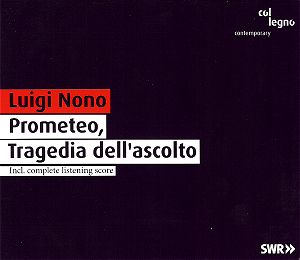
 Solistenchor, Freiburg; Ensemble Recherche;
Solistenensemble des Philharmonischen Orchesters
Freiburg; Solistenensemble des SWR Sinfonieorchesters
Baden-Baden und Freiburg; Experimentalstudio
für akustische Kunst; former Experimentalstudio
der Heinrich-Stobel-Stiftung des Südwestrundfunks;
Andre Richard (director); Peter Hirsch,
(conductor 1); Kwame Ryan, (conductor 2)
Solistenchor, Freiburg; Ensemble Recherche;
Solistenensemble des Philharmonischen Orchesters
Freiburg; Solistenensemble des SWR Sinfonieorchesters
Baden-Baden und Freiburg; Experimentalstudio
für akustische Kunst; former Experimentalstudio
der Heinrich-Stobel-Stiftung des Südwestrundfunks;
Andre Richard (director); Peter Hirsch,
(conductor 1); Kwame Ryan, (conductor 2)
 COL
LEGNO WWE 2SACD 20605 [66:38 + 64:54]
COL
LEGNO WWE 2SACD 20605 [66:38 + 64:54]
