 |
|
|

alternatively
CD: MDT
AmazonUK
AmazonUS
Sound
Samples & Downloads |
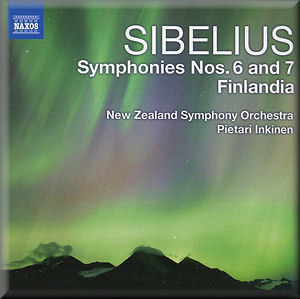
Jean SIBELIUS (1865-1957)
Symphony No. 6 in D minor, Op. 104 (1923) [29:19]
Symphony No. 7 in C major, Op. 105 (1924) [21:04]
Finlandia, Op. 26 (1899) [8:55]
 New Zealand Symphony Orchestra/Pietari Inkinen
rec. 21-23 September 2009 (symphonies) and 27 July 2010, Michael
Fowler Centre, Wellington, New Zealand
NAXOS 8.572705 [59:34] 
|
|
|
The sketching and composition of Sibelius’s last three symphonies
tended to overlap somewhat, so it is all the more surprising
that they are so very different, one from the other. What are
we to make, in particular, of the Sixth? The Fifth had its first
two movements remarkably fused, and in the Seventh all four
are, so it seems doubly strange, between the two, to encounter
a work apparently in four traditional movements. But there’s
nothing traditional about the Sixth. There are many passages
of splendidly sonorous orchestral writing throughout its half-hour
duration, but for the most part the orchestral sound is crystalline,
almost white. I believe Sibelius himself described it as “clear
spring water”. Of traditional – or even progressive – symphonic
growth and development there is little, no tonic/dominant tension,
no searching for resolution. There are not, in truth, even any
themes to speak of. It must be the most difficult of the seven
from the conductor’s point of view, so insubstantial that it
risks disappearing, or at the very least, not leaving much of
an impression.
In fact the impression it does leave is the one established
at the very outset by the strings, lofty, cool, but immensely
calm and tranquil. The music smiles its way through most of
the first movement, at least until we reach the extraordinary,
equivocal coda. Then in the second, what I suppose we should
think of as the slow movement, what are all those rising scales
trying to tell us? For all the brilliance of the writing, the
scherzo is strangely muted, and the finale, which closes most
satisfyingly and convincingly, is very undemonstrative for most
of its length. Listening to the Sixth Symphony brings quite
another kind of satisfaction than that provided by the Fifth
or the Seventh, but satisfying it most certainly is, with not
a single passage that could be confused with the music of another
composer.
Naxos
already have a very fine performance of this symphony in their
catalogue, conducted by Petri Sakari, and others to seek out
would certainly include the splendid, surprisingly dramatic
performance from Sakari Oramo and the City of Birmingham Symphony
Orchestra, originally issued on Erato.
But this one from New Zealand is very satisfying in its own
right. The conductor really has the measure of the work, and
the orchestra plays with just the right balance of weight and
transparency. As an introduction to this marvellous if perplexing
work this performance will serve perfectly well.
Just as there are innumerable rival performances of the Sixth
that remain unmentioned above, so there are even more of the
magnificent Seventh. Indeed, one might think there is a version
of each of Sibelius’s symphonies to suit the sensibility of
each listener. Barbirolli
brings an almost Italianate warmth to the glorious passage for
strings in the early pages of the symphony, and if this is hardly
authentic it is both effective and affecting. Oramo and Petri
Sakari, on the two discs mentioned above, are both, once again,
very fine in their different ways, and Osmo Vänskä’s
performance on BIS,
similarly coupled with the Sixth, is one that held me spellbound
the first time I heard it and still does. No shortage of choice,
then, and here is another, thoroughly recommendable reading.
The rising string scales at the very opening positively glower,
but the music is beautifully, and very subtly, infused with
light at the arrival of the woodwinds. The pace is very measured,
as it also is in the string passage that follows, and which
is sumptuously played and beautifully paced here. The big trombone
theme is played rather more legato than we are used to, and
the balance is more realistic, the instrument more recessed
and integrated into the orchestral texture than is often the
case. The transition into the second section (around the 9:00
mark) is perhaps a little low key and short on atmosphere compared
to starrier readings, and some might find the following section
(13:00) a little breathless, but these really are marginal points,
and do not detract from the overall impression of a very fine
and satisfying performance. And then there are some truly marvellous
moments. The magical resolution that takes place at 19:35 and
the passage leading into it are beautifully handled by these
forces, and I don’t think I have ever heard exactly what happens
in the orchestra in the five closing bars quite so clearly as
I do here.
Only a very few people will, I think, purchase this disc for
Finlandia, but the others might well be pleasantly surprised
to be reminded of what a marvellous piece it is. This is a fine
performance, the dark, brooding opening passage giving way to
the grim determination of the main body of the work. That, plus
the famous, inspiring melody, will leave us with no surprise
that the work was instantly adopted as a patriotic statement.
William Hedley
See also review
and Bargain of the Month rating by Brian Reinhart
|
|























