|
|
|

alternatively
CD: MDT
AmazonUK
AmazonUS |
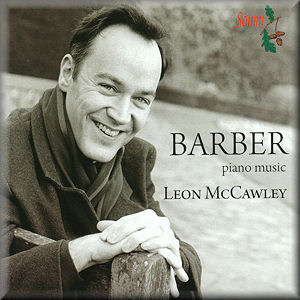
Samuel BARBER (1910-1981)
The Solo Piano Works
Three Sketches (1923-1924) [2:57]
Souvenirs, Op.28 (1950) [17:24]
Interlude I (1929) [4:53]
Interlude II (1931) [1:51]
Excursions, Op.20 (1942-44) [12:03]
Nocturne Homage to John Field, Op.33 (1959) [3:54]
Sonata for Piano, Op.26 (1947-49) [19:27]
Ballade, Op.46 (1977) [5:55]
 Leon McCawley (piano)
rec. September 2010, Champs Hill, Pulborough, West Sussex. DDD.
SOMM SOMMCD 0108 [69:28] 
|
|
|
English pianist Leon McCawley presents to us on one disc all
that is known today of Samuel Barber’s music for piano
solo. He has already recorded a disc of Barber’s piano
music for Virgin EMI in 1997 (724354 537029). On SOMM’s
site he explains why he decided to make this second recording:
“I have always had a special affinity with Barber’s
music. Although at the time I had felt convinced that I had
done the music full justice, I gradually became increasingly
dissatisfied with that first disc which I had recorded 15 years
ago. I had been feeling for some time that my interpretation
had grown and matured over the years. I had also been able to
re-visit the repertoire in Barber’s centenary year in
2010 with many concert performances, all enthusiastically received,
particularly the Sonata, so I felt convinced that given the
chance of a new recording and my close collaboration with SOMM,
I could offer new insight into Barber’s piano music with
interpretations of added zest and sparkle which, I also now
feel, are more sure-footed and give a deeper understanding
of the composer’s intentions.”
John Browning, the Barber champion, recorded a Grammy-winning
album of Barber’s solo piano music in 1993 (on MusicMasters,
reissued on Nimbus),
and it’s with this record I did my comparison listening.
Browning’s album was called “The complete solo piano
music”, but the present disc adds to it the juvenile Three
Sketches, the one-piano version of the dance suite Souvenirs,
and the Interlude II - the latter was not present either
on McCawley’s first record, nor on the Naxos
disc by Daniel Pollack, so this is probably the only place where
you can hear it.
The Three Sketches were written when Barber was 14, and
are sketches indeed. These are miniature waltzes, simple and
unpretentious but sweet and pretty. The first is a love-song
with a Spanish swaying, the second is a tender lullaby, and
the third lilts and is Chopinesque. This cheerful attitude is
continued in Souvenirs, which was originally written
for four hands and orchestrated as a ballet. This is a line
of dances of varying character, with humor, surprises, charades,
and the general atmosphere of a Schubertiade. There are some
sentimental echoes of Tchaikovsky. The old times are remembered
with affection and sweet nostalgia. While not being a must-hear,
these musical pictures have some remarkable moments, and are
never less than good. It must be great fun to hear this music
in concert.
The first Interlude is dark and tense. It is Brahmsian,
of this kind of Intermezzos that Brahms would call “the
lullabies of my sorrows”. In bluish-gray palette, it speaks
of loneliness and fears, but also of beauty and sudden rays
of happiness. The performance of John Browning is more sparse
and barren, with harsh sound in loud places. McCawley is faster,
more dynamic and dramatic. He controls the sound better and
avoids metallic clangour. The silhouette of Brahms is even more
discernible in the Interlude II. This is not an Intermezzo
anymore, but is very close to the Ballade from Brahms’
Op.118: restless, agitated, dark and unbalanced, desperately
lashing from side to side.
Excursions is another suite, but it has a more improvisatory
and introspective character. Barber was not a musical nationalist,
but during the War years he made a few steps towards the Americana.
The first movement is a blue toccata with boiling torrent, growing
and falling, swaying hither and yon over an ostinato boogie-woogie
bass, accentuated and syncopated. The piano sound is shrill
at times, and the loud top notes are naked. The second movement
is soft and bluesy, lazy and warm. Browning’s performance
makes me sleepy; McCawley’s is more lively, softly rocking
like waves on the shore of a warm sea. The third movement smells
like Christmas Eve. This is a set of variations, some of them
quite popsicle-style. Browning gives us sweet syrup, moderate
and steady. McCawley plays faster again, and adds an uneven,
rolling feeling. He makes the piece more attractive: a sleigh
ride instead of a carol. The last movement has the beat of a
hoe-down, with stomping and jumping. It’s sharp and rhythmic,
as if Petrushka’s Shrovetide Fair had moved to
one of the fair fields of Texas. McCawley makes more sense out
of this music: in his hands it is lighter and merrier, not so
angular as with Browning.
Nocturne is dark and luscious. The name is very apposite.
This is Egyptian night: black, grandiose, decorated with rich
golden brocade. McCawley is again fast. This time I think he
is too fast. The music loses some of its measured nobility
and self-confidence, and is turned into a sort of Barcarolle.
The monumental Piano Sonata is Barber’s main statement
in the solo piano repertoire. For me, the first movement depicts
a lonely struggle. One side is the hostile external force, expressed
in the brutal and rhetorical first theme, angular and highly
syncopated. On the other side is the tired soul, in whose sad
motif I hear a telling parallel to the motif of the words “Despite
and still” from one of Barber’s last songs. McCawley
plays with power yet without excess. He finds and projects the
logic of this music better than Browning.
The second movement is short and effective. It is a Mendelssohnian
scherzo, cool and silvery, a mysterious waltz full of glittering
water-drops. McCawley here applies more pressure than necessary,
so the music loses some of the elfin lightness that I feel in
Browning’s interpretation. Its mystery is also compromised.
The slow movement is introspective and gloomy. The music is
cold and glassy, with a funereal air. Browning’s slow
inescapable pace makes a deeper impression than the more impatient
approach from McCawley, The latter delivers more impressive
climaxes but the mesmerizing fascination of this midnight music
suffers unduly. It’s still creepy, but its horrors are
now more graphic. Browning’s interpretation works better
with Barber’s intention to end the sonata after this movement.
Vladimir Horowitz, the work’s dedicatee and first performer,
persuaded the composer to add a virtuosic fourth movement. Thus
despair does not have the last word in this sonata. This movement
is a grand Fugue, Allegro con spirito: dense and defiant,
polyphonic and modern, strong and independent. Again, McCawley
is faster than Browning, and so while Browning’s interpretation
is mighty and steady, McCawley produces some quite unexpected
jazziness. The music becomes a rolling toccata, throwing a bridge
back to the quicksilver second movement. Browning is more heroic;
McCawley more thrilling. I find the latter’s performance
more gripping throughout.
The disc closes with the Ballade, the last piano work
by an insecure and burnt-out composer. It is in ternary form.
The main motif is more rhythmic than melodic, akin to Janaček’s
Veruju from the Glagolitic Mass. Browning’s
outer sections are more misty and bleak, McCawley’s are
more colorful. Personally, I think bleak works better here:
it provides more contrast with the stormy middle episode. McCawley
in the outer sections distils an almost religious solemnity,
and his middle section projects real terror. His reading is
very embossed. The disc ends in the way Barber wanted to end
his Sonata: in desolation and loneliness.
The recording quality is very good. The acoustics are spacious.
The sound is well defined. The piano communicates cleanly and
only rarely rings on the loud notes. The insert note is in English
and French and addresses the music as well as outlining the
pianist’s biography.
This is an excellent collection of Barber’s piano music.
It is performed with devotion and technical brilliance while
remaining emotionally faithful. The tempi are consistently fast,
so at times I feel that the spirit is lost in the speed - mostly
in the slower parts. I understand that this is the added zest
and sparkle that McCawley promised. The result is certainly
thrilling. This disc shows different facets of Barber’s
legacy and depicts him in a portrait that is both personal and
very humane.
Oleg Ledeniov
|
|