 |
|
|

alternatively
CD: MDT
AmazonUK
AmazonUS
|
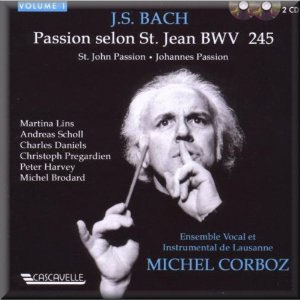
Johann Sebastian BACH (1685–1750)
St. John Passion BWV 245 (1724)
CD 1: First Part (trs.1–14) [37:01]; Second Part (trs.15–20)
[19:04]
CD 2: Second Part concluded. (trs.1–20) [59:55]
 Martina Lins (soprano), Charles Daniels (tenor), Peter Harvey (bass),
Andreas Scholl (counter-tenor), Christoph Prégardien (tenor), Michel
Brodard (bass)
Martina Lins (soprano), Charles Daniels (tenor), Peter Harvey (bass),
Andreas Scholl (counter-tenor), Christoph Prégardien (tenor), Michel
Brodard (bass)
Ensemble Vocal et Instrumental de Lausanne/Michel Corboz
rec. live, Victoria Hall, Geneva, 1994.
CASCAVELLE VEL 3087 [56:05 + 59:55] 
|
|
|
A critic of Christianity might ask why the religion needs four
versions of the same story, as in the gospels of Matthew, Mark,
Luke and John. A classical music lover might respond that the
gospels gave J.S. Bach, among others, multiple opportunities
to set words to music. In Bach’s case, the Passions, of which
he wrote at least three, are among his most beautiful sacred
music. The St. John, though overshadowed by the St. Matthew
through time, ranks among his best.
All Bach’s Passions were written and first performed in Leipzig,
the city he went to following his six happy years at Cöthen.
It was in Cöthen that he married in 1721, started a family,
and composed mostly secular music for a benevolent patron, Prince
Leopold of Anhalt-Cöthen. When the Prince married, coincidentally
a week after Bach, his bride imposed her stricter musical tastes
on the Prince and his court. Bach started to look for other
employment. The Brandenburg Concertos are one result of that
search.
The position of Cantor at the Thomasschule (St. Thomas
School and Church) in Leipzig became vacant on the death of
Johann Kuhnau in mid-1722. The church council first offered
the post to Georg Philipp Telemann, but he could not be released
from his job in Hamburg, so Bach was approached. Prince Leopold
reluctantly accepted Bach’s resignation, and in May of 1723,
the Bach family moved to Leipzig where he would live out his
remaining 27 years.
The Cantor was responsible for all the music in all four churches
in Leipzig, and the formation of choirs for each from among
the students of the school, as well as for a 20 piece orchestra
to accompany major works. This St. John Passion was the first
to be written, and its first version was premiered on Good Friday
1724. Bach did three major revisions, the last one the year
before he died, and that’s the version recorded here.
J.S. Bach was a remarkable adapter and plagiarizer all his life,
and this two-hour work has several examples, the most recognizable
being the chorale In meines Herzens Grunde, in Part 2.
Its tune is familiar as “All Glory Laud, and Honour” written
by Melchior Teschner, born more than a century before Bach.
Part 2 “The Crucifixion” is also remarkable for its structure,
called “chiastic” or symmetrical. The first and last elements
are Chorales, the second and second last are Recitatives, and
so on for all 26 parts.
Bach’s St. Matthew Passion followed in 1727, with Luke in 1730
and Mark in 1731. There is a question about how much of the
St. Luke Passion Bach actually wrote, and how much remains.
The numbering system for all Bach’s works (Bach-Werke-Verzeichnis
– BWV – Bach Works Catalog, developed by Wolfgang Schmieder
in 1950) lists this St. John Passion as BWV 245, and the St.
Matthew as BWV 244 even though it was composed later. The system
is thematic, not chronological: all Cantatas BWV 1 – 224, all
Works for Solo Lute BWV 995 - 1000. The St. Mark Passion is
BWV 247, but the number set aside for the St. Luke Passion (BWV
246) is not clearly linked to it in the catalogue, nor in Grove.
The Passion According to St. John (BWV 245) ranks right below
the St. Matthew Passion among Bach’s most complex and sublime
vocal music. The Swedish theologian Nathan Södeblom called Bach
“The Fifth Evangelist”.
Michel Corboz is fully responsible for this recording. He formed
the chorus and orchestra here (Ensemble Vocal et Instrumental
de Lausanne) in his native Switzerland in 1961 and has honed
it ever since, establishing an enviable reputation for Baroque
performance. The recording quality is top notch. My point of
comparison is with a 9-CD boxed set by Brilliant Classics with
Stephen Cleobury leading the Choir of King’s College, Cambridge
and the Brandenburg Consort in the St. John. The Corboz recording
has a refined, almost French sound which contrasts with the
grittier, more Germanic accent of the British discs. Chacun
à son goÛt.
The accompanying booklet contains full texts in German, French
and English, and a brief write-up on the ensemble, but nothing
on the soloists. All in all, this set is a moving and wonderful
way to spend two hours.
Paul Kennedy
|
|























