 |
|
| 

alternatively
CD: MDT
AmazonUK
AmazonUS
Sound
Samples & Downloads |
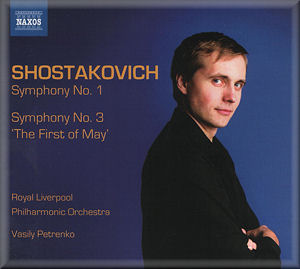
Dmitry SHOSTAKOVICH
(1906-1975)
Symphony No. 1 in F minor, Op. 10 (1924/5) [33:23]
Symphony No. 3 in E flat major, ‘The First of May’, Op. 20 (1929)*
[31:10]
 Royal Liverpool Philharmonic Choir* and Orchestra/Vasily Petrenko
rec. 28-29 July and *22-23 June, 2010, Philharmonic Hall, Liverpool.
DDD
Transliterated Russian text and English translation included
NAXOS 8.572396 [64:33] 
|
|
|
Shostakovich’s First Symphony is an amazingly precocious achievement.
It’s much more than that: it’s also a work of genuine substance.
Vasily Petrenko and the RLPO have impressed me greatly in the
issues that I’ve heard to date from their Shostakovich symphony
cycle and their account of the First is fully up to the standards
so far set.
The first movement contains a good deal of laconic, pithy music
and Petrenko and his team discharge these very well, with crisp
articulate playing. I like the insouciant way the waltz-like
passages are done. This is a movement of several moods and Petrenko
conveys them successfully. He ensures that the nimble second
movement is delivered with great energy and dynamism.
The slow movement takes the work onto a different and deeper
level of expression. It’s launched by an eloquent, keening oboe
solo that’s very well done here and the cello soloist who follows
on is not to be outdone in terms of expressiveness. Petrenko
gives the movement the full weight of emotional gravitas (one
may marvel at the fervour of the eighteen-year old composer.)
The playing of the RLPO is excellent, not least in the dynamic
contrast they provide: there are several stretches of really
hushed playing yet the climaxes, when they come, are towering.
Overall, this is a highly convincing reading of the movement.
The finale can seem episodic but Petrenko knits it all together
expertly. The imposing passage (from 6:28 to the end) following
the timpani solo is powerfully done. This is a very successful
rendition of Shostakovich’s first and very impressive essay
in symphonic form.
I’ve never been able to get to grips with the Third Symphony,
which I first heard decades ago in Morton Gould’s RCA version
on LP. In fact so incomprehensible did I find it that I admit
that I gave up on the piece and I haven’t heard it for years,
other than playing it through when I acquired Rudolf Barshai’s
cycle. In the interim, however, I’ve come to have some understanding
of – and a huge admiration for – the Fourth Symphony, which
I believe is one of the composer’s most interesting and important
works, though it’s a very challenging piece for the listener.
Returning now to the Third in this recording, I suspect that
my appetite for the Fourth may have helped me to an appreciation
of its predecessor.
I’ve also been helped by Richard Whitehouse’s booklet note.
Not only does he outline the background to the work very well
but he’s also very good at describing the music and Naxos helpfully
divide it up into six separate tracks so it’s very easy to follow
Mr Whitehouse’s clear analysis. I was intrigued to learn that
the composer declared that the symphony depicts “the festive
spirit of peaceful construction.” I have to say I don’t really
get that – but I may in time.
The opening, which features an extended, subdued duet for two
clarinets as the introduction to the first movement proper,
gives little hint of what’s to follow. When the main allegro
is reached the pace and the tension of the music pick up appreciably.
Truly, this is driven music – or at least it is in Petrenko’s
hands - and one relishes the bristling, agile playing of the
RLPO. I felt that some passages presage elements of the first
movement of the Fourth Symphony. However, while Petrenko and
his orchestra do their collective best for Shostakovich’s writing
I have to confess that I don’t really discern any progress or
development in the music. Perhaps that’s because I find it well-nigh
impossible to detect – and cling on to – any significant thematic
material. It’s probably there but, despite the clarity of the
playing and the recording. I think Shostakovich has just buried
it under a tumult of often dense scoring.
The slow second movement is easier to appreciate, I find – if
not, perhaps, to love. The hushed, spare textures in the opening
string-dominated paragraphs will surely expose any imprecision
of tuning or ensemble but the RLPO acquit themselves extremely
well. Indeed, the string section plays with great eloquence
in this movement. The third movement, which I hesitate to label
as a ‘scherzo’ since it seems anything but jocular, is fast
and furious – and, to my ears, rather grim. The scoring is often
strident and this is not an easy listen. The thunderous, aggressive
climax reminds me very much of the comparable passage in the
third movement of the Eighth Symphony, which lay some fourteen
years in the future.
The finale is prefaced by a portentous and musically rather
fragmentary introduction. Then Shostakovich deploys an SATB
chorus to declaim a Revolutionary poem by one Semyon Kirsanov.
Frankly, the words amount to little more than revolutionary
tosh but one must make allowances for the oppressive political
climate in which these people were living and working. The RLPO
Choir is suitably fervent in its delivery but I can’t work up
much enthusiasm – no, make that any enthusiasm - for
this part of the work. Neither the music nor the words seem
to have a great deal of connection with what we’ve heard up
to this point and, as Richard Whitehouse very fairly says “there
is little space for any emotional progression.” To be honest,
this part of the work is banal and I was put in mind of part
of the famous description of the Seventh Symphony lying on the
last degree of platitude.
So, I can’t say that I’m still greatly convinced by the piece
overall. However, Vasily Petrenko and the RLPO make the best
possible case for this symphony, however flawed it may be, and
one can see, fleetingly at least, where the Fourth Symphony
has its roots. One may not like the Third Symphony but a recording
such as this makes it plain that one cannot ignore or overlook
it.
The recorded sound in both performances is very good. As I’ve
already indicated, both pieces are very well played and they’re
also nicely illuminated in the booklet note, which is extremely
important in the case of the unfamiliar Third. This is another
impressive instalment in Vasily Petrenko’s Shostakovich cycle.
John Quinn
|
|























