 |
|
| 

alternatively
CD:
MDT
AmazonUK
AmazonUS
Sound Samples & Downloads
|
Johann Sebastian BACH (1685-1750)
CD1
Suite no. 1 in G major for solo cello, BWV 1007 [18:36]
Suite no. 3 in C major for solo cello, BWV 1009 [24:30]
Suite no. 5 in C minor for solo cello, BWV 1011 [24:48]
CD2
Suite no. 2 in D minor for solo cello, BWV 1008 [21:10]
Suite no. 4 in E flat major for solo cello, BWV 1010 [25:04]
Suite no. 6 in D major for solo cello, BWV 1012 [31:09]
 Winona Zelenka (cello)
rec. December 2007 - February 2010, Pong Studio, no other details
given. DDD
MARQUIS 81509 [67:54 + 77:23] 
|
|
|
The Six Suites for solo cello by J S Bach all feature a Prelude
followed by contrasting dance movements; an Allemande, Courante,
Sarabande, and Gigue. In between the Sarabande and Gigue Bach
inserts a pair of “new dances”; Minuets for the first two Suites,
Bourrées for 3 and 4, and Gavottes for 5 and 6 have. Bach also
consistently experiments with his cello writing, using chords
and imitative writing to achieve (or imply) a polyphonic texture.
Each Suite in a different key, with two (2 and 5) being in the
minor. Bach’s cello writing developed as he wrote the Suites,
with the last two being much more difficult technically than
the earlier ones. All these means I believe are aimed at achieving
Discordia concours, or variety within an overall harmony.
Just as Bach’s cello writing developed as he wrote the Suites,
each generation has had different notions of how to play them.
Winona Zelenka grew up revering the romantic Casals approach,
with a big sound, use of vibrato and frequent resort to higher
positions. Study with Janos Starker and William Pleeth refined
these ideas, and her most recent influences have been the historically
informed performance practice of Anner Bylsma and the gamba
player Paolo Pandolfo. The 1707 Guarnerius instrument used in
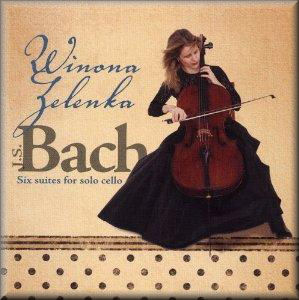
this recording, however, is set up as a modern cello. The photograph
on the CD insert captures how Zelenka straddles the two worlds;
she is pictured playing the Guarnerius with its endpin extended,
but she is holding the bow Baroque-style on the stick.
The romantic legacy of Zelenka’s playing is particularly evident
in her performance of the early Suites. I felt her approach
was a bit too legato in the Prelude to Suite no. 1, and wished
for more of an attempt to contrast the voices and emphasise
the voice leading in the Allemande. The chords in the Sarabande
were quietly eased into, and she varied the Menuets effectively.
She interpolates some notes of her own into the Gigue, something
she admires in Paolo Pandolfo’s playing. The Third Suite opens
in declamatory fashion, and again is played in quite a legato
style. Zelenka varies the dynamics a little more in this movement;
I felt she could have made more of the long pedal note passage.
The Allemande suffered from the same faults as that of the first
Suite, but the Courante had better dynamic variety. The Sarabande
was a bit too legato for my taste, but the Gigue was played
in dashing style, with agile bowing, and the voice leading was
well brought out. The Fifth Suite is one of the strongest performances
in the set; Zelenka seems to respond to the more dramatic Suites.
She differentiates the voices in the Prelude’s fast section,
and the Allemande has an elegant simplicity. I found the great
Sarabande again a little legato, but the dynamics were carefully
shaded.
In the Second Suite the passage at the end of the Prelude was
played as block chords, where it has become usual on “authentic”
performances to play them as arpeggios. The Courante is turbulent.
The Sarabande I felt was one of the most successful movements,
with the chords played with impressive refinement. The Prelude
to the Fourth Suite is played with generally well chosen speeds
and good variety between legato and detached bowing. The Courante
has enjoyably swaggering rhythms, and the pulse is the Sarabande
is maintained without rigidity. Zelenka plays close to the bridge
in the Gigue to vary the tone. Things seem to all come together
in the final Suite. The Prelude has a wide tonal range, and
the fast section is played with unhurried eloquence. There is
an intense musical argument in the Allemande, with great emotional
richness. The Sarabande is reflective, with a melody that is
somehow both plaintive and quietly resolute. Zelenka gives the
chords some air in the first Gavotte, and achieves a delightful
ground bass effect in the second. Her dynamic shading is quite
delightful here. The delicately-stepping Gigue, like the preceding
movements, has a complex emotional underlay that Zelenka brings
out fully.
These Suites pose many interpretive as well as technical challenges
for performers, but richly reward their efforts by bringing
alive many facets of Bach’s complex humanity. For those who
would like to “go the whole hog” and hear this repertoire on
a Baroque cello, to my ears Luigi
Piovano’s set is near ideal. He plays the final Suite on
a five string cello, an instrument with quite a different sound
than the instrument he uses for the first five. I feel he is
more consistent overall than Zelenka, who plays the “big” suites
better than she does the early ones. However, if one is looking
for a historically-informed set of the Bach Suites on a modern
cello, Zelenka’s performances have a lot going for them. She
has obviously lived with this music for a long time, and the
last three Suites in particular are very involving. Marquis’
recording philosophy is to use an acoustic setting without the
use of added effects or reverb, and this recording is very natural.
Guy Aron
Masterwork Index: Bach's
cello suites
|
|























