 |
|
|

alternatively
CD: MDT
AmazonUK
AmazonUS
|
Gustav MAHLER (1860-1911)
Symphony No.4 (1900) [56:26]*
Symphony No.5 (1901-1903) [68:40]
 Camilla Tilling (soprano)*,
World Orchestra for Peace/Valery Gergiev
Video Director: Matt Woodward
rec. Royal Albert Hall, London, August 2010.
(Bonus Documentary [20:45])
Picture NTSC 16:9, colour
Sound PCM Stereo, DTS 5.1
Subtitles Documentary: German,
English (original language)
Booklet English, German, French
Disc format DVD 9.
Region code 0 (all regions).
C MAJOR 702608  [153:51] [153:51]
|
|
|
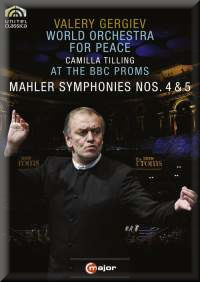
This DVD records a single BBC Henry Wood Proms concert the programme of which comprised not one, but two Mahler symphonies. On the one hand, pairing Mahler’s fourth and fifth in concert seems like such a good idea one wonders why it is not done more often. The juxtaposition of the last of Mahler’s Wunderhorn symphonies with the first instalment of the purely instrumental trilogy that followed has an obvious appeal. And there are thematic links between the two symphonies, notably the trumpet motif buried in the first movement of the fourth that seems to prophesy its own reappearance at the head of the funeral cortege of the fifth’s first movement. On the other hand, it seems like madness to ask an orchestra, however talented, to perform these two works – each hugely demanding both technically and emotionally – in one evening. The reviews of the concert were mixed, and many critics at the time seemed to share Bob Briggs’ views (see Bob’s review at Seen and Heard International).
Reasonable minds, eyes and ears can differ, and in this case they do. I found these performances to be engaging and played with commitment and technical finesse. In fact, I was surprised that the quality of the ensemble is as high as it is. Having heard other scratch orchestras like the World Philharmonic Orchestra on disc and, more recently, the Australian World Orchestra in person, the unity and tonal blend of the World Orchestra for Peace, especially among the strings, was surprising. The winds, by contrast, sound to my ears more as separate voices than the blended ones that you find in permanent orchestras. The technical excellence of this orchestra – player for player and as a whole – is a match for the Vienna Philharmonic under Bernstein on Deutsche Grammophon DVD (DG Unitel DVD 0734090). In fact, the WOP’s ensemble is tighter, with far fewer slips and cracks, than the VPO managed in those live 1970s performances.
Gergiev and Bernstein are very different conductors, and their Mahler fourths demonstrate this. Bernstein delivers a concert performance full of character and feeling. Phrases ebb and flow with natural rubato and fluctuation of tempo. The second movement has an echt Viennese lilt to it, with a retuned violin that is equal parts gypsy, death, and Klezmer fiddle.
Gergiev’s conception is straighter and more aloof. Watching Gergiev’s quivering right hand you would expect something more overt, but the music-making is cool, even a little detached, with emotion sublimated. There is still plenty to admire in this slow-burning performance. Individual instrumental lines emerge with extreme clarity, which is in part due to the close miking of the instruments and a consequently slightly artificial balance – presumably this was a tactic to overcome the inherent problems of recording in the Royal Albert Hall. The first movement moves well and while not all of the transitions ring quite true, there are moments of magic, as at about the 14 minute mark where the opening motif returns. The second movement is beautifully played – a little too beautifully for me. I like more menace in the sound of the retuned violin. The beauty of sound works better in the third movement, with winds prominent over the strings – not a natural concert hall perspective, but quite ear tickling. There is contrast though, with darkness in the central episodes, building to the movement’s climax. Best of all is the final movement, which is capped by the contribution of Swedish soprano Camilla Tilling. She is an engaging soloist, fresh voiced and expressive. I prefer her to the equally radiant but more distant Edith Mathis who sings for Bernstein.
Overall, this is an emotionally cool Mahler 4, with beautiful individual lines emerging with uncustomary clarity from the orchestral textures and a sweet soprano brightening the finale.
The performance of the fifth that follows is more compelling. This symphony was a party piece of the World Orchestra for Peace’s founding conductor, Sir Georg Solti, and Gergiev has a similar conception of the score, with an emphasis on orchestral brilliance and excitement rather than on terror, yearning and the symphony’s psychology. In fact, with the exception of the first movement – unlike Solti, Gergiev keeps a more measured tempo from figure 7 in the score where Mahler's tempo marking is “Plözlich schneller. Leidenshaftlich. Wild.” (Suddenly faster. Passionately. Wild.) – Gergiev’s timings for each movement fall between Solti’s timings in his studio recording with Chicago and his slightly more expansive live Zurich Tonhalle account.
I found Gergiev’s grasp of the symphony’s architecture and the overall sweep of his vision convincing. His pacing of the first movement feels just about right. The solo trumpet of Timur Martynov – principal trumpet in Gergiev’s Mariinsky Orchestra – is clear and bright, sailing above the orchestral maelstrom. The second movement erupts. Bass registers heave and yaw under the tumult. You can almost feel, as well as being able to see and hear, the musicians’ intense concentration. The remainder of the symphony is lighter in tone, with a scherzo that is more playful than puzzling, a flowing adagietto that clocks in at just over 10 minutes, and an exuberant finale.
Throughout the quality of the sound is very impressive. The clarity of ensemble is fabulous and for once the timpani are always audible but never overwhelming.
Solti was not one to deliver deep emotional impact with this symphony, but he was thrilling throughout. So is Gergiev.
The cinematography offers images that are clear and crisp, the distinctive proms lightning bathing the orchestra in pinks and purples. Like the microphones, there are cameras up close, seemingly fitted to the music stands of some of the musicians, including the principal horn, trumpet and bassoon. This allows a variety of close ups shots of the musicians to intersperse with footage of Gergiev’s batonless conducting and long shots of the orchestra from high up in the hall. There are so many cameras at Matthew Woodward’s disposal that the cuts from one to another and the sweeping pans over and around the orchestra can start to seem fussy. I would have liked more sustained shots of the whole orchestra, as one of the things that makes Mahler live in concert so enjoyable is following the sounds from section to section with your eyes. I resent slightly having the camera do this for me quite so much of the time.
The DVD comes with two booklets: one for the main programme on the DVD, and a separate booklet for the mildly interesting bonus documentary, which includes the name of every musician who has played for the World Orchestra for Peace in its first 15 years. It would have been helpful to have the musicians actually taking part in this concert identified in this master list, perhaps by an asterisk next to their names. As it is, we are only told the names of the solo violin in the fourth symphony and the solo trumpet, horn and harp in the fifth.
This is not everyone’s ideal Mahler, but it is thoroughly enjoyable if you favour ensemble clarity and thrilling execution over deep emotion.
Tim Perry
|
|























