 |
|
| 

alternatively
CD: MDT
|
Johann Sebastian BACH
(1685-1750)
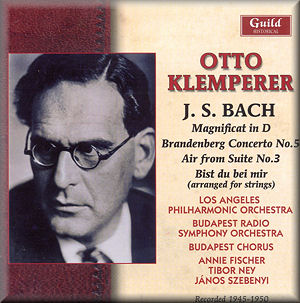
Bist du bei mir BWV 508, arr. Klemperer [3:28] (1), Air from Suite
no.3 BWV 1068 [6:24] (2), Magnificat in D BWV 243 [29:16] (3), Brandenburg
Concerto no.5 in D BWV 1050 [20:42](4)
 Anna Báthy (soprano) (3), Judit Sándor (soprano) (3), Magda Tiszay
(contralto) (3), Lajos Somogyvári (tenor) (3), Grörgy Littasy (bass)
(3), Oliver Nagy (continuo) (3), Sandor Margittay (organ) (3), Tibor
Ney (violin) (4), János Szebenyi (flute) (4), Annie Fischer (piano)
(4), Budapest Chorus (3), Los Angeles Philharmonic Orchestra (1,
2), Budapest Radio Symphony Orchestra (3, 4)/Otto Klemperer
Anna Báthy (soprano) (3), Judit Sándor (soprano) (3), Magda Tiszay
(contralto) (3), Lajos Somogyvári (tenor) (3), Grörgy Littasy (bass)
(3), Oliver Nagy (continuo) (3), Sandor Margittay (organ) (3), Tibor
Ney (violin) (4), János Szebenyi (flute) (4), Annie Fischer (piano)
(4), Budapest Chorus (3), Los Angeles Philharmonic Orchestra (1,
2), Budapest Radio Symphony Orchestra (3, 4)/Otto Klemperer
rec. live, 11 February 1945 (1), 16 December 1945 (2), 13 January
1950 (3, 4), Los Angeles (1, 2), studios of Radio Budapest (3, 4).
GUILD GHCD 2360 [60:38] 
|
|
|
Claudio von Foerster’s booklet notes begin:
“It was a true miracle. Vienna 1947: poverty, famine and
other consequences of the war. People with sad faces assembled
to listen to a 62 year old man who, also partially disabled,
walked painfully toward the rostrum. The music started and everything
changed in the mood of the concert hall: noisy applause and
lots of tears in the eyes of the audience. Klemperer’s magic
was at work”.
If you like this sort of swoony-weepy gossip-columnist style,
you will be pleased to know there are three whole pages of it.
If you don’t, you will at least be relieved to hear that the
three pages do, after their fashion, reasonably chart Klemperer’s
career. All the same, as far as the booklet goes, you may reflect
that you’ve parted with money to get something you could get
much better free on Internet. The Wikipedia article, for a start,
offers a balanced and frank view of Klemperer’s triumphant ups
and sometimes disturbing downs. But, whatever, this is the sort
of account, illustrated with ubiquitous repertory photos like
the group of Walter, Toscanini, Kleiber, Klemperer and Furtwängler
in the 1920s, that would be of use only to the Klemperer novice.
And these dim if listenable early relics of a conductor who
recorded well into the stereo era are assuredly not for the
Klemperer novice. They are for specialists who might welcome
information and discussion about these particular recordings,
how they fit into the Klemperer canon and so on. It would be
nice, too, to know something about the several other artists
involved, hardly household names with one very obvious exception.
So let’s get to the record. The detailed Klemperer discography
on the Internet lists all these performances and indicates earlier
issues of the Los Angeles items and the Magnificat but not the
Brandenburg Concerto, which would therefore appear to be issued
for the first time. And it is the real revelation of the CD.
“Bist du bei mir” is tarted up by Klemperer with some droll
Regerish inner lines. It is played with gravity. I have listed
the piece in the header as it appears on the track list. Klemperer
was presumably unaware that this popular trifle is not by Bach
at all but from an opera by Gottfried Heinrich Stötzel (1690-1749)
which enjoyed a vogue in Leipzig in Bach’s day. Guild have less
excuse.
The “Air” from the Third Suite is played with fervour. Klemperer
is right not to have the bass line played legato, but the lumpy,
un-phrased response – a problem that remained with some of his
Philharmonia Bach too – weighs increasingly on the performance
as it plods through its six-and-a-half minutes.
The Magnificat has a gutsy if ragged chorus, good sopranos,
a powerful Amneris of a contralto, a neat but light-toned bass
and a tenor who is, well, a tenor. We won’t quote Hans von Bülow
on the subject but suffering is assured. And it has a piano
continuo. This lends a surreal air to the more lightly scored
movements, in which the piano is well to the fore. One is reminded
of local choral society rehearsals aided and abetted by a valiant
pianist. Klemperer’s tempi are not quite up to today’s HIP renderings
but brisk by 1950 standards. Over and above all this he obtains,
especially in the final choruses, a massive conviction. No other
performance of this work under Klemperer appears to survive,
but the odds are stacked against it being more than a curiosity.
The presence of a piano in the Brandenburg Concerto, strangely
enough, seems not so much to date the performance as to give
it a timeless air. The tempo in the first movement is pretty
swift, the textures light, the pacing joyful and the interplay
between the three soloists perfectly balanced. Annie Fischer’s
passage-work suggests not so much the traditional pearls but
a clear night sky full of shooting stars – my turn to be swoony-weepy.
I’ve never heard the long cadenza so perfectly integrated into
the rest of the movement. This is one of those occasions when
a Klemperer-miracle has happened. The concept of “tempo”, fast
or slow, disappears, for the music simply unfolds, suspended
in time, from first note to last.
The second movement is also beautifully played. The only problem
with the finale is that Klemperer, like most artists back then,
seemingly didn’t know that the dotted rhythms need to be smoothed
out to match the triplets. Playing them literally introduces
a dogged feeling into a performance that is, in its intentions,
springy and joyful.
But still, that first movement is a miracle. Lovers of Klemperer
and of Bach alike will need it. It may seem extravagant to recommend
a disc just for one track, but miracles are without price.
Christopher Howell
|
|























