 |
|
|

alternatively
CD: MDT |
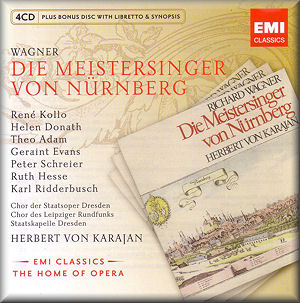
Richard WAGNER
(1813-1883)
Die Meistersinger von Nürnberg (1867)
 Hans Sachs - Theo Adam (baritone)
Veit Pogner- Karl Ridderbusch (bass)
Sixtus Beckmesser - Geraint Evans (baritone)
Walther von Stolzing - René Kollo (tenor)
David - Peter Schreier (tenor)
Eva - Helen Donath (soprano)
Magdelene - Ruth Hesse (mezzo)
Eberhard Büchner (tenor), Horst Lunow (bass), Zoltan Kélémén
(bass), Hans-Joachim Rotzsch (tenor), Peter Bindszus (tenor), Horst
Hiestermann (tenor), Hermann-Christian Polster (bass), Heinz Reeh
(bass), Siegfried Vogel (bass), Kurt Moll (bass)
Choirs of Staatsoper Dresden and Leipzig Radio
Dresden Staatskapelle/Herbert von Karajan
rec. November and December 1970, Lukaskirche, Dresden. ADD. 1999
digital remaster
EMI CLASSICS 6407882 [4 CDs: 70:21 + 72:14 + 70:45 + 52:22
+ CD ROM] 
|
|
|
Two recordings of The Mastersingers dominated the catalogue
when this magnificent performance was released in 1971, both
of them, as this one, on the EMI label. An earlier Karajan
and a reading by Rudolf Kempe are both still available, but
this one from Dresden was in stereo, which rather clinched the
matter for many collectors. The present release is not its first
CD reincarnation, having previously been included in EMI’s
Great
Recordings of the Century series. It is now available
at an absurdly low price, for which we must be grateful. Yet
texts and translations are available only on a “bonus”
CD; this is a poor solution. Reading Richard Osborne’s
excellent background article poses no problems, but if you want
to follow the words you’ll need to sit in front of a screen,
or, of course, print them out, all 111 pages of them.
The Dresden sound is glorious, and perfectly suited to the work.
All the same, not having heard this performance since the LP
era, I found it less sumptuous than I expected, a sign of the
wonders we have become used to. The recording is magnificent,
nonetheless, in a gently reverberant acoustic and with every
thread of orchestral and vocal detail audible. There is an intimacy
about it too, which matches the performance. One would not go
so far as to call it small-scale Wagner, but neither does the
word ‘monumental’ come to mind. There is a certain
mercurial lightness about Karajan’s vision of the work
that comes over very successfully in the performance and which
is perfectly preserved by the recorded sound.
Helen Donath is totally successful, young and eager: hers is,
in my view, a near-perfect realisation of Eva. I very much enjoyed
Ruth Hesse’s portrayal of Magdalene too. Peter Schreier
as David might seem like luxury casting, and so it is, his voice,
that of a lieder singer rather than an operatic tenor, perfectly
suited to the character. As to the mastersingers themselves,
there is not a weak link amongst them, and in particular, Karl
Ridderbusch as Eva’s father, Pogner, is absolutely outstanding.
The voice itself is one of remarkable beauty, rock-steady, and
he assumes the role with a noble authority which is very convincing
and affecting. The tenderness with which he conducts his Act
2 dialogue with his daughter is most moving. I wanted to like
Geraint Evans’ Beckmesser more than I did. There is no
doubt that the character is very vivid and entertaining, but
others have found more humanity there, and I do wish he had
tempered the tendency to near-speech, and actually sung more
of the notes. René Kollo as von Stolzing is very successful
indeed. His singing of the Prize Song is very beautiful, and
he is in slightly better voice there, perhaps understandably,
than in the singing lesson with Sachs, delightfully deft and
comical from both artists, in Act 2. It is known that Karajan
deliberately sought out younger voices for these roles, and
this pays off in Kollo’s case, particularly in those long
conversations earlier in the work, where he is excitable and
ardent, his sudden, overpowering love for Eva very well caught
and acted. When the set was released it was Theo Adam as Sachs
who garnered the least support amongst the different critics,
and so it proves for me too. The main problem is that this marvellous
singer’s voice is simply not right for Sachs. There is
not enough gravity or richness about it, nor warmth of tone.
Sachs is not simply a wise, old father-figure. He is a philosopher
and visionary, but also a cobbler, a fixer, a schemer; he is
even allowed a little flirting. In many of these scenes Adam
is excellent, but Sachs’ wisdom and force of character
provoke the crowd to a final hymn of praise, and in this performance
one can’t quite see why. The chorus is excellent, the
orchestra remarkable, and Karajan, as previously noted, leads
a performance quite different in character from much of his
work in Berlin, with unexceptional but convincing tempi and
not one hint of indulgence.
If an ideal Mastersingers exists on record, I haven’t
heard it. There is hardly a weakness in the marvellous Rudolf
Kempe’s cast, but this opera does need modern sound. This
Karajan performance was followed in quick succession by two
others, Solti on Decca and Jochum on DG. Solti’s performance
has what is for me the finest Sachs of all in the great Norman
Bailey, but others in the cast are less successful, and not
everybody warms to Solti’s rather excitable and foursquare
conducting. Jochum, on the other hand, is marvellous, with Fischer-Dieskau
as Sachs, self-recommending, though the voice itself is so characteristic
that one can never forget it is Fischer-Dieskau. The Knight
is played by Placido Domingo, a surprising choice, but highly
successful, leaving nobody in any doubt that he will win the
Prize! I haven’t heard Solti’s later recording from
Chicago (Decca), but it was well received, the conductor apparently
better attuned to the work this time around. I think I should
enjoy José van Dam as Sachs, and I know I should appreciate
Ben Heppner as von Stolzing, as he is excellent in the Sawallisch
recording on EMI, a very good all-round recommendation despite,
to my ears, a certain lack of intensity and character.
No ideal Mastersingers, then, but this one will do very
well for those untroubled by a less than sympathetic Sachs.
For this listener, the crucial factor in this life-enhancing
opera is the conductor. He must lead the performance as if in
one breath, allowing Wagner’s great paragraphs to pass
almost in an instant. For this, masterly control of pace and
phrasing is required. Of the performances I have heard, Eugen
Jochum comes closest to this near-unattainable ideal.
William Hedley
|
|























