 |
|
|

alternatively
CD: MDT
AmazonUK
AmazonUS |
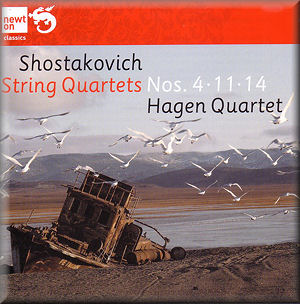
Dmitri SHOSTAKOVICH
(1906-1975)
String Quartet No. 4 in D, Op. 83 (1949) [26:34]
String Quartet No. 11 in F minor, Op. 122 (1966) [17:13]
String Quartet No. 14 in F sharp minor, Op. 142 (1973) [27:01]
 Hagen Quartet (Lukas Hagen, Rainer Schmidt (violins); Veronika Hagen
(viola); Clemens Hagen (cello))
Hagen Quartet (Lukas Hagen, Rainer Schmidt (violins); Veronika Hagen
(viola); Clemens Hagen (cello))
rec. December 1993, Bibliothekssaal, Polling, Austria (Op. 83) and
April 1994, St Konrad’s Church, Abersee bei St Gilgen, Austria
NEWTON CLASSICS 8802056 [70:48] 
|
|
|
Newton Classics is one of the latest companies to spoil us by
making available the riches of the majors’ back catalogues.
Here we have a straight reissue of an outstanding DG disc from
the nineties, but with a new booklet note, in English, French
and German, by Arnold Whittall.
The Fourth Quartet opens, as Whittall observes, in pastoral
calm, a rare enough event in Shostakovich. This brief movement
passes on to a second, in slow triple time, where the atmosphere
is more sombre, yet equivocal, the listener left unsure. And
so it proves for the third movement too, restless and nervous
despite the apparent genial nature of much of the musical material.
Shostakovich in Jewish guise emerges in the final movement,
the longest of the four. A two-note motif, rising first, then
falling, dominates this movement, which rises to a dramatic
and sonorous climax of unisons and pizzicati before subsiding
into a kind of tranquillity, a long-held note accompanied by
pizzicato chords. The last of these allows the work to close
in the major key, but the listener is left, as so often with
Shostakovich, with the feeling that nothing is resolved. We
are not even sure we know what he was saying to us. The work
was dedicated to the memory of the composer’s artist friend,
Pyotr Vilyams, which might have been enough to justify its overall
sombre tone. But the climate wasn’t right, and the Jewish
connotations of the finale added to the problem. Thus this superb
and deeply moving quartet, completed in December 1949, was withheld
and only received its first performance in December 1953.
If the Fourth Quartet is equivocal in nature, the Eleventh
is even more so. The shortest of the quartets, its seven sections
play without a break. The important theme from which much of
the thematic material grows is first intoned by the cello in
the thirteenth bar, and the disembodied tone of the three other
instruments at this point is very affecting indeed. The work
is full of ostinato figures, and the Hagen Quartet tend to bring
these well into the foreground. This can take some getting used
to, but is all of a piece with a view of the work that seems
to want to emphasise its harsh, unremitting nature rather than
its charm and admittedly quirky elegance. The first violinist,
Lukas Hagen is brilliant in the non-stop semiquavers of the
short “Etude”, and the next to last section, “Elegy”,
is given with all the lugubrious weight it requires. In the
closing section, with the four instruments muted and the pianissimo
indication scrupulously respected, the Hagens adopts what sounds
like a dangerously slow tempo to the point that the music becomes
so fragile as to threaten to disintegrate completely. Checking
reveals that the tempo is as close as one can get to the composer’s
metronome mark, though few other quartets in my experience have
had the courage to put this to the test.
The Fourteenth Quartet begins in genial, almost playful
mood, but the first movement soon visits some pretty anguished
places. The slow movement is a long outpouring of melody, harrowingly
intense for the most part, and ultimately leading nowhere. The
finale is very puzzling, passing through a series of moods,
including a passage early on remarkable for its apparently unprovoked
wildness. The work ends quietly, however, coming to rest on
a chord of F sharp major, which may be a resolution of sorts
- it is indeed a musical one - but once again the listener is
left pondering over the journey the composer has taken. This
work, like the other two on the disc, offers no solutions.
The Hagen Quartet recorded another disc of three Shostakovich
quartets, but did not, I think, complete a whole cycle. These
beautifully recorded performances are as fine as any in the
catalogue. Whilst one might prefer this or that movement from
this or that group, no collector wanting these particular works
and purchasing this disc, especially given the absurdly cheap
price, can go wrong.
William Hedley
|
|























