 |
|
|

alternatively
CD: MDT
AmazonUK
AmazonUS
Sound
Samples & Downloads |
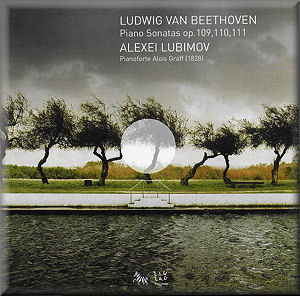
Ludwig van BEETHOVEN
(1770-1827)
Piano Sonata No 30, Op. 109 in E major [19:14]
Piano Sonata No 31, Op. 110 in A flat major [20:22]
Piano Sonata No 32, Op. 111 in C minor [26:22]
 Alexei Lubimov (pianoforte, Alois Graff, 1828)
rec. 14-15 July 2009, United Mennonite Church, Haarlem, The Netherlands
ZIG-ZAG TERRITOIRES ZZT110103 [65:58] 
|
|
|
We are now officially spoiled for choice in period-pianoforte
performances of Ludwig van Beethoven’s last three sonatas.
Ronald Brautigam on BIS, Paul Komen on Globe, and now Alexei
Lubimov on Zig-Zag are a distinguished trio. Their performances
are all very good, and all in very different ways.
To begin with Lubimov: this is a highly individual account,
and if I was a little disappointed in some places, it was only
because Lubimov’s glowing Schubert readings set the bar
so high. His pacing is a little eccentric in the slow first
movement of Op. 109 and the hesitating allegro molto
of Op 110, and the syncopated “fast” variation in
the last sonata’s arietta sadly falls flat. Elsewhere,
though, he does very well; the poet with a great ear for rubato
is in evidence at the beginning of the A flat sonata’s
adagio, and in the luminous final variations of Op 109, the
fortepiano singing despite its short sustained notes.
The other two readings available sit at opposite ends of a spectrum
in which Lubimov might be seen as the moderate figure. Paul
Komen has a gorgeous-sounding Graf piano with a dark, rich night-time
timbre, slightly less pearly than Lubimov’s and a little
tinkly in the top registers. He doesn’t hesitate to take
advantage in Op. 111, the final arietta of which expands out
to 18 minutes, but his quick movements never lack bite - indeed
he’s faster everywhere else than Lubimov. Fast is not
to say insensitive: Op. 109 begins with delicately voiced rolls
of notes - this is how it’s done! - and some of its final
variations (as at 5:30) are magically sung. The fugue in Op.
110 feels rather fast - but then, Beethoven did mark a tempo
jolt from adagio to allegro. Komen takes him literally. His
Op. 111 is one of my reference versions on any instrument: the
first movement strikes a balance between relentless middle-period
sturm und drang and moments of calming repose. The arietta
is a transcendent reading, with delightful snap and energy when
called for and a simply divine touch, lighter than you’d
think possible on pianoforte, after 11:00.
Ronald Brautigam’s traversal, on a modern Paul McNulty
instrument after an 1819 Graf, enjoys a piano which is both
clear and light in action and warm in tone - only a bit more
percussive than Komen’s. Brautigam sails through the fast
movements with aplomb and virtuoso technique; his style is to
compensate for the instrument’s less powerful sustain
by playing quickly but lightly. The opening movement of Op.
109 is a little miracle, as is the powerful close of Op. 110,
in both of which the cascades of notes never blur. The Op. 109
variations are just 11 minutes in duration, Op. 111’s
not even 15, to Lubimov’s 12:39 and 17, and in truth the
whole final sonata does feel a bit too fast. It’s not
rushed, indeed it feels quite natural, but the arietta is not
ideally contemplative and the first movement is unrelenting
in its fierceness.
I would say, then, that what we have here are three distinguished
competitors indeed. Alexei Lubimov takes a very honorable bronze:
his eccentricities at certain junctures, like the first bar
of Op. 109, are minor blemishes on a poetic, very individual
achievement. Brautigam does make a superb impression in Op.
109, and Komen is consistently my favorite interpreter of the
three, but there are moments in Lubimov’s readings which
are to be treasured. I’ll be glad to keep it on the shelf,
especially with nigh-ideal acoustics, not as boomy as one might
expect from the church venue but also not close enough to capture
the clicks of the instrument’s actions.
Zig-Zag have unnecessarily introduced a fly in the ointment
with their odd tracking; the Op. 110 sonata is split across
four tracks, helpfully, but the Op. 109 is compressed into just
two, the shorter opening movements stuck together. What’s
that for? Why the inconsistency? This doesn’t actually
impact the playing on any equipment I know of, but it does leave
my obsessive-compulsive side a little displeased.
As I’ve finished writing this review, another disc has
arrived for review - another set of Opp. 109-111, on another
Graf fortepiano, played by Penelope Crawford. The original suggestion
that we are now spoiled for choice is now even more true. Paul
Komen on Globe might still be my top choice here, but for the
fortepiano devotee there are now four excellent artists, on
four good instruments, and all of them are well worth hearing.
Watch this space.
Brian Reinhart
|
|























