 |
|
|
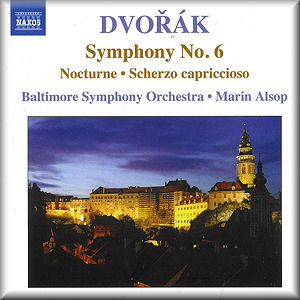

alternatively
CD: MDT
AmazonUK
AmazonUS
Sound
Samples & Downloads |
Antonín DVORÁK
(1841-1904)
Symphony No. 6 in D, Op. 60 [45:38]
Nocturne in B, Op. 40 [7:38]
Scherzo Capriccioso, Op. 66 [15:00]
 Baltimore Symphony Orchestra/Marin Alsop
rec. live 27-30 March 2008 (Symphony, Nocturne), 19-22 March 2009
(Scherzo), Joseph Meyerhoff Symphony Hall, Baltimore, Maryland,
USA
NAXOS 8.570995 [68:14] 
|
|
|
I had a lukewarm response to Marin Alsop’s Dvorák Ninth with
the Baltimore Symphony, and was hard-pressed to find anything
special about it. I felt the same way about her Eighth and was
harshly critical of the Seventh. But now, just when I was ready
to write off Alsop’s Dvorák cycle entirely, she offers an unquestionably
superb Sixth.
This is a performance of the symphony which has nearly every
advantage: lively tempi in the outer movements which ensure
that things move along excitingly, a full orchestral sound with
especially commanding brass, and sound which puts the listener
in the center of the concert hall. At first I thought that the
timing of the first movement (16:12) was a misprint, but no:
Alsop, like Witold Rowicki and almost nobody else, takes the
first-movement repeat. True, Dvorák felt the repeat was best
left aside, but Alsop and her band make a great case for it,
especially at the vigorous tempi they have chosen. It feels
right: the music moves along with freshness and life.
The adagio is good. However, Václav Talich’s luxuriously slow
adagio (13:28) has utterly ruined most rivals for me; Talich
and his Czech Philharmonic linger lovingly over every single
woodwind solo in a way which might well strike some as excessive.
I, however, adore it, and as good as Alsop is, her adagio sounds
rather ordinary in comparison. Not that she can be faulted:
sounding ordinary, too, are Kubelík, Ancerl, Rowicki, and Mackerras,
although Otmar Suitner conjures up his own magical effects.
The scherzo is lively but a bit herky-jerky next to Kubelík’s
- does the main tune get faster after the trio? The finale is
hugely exciting and benefits from splendid brass and wind playing,
especially in the thrilling coda. The trombones, especially,
have a satisfying weight which makes their appearances memorable.
All in all, I would say that this eclipses the previous Naxos
effort with the Slovak Philharmonic and Stephen Gunzenhauser
- that sounds like a grudging compliment, but in fact Gunzenhauser’s
Sixth is very good - and will please both Dvorákians and newcomers.
The best digital account is probably that from Charles Mackerras
on Supraphon - which has a simply blazing finale and the glorious
Czech Philharmonic - but any buyer has to consider this.
The couplings are not bad either. The Nocturne is simply gorgeous,
and sounds ahead of its time. Marin Alsop gave us my preferred
recording of Barber’s Adagio (with the Royal Scottish National
Orchestra) and in many ways the Dvorák Nocturne is a perfect
complement: both string orchestra scores with immediate lyrical
and emotional appeal, unusually deep and reflective in mood,
in neighboring keys (B flat minor and B major), and achieving
nearly exactly opposite effects. No wonder Alsop is so assured
here. The Scherzo capriccioso is less unambiguously a
success: it sounds as if Alsop has knowingly traded rhythmic
snap and energy for tonal allure. The advantage is that the
Baltimore Symphony sounds really wonderful; the disadvantage
is that the scherzo is not as capriccioso as Kubelík,
Dohnányi or Mariss Jansons would have it. Kudos to Alsop, though,
for observing the trio’s repeat, something those three men fail
to do.
The last CD in this series was one of my two least favorite
CDs of 2010. So what has changed between this installment and
previous ones? First, Alsop has had a predilection for fast
tempi which helped ruin her Seventh but suits the outer movements
of the Sixth well; second, her orchestra is one I have described
as a Brahms orchestra, with full, rich strings, and the Baltimore
Symphony is therefore better-suited to the Sixth as well. Equally
importantly, the sound engineers here finally give the winds
a bit of room to breathe. The timpani are still rather recessed,
but the brass have much more of a say here than they did in
the Seventh, where they occasionally seemed to have been caught
napping or in another room. The trombones, as mentioned, earn
a really satisfying prominence.
The bottom line: this is the best (so far) of Marin Alsop’s
Dvorák, by a long shot. Admirers of the Sixth Symphony will
find much to enjoy. If you have been collecting this series,
invest in the new volume with confidence, and then sell the
earlier issues at a rummage sale.
Brian Reinhart
|
|























