SPECIAL OFFER


Mozart complete edition


Available again
|
 |
 |
|
Buy
through MusicWeb
for £11.50 postage paid World-wide.
Musicweb
Purchase button
|
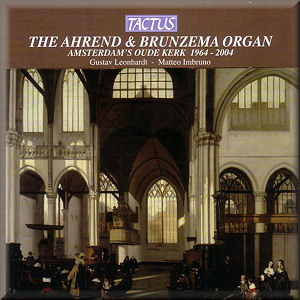
The Ahrend and Brunzema
Organ of the Amsterdam's Oude Kerk 1964 - 2004
Heinrich SCHEIDEMANN
(1596-1663)
Herr Christ, der einig Gottessohn* [05:05]
Anthoni VAN NOORDT (1620-1675)
Psalm 50* [10:35]
Heinrich SCHEIDEMANN
Toccata in G* [07:35]
Jan Pieterszoon SWEELINCK
(1562-1621)
Toccata in C [02:02]
Ballo del Granduca [04:56]
Echo Fantasia in a minor [04:24]
Anon (Neth, 17th C)
3 Variations on 'Daphne' [04:26]
SAMUEL SCHEIDT
(1587-1654)
Bergamasca [04:08]
Anon (Neth, 17th C)
3 Variations on Psalm 23 [07:36]
Heinrich SCHEIDEMANN
Erbarm dich mein, o Herre Gott [05:53]
Surrexit pastor bonus (after Orlandus Lassus) [05:23]
Gustav Leonhardt*, Matteo Imbruno (organ)
rec. ?* September 2004, Oude Kerk, Amsterdam, Netherlands. ADD*/DDD
TACTUS TC 570001 [63:06] 
|
|
|
The Netherlands are full of historical organs. Then why does
Tactus release a disc with recordings of an organ which is less
than 50 years old? There is a good reason. The building of the
transept organ in 1964 in the Oude Kerk in Amsterdam was groundbreaking,
at least in the Netherlands. It was the reconstruction of an
instrument built in 1657 by Hans Wolff Schonat which replaced
the one Jan Pieterszoon Sweelinck had played when he was the
organist of the Oude Kerk. In 1821 the pipes - some of which
Schonat had taken over from Sweelinck's organ - were all taken
out; some of them have found their way into another organ elsewhere
in the Netherlands. Today the building of an organ after models
from the 17th or 18th century is common practice, but in the
1960s this was a relatively new concept. One of the key figures
was the German organ builder Jürgen Ahrend who was also responsible
for the reconstruction of this organ, and who already had some
experience in this department.
Fortunately a list of stops was available. It was included in
a book published in 1774 by the German-born organist Joachim
Hess. This was used to reconstruct the disposition of the organ.
Ahrend made faithful copies of old pipe-work. Other parts of
the organ were reconstructed on the basis of his vast knowledge
of 17th-century organs. In 2002 the tuning of the organ was
changed into mean-tone temperament. This recording consists
of two parts. The first three items are from an old recording
by Gustav Leonhardt before the change of temperament, whereas
Matteo Imbruno recorded his part of the programme afterwards.
The date of Leonhardt's recording is not given. It is likely
the original tape has not been preserved. Listening with a headphone
I heard some noises which suggest to me that the recording was
copied from a vinyl disc. The differences between the two temperaments
are also noticeable - depending on the music chosen - for instance
in the last variation on Psalm 23 by an anonymous composer and
in Scheidemann's Erbarm dich mein, o Herre Gott.
The programme centres around Sweelinck who played a key role
in the development of keyboard music in Europe. He adopted composition
techniques from various regions in Europe, developed and adapted
them and passed them over to his many pupils. In particular
many young organists from Germany went or were sent to Amsterdam
to study with him. His influence is clearly noticeable in the
oeuvres of, for instance, Heinrich Scheidemann and Samuel Scheidt.
Sweelinck adopted the variation technique of the English virginalists
and extended it to the pedal in pieces on sacred melodies. Likewise
he used the Italian form of the toccata. A number of his toccatas
have pedal parts, because in contrast to Italian organs most
Dutch organs had pedals. Another feature of Sweelinck's keyboard
oeuvre is his use of the echo technique, reflecting the possibilities
of his own organ in the Oude Kerk which had three manuals and
pedals. The echo technique is also frequently applied in the
oeuvre of his pupils.
This disc includes some pieces by anonymous composers. Whether
these were pupils of Sweelinck is impossible to say, but their
compositions clearly show his influence. Anthoni van Noordt
was one of the most important organists in the Netherlands of
a later generation. His variations on Psalm 50 are from his
only collection, with fantasias and psalm arrangements. These
are still close to the style of Sweelinck. It should be noted
that most organ music in the Netherlands by Sweelinck and the
next generation was not intended for liturgical use. It was
only later in the 17th century that the organ started to be
used to accompany the congregation. Before that it was silent
during Sunday services. Organists were employed by the city
council and were required to play before and after services
and to entertain people on weekdays.
Gustav Leonhardt's recording may be a bit under par in regard
to recorded sound but his performance is excellent, very rhetorical
and well articulated. Matteo Imbruno, of Italian birth but attracted
by the Netherlands and its music and now living there, is his
equal. The variety in his registration offers the possibility
to become acquainted with the rich range of colours of this
organ.
The booklet contains notes on the history of the organ and a
disposition and picture of the organ as well as biographies
of the artists in Italian, English and French.
Johan van Veen
|
|

Gerard Hoffnung CDs |
 Donate
and get a free CD |
New Releases


 Follow us on Twitter
|