 |
|
| 

alternatively
MDT
AmazonUK
AmazonUS
|
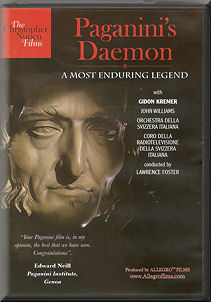
Paganini’s Daemon – A Most Enduring
Legend
A film by Christopher Nupen.
 With Gidon Kremer, John Williams, Chorus of Radiotelevisione della
Svizzera Italiana, and the Orchestra della Svizzera Italiana/Lawrence
Foster
With Gidon Kremer, John Williams, Chorus of Radiotelevisione della
Svizzera Italiana, and the Orchestra della Svizzera Italiana/Lawrence
Foster
Format 16:9, Stereo, Subtitles D, E, F, I, J
ALLEGRO FILMS A2CND  [79:00]
|
|
|
Sufficient documentary evidence exists for Paganini to become
the subject of numerous biographies. Some are skimpy, whilst
others are bulked out with lithographic portraits, programmes,
bills of account, letters and all the impedimenta of an itinerant,
indeed ultimately superstar instrumentalist’s life. Some of
these are transferable to the medium of a documentary portrait
on film. In fact Christopher Nupen makes good use of the ‘lithographic’
aspect of his subject, providing us with numerous portraits,
and pictures of a man who died before he could be captured by
photograph. Indeed the famous faked picture of him could almost
serve as an emblem of Nupen’s search for the ‘legend’ of Paganini
– though fortunately Nupen doesn’t perpetuate it in his film.
The thread that runs through the 79 minute programme – which
includes a bonus segment devoted to Gidon Kremer discussing
and playing Paganini, taken from another DVD – is both biographical
and musical. A near-chronological survey is accompanied by filmed
extracts of a significant number of Paganini’s music. Kremer
is the interpreter with the Orchestra della Svizzera Italiana
directed by an unseen Lawrence Foster. His effacement is doubtless
deliberate, because for music in the earlier portion of the
footage Kremer’s face too is never seen, only his athletic,
spindly fingers on the fingerboard. The compositions for violin
and guitar, amongst Paganini’s most directly affecting – he
began as a guitarist – feature John Williams, but we only see
his fingers as well. This concentration on mechanics, on the
digital, is surely a deliberate ploy not to personalise these
scenes; to preserve a degree of association between viewer and
the subject via a preservation of Paganinian mystique. If you
look at John Williams, you no longer see Paganini. Whether you’d
actually prefer to see Williams; whether indeed it’s perfectly
possible to see Williams and also ‘see’ Paganini is a question
to which Nupen has presumably answered in the negative. I think
you can. I think it’s actually a bit weird not to see Williams
and Kremer playing their instruments.
Numerous quotations from contemporaries and listeners illuminate
the programme; Liszt (a huge fan), Schumann (likewise), Goethe
(bullish, anti), and many others who range from idolaters to
criers of ‘charlatan’. We learn that he kept his audiences waiting
– perhaps the first in a long line of musical headline acts
so to do - and probably deliberately broke strings as he played
to demonstrate increasingly dazzling feats, not least when he
was reduced to just the one. But for all his love of money,
and status, and women, all of which were characteristically
excessive, he also loved his son, Achille, and these passages
are some of the most affecting in his whole biography; such
as the time when the boy interpreted his father’s syphilis-ravaged
voice for the listening Berlioz – to whom Paganini then gave
the vast sum of 20,000 Francs.
Paganini was the first executant superstar. He doubled ticket
prices for his London tour – and then suffered when the English
public stayed away. But he still made at least £10,000 in London
in one season alone. His income was astronomical. His conceit
was fabulous. His manner was ostentatious and offhand. The more
prestigious the milieu the more the cock crowed, and the more
often he was forced to flit. He was an accumulator and a bolter.
He performed, took his winnings, committed indiscretions, and
was forced to leave. His existence was gilded but provisional,
and when the end came, via financial near-disaster in Paris,
and physical decline, he had long since ceased to play his beloved
violin, and his vocal chords had become useless. To confirm
the provisionalness not only of his life but of his mortal remains,
every so often his body was dug up and moved. Finally, as the
twentieth century dawned, his corpse finally came to rest. Indeed
as he was finally re-buried, in 1892, new giants, very different
ones, had risen; Sarasate the brilliant, Joachim the dour.
Naturally the traditional arc of such a life is mirrored here.
Birth into poverty, relentless practice, a semi-tyrannical father,
an escape into luxury, and the comforts of debauchery, followed
by over-ambition, poor judgement, crippling court-cases, physical
disintegration, and death. But with Paganini everything was
taken to excess. This documentary presents this quality as his
‘daemon’, possibly correctly. It’s a handsome film, doubtless
partial, but well worth watching.
Jonathan Woolf
|
|























