What is the function of an arrangement? Historically it was a
legitimate way of bringing otherwise unavailable music into wider
public knowledge. Composers such as Schumann or Mendelssohn added
piano accompaniments to the Bach solo violin works both to give
the repertoire wider circulation as well as sharing their own
compositional insights into the working of Bach’s mind. Today,
with almost the entire repertoire available in multiple versions
from authentic to enthusiastic what does an arrangement add to
the sum of all human knowledge? In this particular instance I
would have to say very little. That is not to say for a moment
that this is not a well arranged and well performed disc because
it is but I don’t really know why so much effort was expended
creating it.
I first came across the name of William Zinn about 35 years ago.
Back then there was literally nothing published for String Quartet
except standard quartet literature. As I played in a quartet that
needed repertoire to perform at weddings and parties we were always
on the look-out for anything ‘light’. The first book of quartet
arrangements (of Scott Joplin rags) I bought in 1975 was by William
Zinn. Whatever his ‘serious’ arranging and performing credits
it is in this field as a classical pops arranger he remains best
known. In the intervening time the background string quartet has
become one of the few areas of growth in the professional music
field. To serve that need there has been an explosion in the quantity
of published arrangements. Should you now wish you can buy everything
from
The Planets, Star Wars, even
Mahler 5 arranged
for quartet. Obviously, the function there is to play a familiar
melody that people enjoy hearing – there is no sense of giving
new insight. I could certainly imagine hearing one or two of these
Caprices as an exciting and exhilarating encore at a concert.
Whether a disc of all 24 really measures up is a matter of taste.
The Wihan Quartet is an experienced and talented group in the
best traditions of Czech String playing. The fact that they won
the coveted first prize - and the audience prize - at the well
respected London International String Quartet Competition in 1991
is evidence enough of their quality. Individually they are fine
players but, in choosing to stare down both barrels of the 24
Paganini Caprices they are facing some of the hardest string music
ever written. Recently I had the great pleasure of reviewing James
Ehnes’ new recording of these works in their original solo version
review.
That is a magnificent recording in many respects but the element
of it that lodged most firmly in my mind was the effortless technical
grace that Ehnes has. The gives him that miscroscopic extra
bit of time to give the illusion of ease to all he plays. The
leader of the Wihan Quartet plays all the notes he is given for
sure but the extra effort is palpable. Add a rather close recording
set in a resonant acoustic as well as three extra parts thickening
the instrumental texture and it all makes for a rather unrelenting
musical experience. I have to disagree with the liner-notes of
Stephen Pettitt. He writes; “[this arrangement] is no longer about
a single performer showing off. It’s about the notes and the music
that lies between them … the impression his [Zinn’s] arrangement
gives is not so much a matter of arrangement but of discovery”.
The pleasure in listening to this piece is surely the balance
a great performer (such as Ehnes) finds between the technical
challenge and the musical goal. Lowering the technical barrier
upsets that balance and for me reduces the fascination. Also,
I have to say I find the arranging never less than competent but
rarely inspirational. A valid case could have been made for a
quirkily extreme version but this sits resolutely in the field
of solid transcription. Yes, Zinn has to add supporting harmonies
and occasional counter-melodies but not once did I sense profound
new insights being offered. The addition of the three extra players
fattens out the music and it loses the fantasy element and rhythmic
freedom that graces the best of the solo versions. The many quick
passages – well played though they are – have more of a bludgeoning
effect when all four players are giving it their all. Try the
very first caprice or for that matter the famous twenty-fourth.
The opening is undoubtedly impressive but less … well … capricious.
Don’t forget that these are works originally written sometime
before 1820 at the Classical/Romantic cusp – this version pushes
them into a high romantic sound-world which is a style the musical
content is not able to support for much of the time. Given just
how hard this music is and essentially how well the quartet play
– I do find it rather aggressive playing too much of the time
though – I feel rather mean-spirited not warming to this disc
more.
Nick Barnard























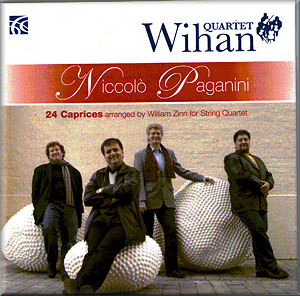
 Wihan Quartet
