 |
|
|

alternatively
CD: MDT
AmazonUK
AmazonUS
Sound
Samples & Downloads
|
Enrique GRANADOS (1867-1916)
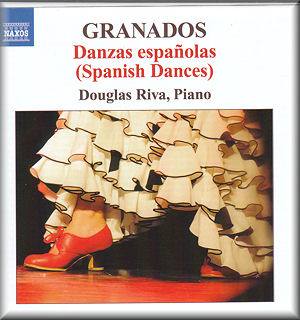
Danzas españolas (Spanish Dances) (c.1887-1889)
Galante, DLR I:2.1 [2:48]
Oriental, DLR I:2.2 [5:19]
Fandango, DLR I:2.3 [4:30]
Villanesca, DLR I:2.4 [5:57]
Andaluza, DLR I:2.5 [4:32]
Rondalla aragonesa, DLR I:2.6 [4:15]
Valenciana, DLR I:2.7 [4:56]
Sardana, DLR I:2.8 [4:01]
Romántica, DLR I:2.9 [5:23]
Melancólica, DLR I:2.10 [4:03]
Arabesca, DLR I:2.11 [7:31]
Bolero, DLR I:2.12 [4:55]
Improvisación sobre la jota valenciana (transcr. by Augustin M.Martinez)
(1916) [5:03]
 Douglas Riva (piano)
rec. March 2009, Potton Hall, Westleton, Suffolk UK. DDD
NAXOS 8.572313 [64:01] 
|
|
|
Spanish music is very special. It has so many characteristic
elements – rhythmic, melodic, harmonic. One can use them to
create long musical works where each measure is unmistakably
Spanish, and nothing is repetitive or boring. Yet, it’s not
enough to master the technical side and just mix the elements.
The real magic happens when you add a subtle, elusive component
that can be called “the Spanish soul”. Although the output of
Enrique Granados may not be “Spanish through and through”, his
first masterpiece, the collection of twelve Danzas Españolas,
certainly falls into that category.
Breaking the dozen into four sets of three can help to understand the overall pattern. Each triad has a fast-slow-fast structure, where each part is usually in ternary form. Broadly speaking the first movement of each such small “suite” has a grander, more solemn character; the second is darker, slower, and often mystic; the third is happy and celebratory.
The pieces are not that different in appearance: after all, these are dances, not just a set of lyric pieces à la Grieg. From the Schumanesque opening chords of No.1 we move to the silver sadness of No.2, with its mysterious flickering light. No.3 is proud, with castanets and a distinct separation of “male” and “female” episodes. Rustic bells fill the bucolic atmosphere of the tranquil No.4. No.5 is the most famous, probably the best-known piece by Granados. It is dark and passionate, with gypsy rhythms. No.6 has a sensual middle episode, framed by two outer episodes of increasing celebration, with a swirling accelerando. No.7 is sunny and feminine, a bit coquettish. It’s like a colorful merry-go-round that does not want to stop. No.8 is solemn and festive, reaching moments of golden ecstasy. No.9 is like a mazurka, with an attractive swing. It compensates in enthusiasm for what it lacks in refinement. The pieces from the last triad share a certain feeling of a wide and uniform canvas: the gentle hurry of No.10, with its five-note ostinato; the nocturnal spices of No.11, with oriental notes; and the mysterious yet lively No.12.
The playing of Douglas Riva exudes authority. This is not surprising, knowing that he was the Assistant Director of the critical edition of the Complete Works for Piano of Granados, where Alicia de Larrocha was the Director. Accordingly, his approach to this music is rather similar to that of de Larrocha. The most noticeable difference is in the rubato. Where de Larrocha lets the music “roll”, very evenly – Riva uses pauses and moments of slowing down, in order to place the accents. Both approaches work well: they are just different. Sometimes, as in No.7, Riva shows a more masculine view, while de Larrocha’s style is more feminine. No.2 sounds more mesmerizing in de Larrocha’s hands, where the forward movement is smoother. Riva’s No.11 is very atmospheric and has a lot of space. His Andaluza is simple, and the slightly torn rhythms that he uses add to the “gypsy” feeling. Overall, Riva’s playing simultaneously evokes two impressions: authentic and modern.
As a bonus, Riva adds a transcription from a piano roll that Granados recorded in New York in 1916, just before his tragic death. This is an improvisation on a Valencian jota, but you won’t hear the busy merriment normally associated with a jota. Instead, the music is very poetic and gentle. It is an unhurried landscape painting, very different from the bright and accentuated Danzas.
The recording quality here is excellent. The insert note is by Douglas Riva himself. Being one of the most prominent Granados scholars living, Riva compresses into two small pages a great deal of information and reflection.
These are splendid performances of beautiful music. The featured works stand well together, and listening to the entire disc as a whole is a very pleasant experience.
Oleg Ledeniov
|
|























