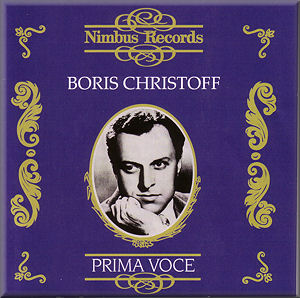
Boris Christoff
CD 1 [70:19] Italian Opera
Wolfgang Amadeus MOZART (1756
– 1791)
Don Giovanni
1. Madamina! Il catalogo e questo [5:35]
Antonio CALDARA (1670
– 1736)
2. Come raggio di sol [3:12]
Vincenzo BELLINI (1801 – 1835)
Norma
3. Ite sul colle [10:13]
La sonnambula
4. Il mulino! Il fonte! … Vi ravviso [5:00]
Giuseppe VERDI (1813 – 1901)
Nabucco
5. Sperate, o figli! … D’Egitto la sui lidi
[4:58]
6. Oh chi piange? … Del futuro
nel bujo discerno [4:47]
La forza del destino
7. Il santo nome di Dio [6:54]
Simon Boccanegra
8. A te l’estremo addio … Il lacerate spirito [5:53]
Ernani
9. Che mai veggio! … Infelice … L’offeso
onor [6:50]
Don Carlo
10. Ella giammai m’amo … Dormiro sol [9:14]
Arrigo BOITO (1847
– 1918)
Mefistofele
11. Ave Signor! [3:55]
12. Son lo spirito che nega [3:48]
CD 2 [71:56]
Russian Opera
Modest MUSSORGSKY (1839
– 1881)
Boris Godunov
1. Prologue: Coronation Scene [10:53]
2. Act 1. Pimen’s monologue [5:52]
3. Act 1. Varlaam’s song [2:33]
4. Act 2. Boris’s monologue [6:05]
5. Act 2. Clock scene [3:58]
6. Act 4. Farewell and Death of Boris [11:46]
Khovanshchina
7. Dosifey’s aria [6:22]
Nikolai RIMSKY-KORSAKOV (1844 – 1908)
Sadko
8. Song of the Viking Merchant [3:46]
The Legend of the Invisible City of Kitezh
9. O vain illusion [4:27]
Pyotr TCHAIKOVSKY (1840
– 1893)
Eugene Onegin
10. Everyone knows love on earth [4:55]
Alexander BORODIN (1833
– 1887)
Prince Igor
11. Prince Galitsky’s aria [3:52]
12. Konchak’s aria [7:23]
CD 3 [72:25]
Russian Songs and Sacred Music
Alexander SEROV (1820
– 1871)
1. Shrove Tuesday [4:39]
Traditional Songs
2. Song of the lumberjacks [5:00]
3. The Bandore [3:29]
4. Down Peterskaya Street [2:13]
5. Going down the Volga [3:40]
6. The lonely autumn night [5:22]
7. Psalm 137. By the waters of Babylon [5:25]
Mikhail STROKINE (1832 – 1887)
8. Prayer to St. Simeon [2:36]
Pavel CHESNOKOV (1877
– 1944)
9. Lord have mercy on our people [4:00]
Trad.
10. The song of the twelve robbers [5:56]
Alexander GRECHANINOV (1864
– 1956)
11. Litany [6:02]
Trad.
12. Siberian prisoner’s song [4:17]
Modest MUSSORGSKY
Songs and Dances of Death
13. No 4 Field-Marshal Death [4:55]
14. The Grave [3:44]
15. Softly the spirit flies up to heaven [3:15]
LISHKIN (? - ?)
16. She mocked [3:32]
Trad
17. Song of the Volga boatmen [4:20]
Boris Christoff (bass)
rec. CD 1 Tracks 1(1952), 9 (1951) – Orchestra/Fistoulari; CD
1 Track 2 (1952) - Gerald Moore, piano; CD 1 Tracks 3-8 (1955)
- Orchestra and Chorus of the Opera House, Rome/Gui; CD 1 Track
10 (1950) - Philharmonia Orchestra/Karajan; CD 1 Track 11 (1949)
- Philharmonia Orchestra/Dobrowen; CD 1 Track 12 (1949) - Philharmonia
Orchestra/Malko; CD 2 Tracks 1, 4, 5 (1952) — excerpts from
the complete opera.; Orchestre National de la Radiodiffusion
Francaise/Dobrowen; CD 2 Track 2 (1949) - Philharmonia Orchestra/Malko;
CD 2 Track 3 (1949) - Philharmonia Orchestra/Karajan; CD 2 Tracks
6 (1949), 7, 8, 11, 12 (1950) - Philharmonia Orchestra and;
Chorus of the Royal Opera House, Covent Garden/Dobrowen; CD
2 Tracks 9, 10 (1952) - Philharmonia Orchestra/Schuchter; CD
3 Tracks 1-11 (1954) - Feodor Potorzhinski Russian Choir; CD
3 Tracks 12-15 (1951), 16 (1952) - Gerald Moore, piano; CD 3
Track 17 (1952) - Philharmonia Orchestra/Dobrowen;
NIMBUS PRIMA VOCE NI7961/3 [3 CDs: 70:19 + 71:56
+ 72:25]
Christoff has one of those voices which is instantly recognisable.
His was a voice which, like a select few of the greats, from
its first notes brings more than just recognition, in that there
is a palpable thrill in its inimitable tones. I heard him live
only once as a student in, I think, 1974, when he had informed
Oxford University that he would like to sing in Oxford and consequently
gave a recital in the Sheldonian Theatre. Although only an opera
tyro, I knew that this was my chance to hear one of the greats
and that given the curtailment of performances at this late
stage of his career, this would probably be my only opportunity,
so I bought a couple of tickets and dragged along a curious,
not-very-musical friend to hear him. As Christoff strode onto
the proscenium, there was an audible intake of breath; the man
had such a presence about him. I shall always remember the way
he stood there, sombre in his tails, his massive chest filling
the snowy-white shirt front, his iron-grey head bowed to acknowledge
the welcoming applause. Even before he had sung a note there
was such a sense of occasion about him; my friend turned to
me and whispered, “Isn’t he magnificent!” – and I could
not but agree.
And then he began to sing. I do not remember the whole programme,
but I know he sang some of the items included in this 3 disc
Prima Voce compilation and I especially remember his delivery
of Boris’s Death Scene. Even the most delicate pianissimo could
be heard way up in our cheapest seats. Despite his histrionic
tendencies, he was an artist who knew exactly how to exploit
the emotional impact of really soft singing. His was not an
exceptionally voluminous sound, but it was rich and penetrating.
His magnetic stage presence was perfectly complemented by a
bass of great flexibility. Something of the aura which surrounded
him on stage can be divined from these recorded performances,
made in his absolute prime between 1949 and 1955. He was still
in very good voice when I heard him twenty years later and gave
his last performance as late as 1986, but he is best heard here
when he had optimum flexibility and the characteristically tight
vibrato had not begun to loosen. He is often compared with his
great predecessor Chaliapin and also with his younger Bulgarian
compatriot Nicolai Ghiaurov; great artists all three, but actually
none sounds especially like the other beyond the fact that they
are all celebrated Slavic basses who shared similar repertoire.
At the core of this recital is his tour de force in assuming
all three major bass roles in “Boris Godunov”. Some found his
impersonation of all three characters inexcusably self-aggrandising
– he was not a modest man, but like many such artists he imposed
upon himself the same high standards that he expected of his
colleagues. These recordings are from the complete recording
conducted by Dobrowen in 1952; marginally preferable to the
later version with Cluytens. I for one cannot but admire his
ability to colour and shade his voice so expertly in accordance
with the demands of each characterisation. As Boris, he is agonised
and unstable, switching between the utmost tenderness as he
bids farewell to his children and then uttering snarling imprecations
upon the treacherous Boyars. I find his death scene electrifying,
although I imagine some might find it a touch hammy. As Pimen,
he exudes a saintly calm, occasionally allowing his voice to
sound grey and old, then breathing a golden glow back into the
tone as he contemplates his sacred duty as the chronicler of
tumultuous times. For the drunken Varlaam he adopts a coarser,
cruder voice, complete with yells and cackles.
As a compilation, this set more than adequately reflects Christoff’s
range and talents. He was a supreme singer-actor and one is
always conscious both of the clarity of his diction and his
determination to take risks in order to ensure that drama is
never sacrificed to sheer beauty of sound. He certainly could
do “sheer beauty” but frequently chose not to. He brings the
same fierce dedication to the near-ditties on disc 3 as he does
to the great operatic set-pieces on the previous two discs.
Having said that, I never thought of Christoff as having a knockabout
sense of fun, but his delivery of “Down Peterskaya Street” has
changed my perception of him. Nor had I heard his exquisite
falsetto control before listening to the haunting “Lonely Autumn
Night”; this last disc springs some surprises. The Feodor Potorzhinski
Russian Choir provides authentic backing, complete with cavernous
basses.
Some object to the intrinsically Slavic sound Christoff brings
to the Italian arias. His Italian is good if not exactly idiomatic;
his voice is his voice – and what a voice it is. I find it churlish
to begrudge him his version of King Philip’s confessional lucubrations
when it is sung as it is here with such depth of expression.
Disc 1 provides a survey of his most celebrated Italian assumptions,
many of which are available on complete recordings which seasoned
collectors might already own, although he may be found in marginally
fresher voice here. He is as at home in the bel canto world
of Bellini as he is in the more overt expressiveness of Verdi,
bringing a noble restraint and admirable legato to the aria
from “La Sonnambula” in a manner which makes him quite the equal
of contemporaries such as Siepi. In the “Mefistofele” arias,
he is able to cut loose and echoes of Varlaam are tempered by
an appropriate diabolical elegance, and capped with a splendidly
secure top F.
The sound on these discs is superb; I was scarcely aware that
they are mono and the transfers from LPs are impeccable. Nimbus
is to be congratulated on the care and attention they have brought
to realising this set.
In short, this is an invaluable compilation of the finest performances
of one of the greatest twentieth century singers. It has made
me appreciate afresh Christoff’s unique talents and artistic
versatility and I heartily urge both the curious and the experienced
collector to acquire it.
Ralph Moore
See also review
by Goran Forsling























 Boris Christoff (bass) with piano acc, orchestras and choir
