Editorial Board
MusicWeb International
Founding Editor Rob Barnett Editor in Chief
John Quinn Contributing Editor Ralph Moore Webmaster
David Barker Postmaster
Jonathan Woolf MusicWeb Founder Len Mullenger
With
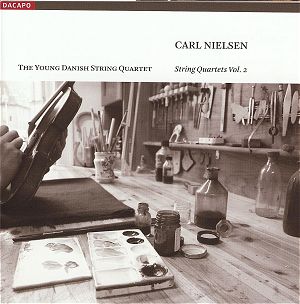
Volume 2, The Young Danish String Quartet completes its
excellent traversal of the four Carl Nielsen String Quartets.
These
are early Nielsen except for the Quartet No. 4 in F major
composed in 1919. Still, we find in this music a bridge
between the traditions of the Romantic era and the early
20th Century aesthetic. Nielsen graces us with much harmonic
adventure and delicious moments of key ambiguity as he
searches for a home key such as in the opening bars of
the Quartet in E flat major's second Movement Andante
sostenuto. Another impressive feature of the string
quartets is the abundance of emotional content ranging
from the fierce and rugged first theme of the F minor Quartet
to the sublime and gorgeous lyricism of the first movement
of the E flat major. My interpretive preferences for Nielsen's
string quartets tend toward forward-looking performances
of a rustic nature that neither stint on the composer's
rugged terrain nor on his more tender and heart-felt declarations.
Although
the string quartets are not among Nielsen's more popular
works, they are very strongly represented on record. Each
of the comparison versions are worthy contenders with the
Danish, Kubin, Oslo and Vertavo Quartets heading the list.
The Zapolski Quartet's interpretations are very interesting
and romantic in style, but I should caution that this group
takes many liberties with the scores. Concerning the highly
praised recordings by the Kontra Quartet, I have a few
reservations: the performances minimize the effect of Nielsen's
harmonic experimentation, are rather cosmopolitan and are
recorded in an overly reverberant acoustic. This "wet" sound-stage
is damaging to the composer's counterpoint and to fugal
passages such as the two fugues of the fourth movement
of the Quartet in E flat major.
The
Young Danish String Quartet was formed in 2001 when each
member was under 18 years of age. The group studied under
Professor Tim Frederiksen at the Royal Danish Academy of
Music and was the youngest ensemble to win the DR Chamber
Music Competition. It has subsequently won many other prestigious
competitions and has concertized in Germany, Holland, Scandinavia
and the United States.
Although
only young adults, the members of the group show a remarkable
affinity for the Nielsen idiom, entirely up to the highest
standards achieved by the comparison recordings. Their
youthful exuberance is second to none while they also convey
the full measure of tenderness and expression in the slower
movements and passages. Further, they never stint on Nielsen's
romantic foundations nor on his presentation of daring
harmonic progressions.
Among
the numerous highlights of the performances, a few features
stand out. In the Quartet in F minor, The group treats
the opening theme as an apocalyptic event, the second movement
brings an irresistible blend of romanticism and harmonic
adventure while the third is performed in a playful, energetic
and bold fashion. Concerning the Quartet in E flat major,
the Young Danish String Quartet offers the maximum degree
of mystery to the second movement's core which is dominated
by dotted rhythms. The third movement's central episode
is played in a wild and intense manner. The fugal elements
of the fourth movement are beautifully detailed and compelling
in their conversational progression.
In
addition to the exceptional performances, this quartet
has a significant aural advantage over all alternative
versions. The SACD sound, fantastic in its expansiveness,
depth and clarity, results in an illumination of each musical
strand. As fine as the acoustics are for most of the comparison
versions, they simply cannot match a superbly engineered
SACD recording.
Given
the high quality of these performances and the superlative
Dacapo sound, this traversal of the Nielsen string quartets
is now the most desirable on the market. If price considerations
are paramount, the set by the Oslo Quartet on Naxos is
an excellent alternative.
Don Satz
Please support our advertisers below by clicking on the logos for further information.

























 The Young
Danish String Quartet
The Young
Danish String Quartet  [63:59]
