Making
a Donation to MusicWeb
About MWI
Site
Map
More
Reviews
How to find a review
Books
Film
Music
Nostalgia
Records Of The Year
Recommendations
Comment
Arthur Butterworth Writes
Phil
Scowcroft's Garlands
Classical
blogs
Reviewers
Logs
Announcements
Don't
Go Here!
Community
Bulletin Board
Web
Ring
Reviewers
Helpers
invited!
Resources
How
Did I Miss That?
British
Composers
British
Light Music Composers
Other
composers
Indexes
Label
Masterwork
Discographies
Composer
National
Themed
Review pages
Complete Books
Programme
Notes
External sites
British Music Society
The BBC Proms
Performers
Orchestra Sites
Recording Companies & Retailers
Online Music
Agents & Marketing
Publishers
Other links
Newsgroups
Web News sites etc
Editorial
Board
Classical Editor
Rob Barnett
Seen & Heard
Editor and Webmaster
Bill Kenny
MusicWeb Webmaster
Len Mullenger
Assistant Webmaster
David Barker
PotPourri
A
pot-pourri of articles
MW
Listening Room
MW
Office
Helping
MusicWeb
Advice
to Windows Vista users
Questionnaire
Site
History
What
they say about us
What
we say about us!
Where
to get help on the Internet
CD
orders By Special Request
Graphics
archive
Currency
Converter
Dictionary
Magazines
Newsfeed
Web Ring
Translation Service
Rules
for potential reviewers :-)
Do
Not Go Here!
April Fools
|

REVIEW
|
Advertising
Rates
Visitor
stats
MusicWeb
International
has over 25,000 Classical CD reviews on offer
Gerard
Hoffnung Concerts &
The
Bricklayer Story

New
Releases

New
Releases


MusicWeb
sells the Polish
catalogue CDAccord
£10.50 post free W-W

MusicWeb sells the
Arcodiva catalogue
£12.00 post free W-W

£11.50
post-free world-wide
Try
it and see - Sale or Return
MusicWeb
can now offer you discs from the following catalogues:
Prices include postage
Musicweb
Special
Offers
Google Ads - for information about privacy matters, click here.
|
 |
 |
|
AVAILABILITY
Buywell.com
|
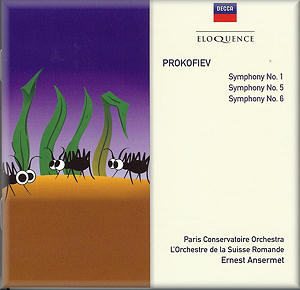
Sergei PROKOFIEV
(1891-1953)
Symphony No.1 in D Major, Op.25 'Classical' (1916-1917) [13:92]
Symphony No.1 in D Major, Op.25 'Classical'* (1916-1917)
[13:98]
Symphony No.5 in B Flat Major, Op.100 (1944) [40:37]
Symphony No.6 in E Flat Major, Op.111 (1945-1947) [39:75]
Paris Conservatoire
Orchestra*/L'Orchestre de la Suisse Romande/Ernest
Ansermet
rec. October 1951 (Symphony No.6), February 1961 (Symphony No.1: OSR);
April 1964 (Symphony No.5), Victoria Hall, Geneva, Switzerland; June
1953 (Symphony No.1: PCO), Maison de la Mutualité, Paris, France.
ADD
DECCA ELOQUENCE
4800834 [55:13+56:26]  |
|
|
Ansermet's Prokofiev never attained the recognition enjoyed
by his Tchaikovsky. Why may that be? Ernest Ansermet (1883-1969)
had nearly fifty years of relationship with the Swiss Radio
Orchestra (1918-1967). Despite this his complete Decca Prokofiev
can be counted on the fingers on both hands. Decca's Eloquence
Ansermet Legacy series has made efforts to revive these for
those who missed them during the LP era. These include volcanic
interpretations of the composer's Violin Concerto Nos. 1
and 2 and the Piano Concerto No.3. There were made with violinist
Ruggiero Ricci from May 1958 and pianist Julius Katchen from
October 1953, respectively. They are on Eloquence 4800837
(tbr). There are also selected Ballet Suites from Prokofiev's
music for the stage (Eloquence
4800830) as well as the Symphonies presented on these
recordings. In this latter, one catches something of the depth
and breadth of Ansermet's artistry. Moreover, an ever so
wise decision from Eloquence has enabled listeners to have a
comparative listening of two versions of Prokofiev's 'Classical'
Symphony under Ansermet's direction - first, a 1953 Paris
Conservatoire Orchestra (PCO) interpretation, followed by a
1961 stereo performance with the Swiss Radio Orchestra (OSR).
Importantly, both the PCO 'Classical' Symphony
performance with the OSR Symphony No.6 appear
for the first time internationally in compact disc format. These
are all noteworthy as evidence of the Swiss conductor's
humble commitment to illuminate and to inspire.
In his liner-notes, Raymond Tuttle claims that many conductors
use the Prokofiev 'Classical' to showcase their
orchestra's virtuosity. This can sometimes have repercussions
that jeopardize the tempi and subject the music to unnecessary
extremes. In the earlier of the two performances Ansermet presented
the work with meticulous care rather than diving in with Olympian
speed. In doing so, he paved the stage for the spirited humour
that filled the opening Allegro. In the Larghetto,
Ansermet lays bare the 'soulful calling of Prokofiev'.
Although the Paris Conservatoire Orchestra has been termed a
'second-tier orchestra' its high strings, low brass
and percussion have the clarity and precision we normally associate
with the 'first-tier'. Ansermet's conducting has
great energy, as the music pushes to the very end of the Finale
with polish and personality. On the other hand, the later version
with the SRO made nearly a decade later, while just as elegantly
strong as the earlier version, seems far less adventurous. At
times the orchestral playing sounded too rich. Nevertheless,
one is rewarded at the end, where the complicated writing in
the Finale's coda is performed with kinetic excitement.
The Prokofiev Symphony No.5 recorded here comes from
the late years of Ansermet's tenure. It features an increased
intensity and greater emphasis on colour and ensemble clarity.
Take the second and fourth movements as examples. Here Ansermet
limns in the many details with exceptional clarity; from the
string tremolos of the Adagio to the big sound of the
central climax in the Vivace. Yet, such effects were
perhaps what Tuttle rightfully describes as a combined 'penchant
for motoric rhythms and primitivism'. Like the Prokofiev
First Symphony, the Fifth is one of those conductor-proof
pieces. Ansermet may not have the qualities innate in Valery
Gergiev or Vladimir Jurowski, but his measured refinement is
convincing in its own right.
The Symphony No.6 composed shortly after the Second World
War belongs in a class of its own in the Prokofiev Symphonies.
The gradual build-up that Ansermet prepares early on is effective
in setting the so-called 'dramatic stage'. The music
rises quickly to a crash, only to rebuild again slowly until
the music ends in withering quiet. The middle movements are
superbly played; the menacing chords of the beginning set the
mood for the sorrowful theme, while the Finale is a celebrates
temperament and fear.
If the Ansermet-Prokofiev link has never crossed your mind -
think again! This set can make converts of unbelievers and with
the other two Eloquence titles in this series the converted
will become preachers.
Patrick P.L. Lam
|
|
|