Steve Davislim and Simone Young offer here a representative selection
of Britten’s folksong arrangements in English for voice and piano.
In the heading I’ve cited the source volumes and dates. To give
a different perspective from the review of this SACD
by John France I’m comparing these performances with those on
the complete set of folksong arrangements recorded in 1994 on
Hyperion CDD 22042. This omits two items on the present SACD.
These were not published until 2001.
Steve Davislim’s
account of The Salley Gardens is relaxed and lyrical
which suits the text and points the emphasis on ‘foolish’
in the final lines of both stanzas. The tenor Jamie MacDougall
(Hyperion) is faster and more emotive while Malcolm Martineau’s
piano accompaniment is more tellingly poised than Simone Young’s
in its elegiac solos and greater intensity in the second stanza.
Young is sonorous but less varied.
Davislim and Young
bring a romping bounce to Little Sir William but MacDougall;
and Martineau are more successful in making its first four
stanzas gradually louder and more serious. They also achieve
more contrast with the fifth and sixth stanzas’ sotto voce
ghost and the final stanza’s ironic return to skipping innocence.
The raw lament
The bonny Earl o’ Moray is more emotively treated by
Davislim with a more heroic quality than the piercing vibrato
of soprano Lorna Anderson in the Hyperion recording but again
Martineau’s accompaniment is more pointed as it intensifies
for the refrain of both stanzas. The trees they grow so
high, a text better suited to female voice, is delivered
by Anderson with directness and fluency. Davislim’s more measured
approach allows more reflection on the text but misses the
chilling sense of the sheer sweep of life. The slower tempo
also gives Young less scope and expressiveness than Martineau
in pointing the gradual elaboration and then deconstruction
of the accompaniment to match the narrative.
The Ash Grove
relies for its effect as much on the contrast of dynamics
as varied characterization of the accompaniment. In both MacDougall
and Martineau are more dramatically expressive though Davislim’s
languorous opening and Young’s gently lapping accompaniment
are beguiling. Davislim and Young’s approach to Oliver
Cromwell is rather measured. Anderson and Martineau realize
its Vivace marking more effectively but this song is
better suited to the weight of a male voice, backed by greater
density from Young. This also allows for greater contrast
of softening at the close.
Davislim’s approach
to The plough boy is unusually lyrical where MacDougall
and Martineau show more outlandish verve which matches the
text better; but Young’s accompaniment, in clarifying the
staccato elements, provides a fair counterbalance.
Being narrated from the female perspective, Sweet Polly
Oliver is better suited to Anderson than Davislim who
mulls over the text more, savouring it so you concentrate
on events as they happen rather than, as with Anderson, being
swept along. But the greater pace allows Martineau to reveal
more tellingly how the accompaniment mirrors both the melody
and the characterization.
The miller
of Dee is more starkly realized by MacDougall and Martineau:
you feel the whole atmosphere of the mill in the accompaniment
an oppressive burden. Davislim, however, brings more sense
of heroic striving against a grim but more manageable environment.
In The foggy foggy dew MacDougall and Martineau’s approach
is lighter and more smiling but Davislim and Young’s more
dramatized, winking, even leering manner is very engaging.
O waly, waly
is a classic example of Britten’s use of accompaniment, a
three-note mantra and dynamic contrast to turn folk song into
art song rich in longing for unrequited love. Davislim and
Young reveal the song’s lyricism and dynamic contrasts but
their comfortable tempo lacks tension, even though it emphasises
the sense of elegy of the final stanza. Anderson and Martineau’s
presentation is more appreciably poised, growing and then
fading in intensity. In Come you not from Newcastle
honours are fairly even between the spirited, blithe but somewhat
thin-toned articulation of Anderson and the fuller-toned,
more ardent Davislim. Anderson and Martineau get across better
the echo effect of the repeated stanza.
Davislim contrasts
well the dialogue between The brisk young widow and
her suitor but Young’s accompaniment is squarer and more deliberate
than Martineau’s nervier, spikier manner. This allows MacDougall
to be crisper in articulation and thereby more acerbic. In
Sally in our alley MacDougall deals more naturally
with the progression of the narrative without detriment to
the lyricism in which Davislim is more self-conscious, emphasising
the apexes of the melody. Again Martineau brings more variety
than Young to an accompaniment which begins dreamily but grows
ever more lively.
The text of Early
one morning is better suited to female delivery and Lorna
Anderson’s simple, sorrowing manner is more effective than
Davislim’s more evident colouring of the refrain. This emphasises
the artifice of the setting, but the quieter final verse is
realized with fine sensitivity. On the other hand, the declamation
required in the refrain of Ca’ the yowes is better
suited to Davislim and he also points with greater meaning
the growing intimacy of the verses and the closing soft refrain.
Britten’s ‘slow
march’ for piano before and after the verses of the elegy
Tom Bowling is creamily floated followed by a dull,
routine recognition of nothingness, “a sheer hulk”. The recording
of Britten’s concert performance with Peter Pears (BBC Legends
BBBCB 80062, no longer available) contrasts the two phrases
more vividly than Young does here. Davislim sings with direct,
affecting lyricism but the formality which is part of the
work’s complexity is blunted in that he doesn’t always observe
the ornamentation written out in the realization. For example,
in verse 1 on ‘Tom’ (tr. 17 0:25), ‘tempest’ (0:40)
and ‘soft’ (1:03) though it is observed in verse 2 on ‘oft’
(2:13). As it happens Pears is even less scrupulous about
observing ornamentation.
Britten’s arrangement
of Greensleeves is an icy reality check, the lament
of a jilted lover with a dull, unsettling jabbing piano accompaniment.
This is intensified by appearing an octave higher in the second
verse, varied in the refrain by a brief, aching counter-melody
of what might have been. Davislim and Young are vividly blunt.
Avenging and
bright is delivered by Davislim with some brio but lacks
the heft to match its ‘fast and furious’ marking, nor is verse
3 (tr. 19 0:42), which should be ‘in undertones’, sufficiently
conspiratorial. Soprano Regina Nathan on Hyperion is more
suitably dramatic, albeit rather shrill. Davislim is more
successful in the comely lyricism of How sweet the answer,
beginning sotto voce and opening out in the second
verse marked ‘more express.’ (0:44). Nathan, however, offers
a pearly simplicity and is more winsome in the final verse.
The minstrel
boy is well treated by Davislim and Young in the broad,
heroic first verse and quieter, memorial second. Nathan and
Martineau achieve a greater and more poignant contrast between
the two, even if Nathan’s first verse is rather too strident.
Dear harp of my country is a fine example of a work
whose expansive line and elaborate intrinsic ornamentation
are comparable to that of Purcell. However, Davislim and Young
are too deliberate, too immediate for its delicate, passing
dream of brief happiness. Even so, its moments of rapture
like “the warm lay of love” (0:36) are well realized. Nathan’s
gentler, more measured reflection conveys the text more revealingly
while Davislim glories in the melody.
Much the same
may be said about Oft in the stilly night whose kernel
is the transformation from fond to sad memory. Davislim achieves
a ‘more sonorous’ second verse (tr. 23 1:21) as marked but
Nathan again locks attention more vividly on the text. The
last rose of summer finds Britten in his growing elaboration
of musical line, accompaniment and ornamentation again moving
folk song close to art song. Davislim brings to it a measured,
full-toned, densely emotive, even tragic vein; the final verse
(tr. 24 3:02) more grimly resolute. Nathan is more gaunt,
spare and thereby evokes more pathos.
The SACD recording,
as you might expect, is vividly immediate and pleasingly full-toned.
These are accomplished performances which convey well the
range of mood and expression in these arrangements, but at
times the Hyperion set has more depth.
Michael
Greenhalgh
see also Review
by John France























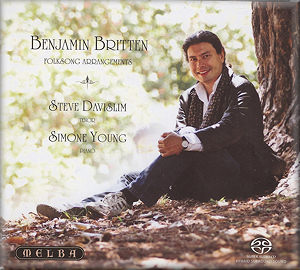

 Steve Davislim (tenor); Simone Young (piano)
 [65:49]
