|
|
|

alternatively
CD: Crotchet
Download: Classicsonline
|
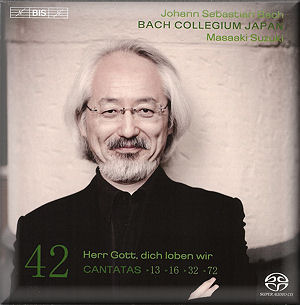
Johann Sebastian
BACH (1685-1750)
Cantatas - Vol. 42
Alles nur nach Gottes Willen, BWV72 (1726) [15:07]
Liebster Jesu, mein Verlangen, BWV32 (1726) [22:46]
Meine Seufzer, meine Tränen, BWV13 (1726) [20:11]
Herr Gott, dich loben wir, BWV162 (1725) [15:51]
 Rachel
Nicholls (soprano); Robin Blaze (counter-tenor); Gerd Türk (tenor);
Peter Kooij (bass) Rachel
Nicholls (soprano); Robin Blaze (counter-tenor); Gerd Türk (tenor);
Peter Kooij (bass)
Bach Collegium Japan/Masaaki Suzuki
rec. Kobe Shoin Women's University Chapel, Japan, February 2008
BIS SACD 1711 [75:24]   |
|
|
A consistently useful feature of Bach Collegium Japan's
BIS Bach cantata series has been the erudite booklet notes by
Klaus Hofmann. In the introductory paragraph to the essay accompanying
this latest volume he reminds us of Bach's extraordinary
industry - a new cantata each Sunday - during the years he worked
as Kantor at the church of St Thomas, Leipzig. Some may have
been lost from 1726, however, as the allotted cantata for certain
Sundays has not survived. It may even be that Bach's rate
of production slowed for some reason, but in any event here
are four from January of that year, including one composed for
New Year's Day.
I was particularly glad of the booklet notes in respect of Meine
Seufzer, which takes as its starting point the wedding at
Cana where Christ turned water into wine, this being the gospel
passage for the particular Sunday for which this cantata was
composed. It would take a canny reader, though, to work this
out for himself, there being but a single, and rather oblique
reference to the story in the text. Christ learned that there
was no more wine from his mother, to whom he replied 'Your
concern…is not mine. My hour is not yet come.' This
last phrase, writes Hofmann, is what the cantata is really about,
'abandonment, hopelessness, but later also about confidence
that the hour will come.' Christ's hour came with the
betrayal by Judas Iscariot, and given that he fully understood
his purpose on earth, and therefore his fate, we can understand
that he already had presentiments of abandonment and hopelessness.
All this serves to illustrate the depth of philosophical debate
contained in the libretti of Bach's cantatas, and also to
make one wonder how accessible were the messages to the congregations
at Leipzig. In the present case, a cantata which takes as its
starting point the miracle of turning water into wine is transformed
into a meditation of misery and despair. Significantly, though,
it is only at the point in the libretto where the vaguest reference
to the miracle is made that hope begins to shine through, however
dimly. It is a beautiful work, with, in particular, a long tenor
aria featuring two recorders and oboe da caccia. Some might
find Gerd Türk rather cool here, but he is vocally splendid,
and I find that a slight trace of detachment only serves to
bring out with even greater pathos the meaning of the words.
He sounds oddly out of sorts, though, in Herr Gott, dich
loben wir, composed for New Year's Day, but lacking
the customary trumpets and fanfares which generally symbolise
the joy of that particular feast. The chorus, too, earlier in
the work, are rather lacking in festive spirit, and in both
cases it seems that a combination of a steady tempo and certain
stolid heaviness in the rhythm combine to create this effect.
The link between the cantata subject and its libretto is easy
to discern in Liebster Jesu. Another well-known story
is the starting point, the occasion when visiting Jerusalem
that Mary and Joseph thought they had lost the child Jesus but
find him in the temple debating with the elders. The voice of
Christ is allotted to the bass, even though he is a child in
the story, and in this Concerto in Dialogo the role of
his mother - the Soul, here - is sung by a soprano. Rachel Nicholls
appeared in Suzuki's recording of the B minor Mass, and
now makes her cantata series debut here. I find her singing
ravishing; her tuning is absolutely spot-on and she sings with
striking purity and beauty of tone. Her opening aria is beautifully
complemented by the playing of oboist Masamitsu San'nomiya
and the closing duet of contentment with Peter Kooij is a delight.
She is even more satisfying in the jewel of an aria which closes
BWV72. This cantata deals with Christ healing a leper, but typically
focuses on the notion of submission to Christ's will as
in the leper's words '…if thou wilt, thou canst
make me clean.' The soprano aria rejoices in the knowledge
that God's will is that mankind be saved, and therefore
mankind should have faith in the will of God. Once again she
is in duet with the oboe, and the aria serves as a reminder
of the glorious jewels to be found hidden away in this immense
series of cantatas. Earlier in the work Robin Blaze has also
been given the opportunity to shine, and though the chorus has
relatively little to do in these four works their contribution
is excellent too. The recording - which I listened to in ordinary
two-channel stereo - and the production values in general are
well up to the standards of the house.
Those collecting this
series can, therefore, add this one in without hesitation.
William Hedley
|
|