 |
|
|
AVAILABILITY
Immortal
Performances Website
|
Richard WAGNER
(1813-1883)
Parsifal (1865-1882)
Act I
Amfortas - Herbert Janssen (baritone); Titurel - Jorge Danton; Gurnemanz
- Emanuel List (bass); Parsifal - Torsten Ralf (tenor); Kundry - Rose
Bampton (soprano); Orchestra of the Teatro Colón/Erich Kleiber
rec. live, 1946, Buenos Aires
Act I Prelude and Transformation Scene to the end of the act and
Act III Good Friday Scene to the end of the act
Amfortas - Herbert Janssen (baritone); Titurel - Robert Easton (bass);
Gurnemanz - Ludwig Weber (bass); Parsifal - Torsten Ralf (tenor)
Orchestra of the Royal Opera House Covent Garden/Fritz Reiner
rec. live 1937, Royal Opera House, London
Interpolations and extracts from Act I from the commercial
performance with Ralf and Weber, conducted by Rudolf Moralt in 1951
in Vienna
Bonus items:
Act I - Vom Bade kehrt der König heim (Andrésen,
Pistor, Frieder Weissmann) [7:09]
Act II - Flowermaiden Scene Act II (Karl
Muck, Bayreuth, 1925) [4:53]
Act II - Ich sah’ das Kind (Frieda Leider/LSO/John
Barbirolli, 1931) [4:22]
Act II - Amfortas! - die Wunde! (Lauritz Melchior/Philadelphia
Orchestra/Eugene Ormandy, rec. 1938) [7:26]
Good Friday Music (Alexander Kipnis, Fritz Wolf/Bayreuth
Festival Orchestra/Siegfried Wagner, rec. 1937) [11:39]
Act III - Nur eine Waffe taugt (Lauritz Melchior/Philadelphia
Orchestra/Eugene Ormandy, rec. 1938)
Act III - finale (Orchestra and Chorus/Rudolf Moralt, rec.
Vienna, 1949) [3:12]
 IMMORTAL PERFORMANCES
IP CD 1006-3 [3 CDs: 74:33 + 79:10 + 78:38] IMMORTAL PERFORMANCES
IP CD 1006-3 [3 CDs: 74:33 + 79:10 + 78:38] |
|
|
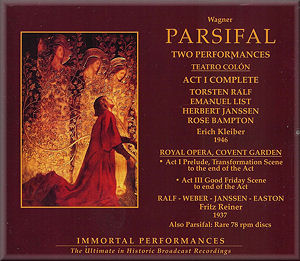
Immortal Performances continues its historic explorations with a tripartite three CD set that needs some background explaining. The first CD gives us a real rarity: a 1946 performance of Act I of Parsifal given in 1946 at the Teatro Colón under the direction of Erich Kleiber. This is important for its preservation of the performances of Ralf, List, Janssen and Bampton in, as the notes make clear, music that was otherwise unrecorded by them. Act I of this performance extends into the second disc where we find parts of Act I in the better known 1937 performance given by the orchestra of the Royal Opera House Covent Garden and Fritz Reiner. Act III is contained in the third disc. Finally we have some famous extracts from Parsifal 78s from the pre-War period - roughly 1925-1938.
This all adds up to an intriguing collection, though not one without its problematic aspects. The first concerns the recorded quality from the acetates that preserve the 1946 Buenos Aires performance. The Prelude is missing so a Kleiber performance with the NBC from the same year was substituted. A few brief passages could not be found so interpolations have been used. Pitching was, as so often, a real problem, but it has been intelligently remedied here. There was not a huge amount that could be done to mitigate the rather limited signal. For this reason the sound is rather compressed and there are brief patches of flutter and hum. That said, we hear the forward, ringing sound of Torsten Ralf as Parsifal. Greater still is the Amfortas of Herbert Janssen. He may occasionally be off-mike during parts of So recht! but his magnificent singing and dramatic conviction carry all before them. Emanuel List is dismissed in the notes as competent but uninteresting. And it’s true that he is no match for Ludwig Weber in the Covent Garden performance, but he does at least deal justly with the narrative discourse and a sense of scene-setting. Rose Bampton is a persuasive Kundry. The sound does get murky in places - Oh! Dass Keiner diese Qula ermisst, which starts the second disc is an example. Kleiber proves a strong but flexible conductor. His Prelude is slow but, as noted, derives from another performance altogether.
The Covent Garden event is a melding together of performances. EMI recorded chunks of two 1937 performances on lacquers, later transferred to shellac. Once again the Prelude is an interpolation, this time from Reiner’s New York Philharmonic-Symphony performance of November 1938 published anonymously by Victor at the time. Part of the Transformation Scene, the start of the Grail Scene, and the end of Act I come from Rudolf Moralt’s Vienna commercial recording of 1949. Subsequently in Act III more Moralt is used to patch - and that includes a scene with Ralf and Weber conducted by Moralt in 1951. The Good Friday music comes from Moralt, and though it’s tracked at the start of CD3 the difference in sound quality is all too audible. These interpolations are IP house policy to ensure Wagnerian continuity and narrative theatrical verisimilitude.
Once again Herbert Janssen lives up to his august reputation, whilst Reiner conducts with great fluidity and the orchestra plays with real style. The Gurnemanz is Ludwig Weber, and he proves an altogether impressive interpreter of the role. His theatrical instincts, allied to a noble frame, are parts of an armoury of expressive virtues. Ralf reprises his Parsifal with precision and clarity.
The bonus recordings are all pretty well known but have been sympathetically restored. There is one slight exception and that’s the 1927 recording of the Good Friday Scene under the composer’s son Siegfried. Here IP have added a concert ending to a recording which did not have one and ended quite abruptly as a result. It’s a practice I dislike, but it’s part of IP’s philosophy.
One thing that rather disturbs me in IP’s notes is the occasional dig at admittedly inferior transfers by other companies. Fair enough, I suppose, in the cut-and-thrust world of releasing rare historical recordings - but the dissing reads badly, at least to me, and I don’t enjoy it in this context. I also wish some method could be devised of indicating interpolations in the track-listing rather than via the medium of wading through the booklet text. When it’s as extensive as interpolating the whole of the Prelude, say, we should know about it. Another smaller point: the IP team is aware that the notes have omitted a biography of Janssen and have taken steps to remedy this. There is also a track-listing glitch on CD2 - a typo has resulted in the omission of track ten, so be cautious here. Finally the Philadelphia Orchestra was never known as the Philadelphia Symphony, as the discographical information has it
This is a historically important three CD set that suffers from sound problems, and what some will style as an idealised approach to presenting Wagner on record. It preserves, nevertheless, some exceptionally valuable torso performances in painstaking transfers.
Jonathan Woolf
|
|























