1.
Der Jüngling an der Quelle, D.300 [1:40]
2.
Der Herbstabend, D.405 [2:33]
3.
Der Entfernten, D.350 [2:23]
4.
Lied ‚Ins stille Land’ D.403 (1st version) [1:04]
5.
Lied ‚Ins stille Land’ D.403 (4th version) [1:37]
6.
Fischerlied, D.351 (1st setting) [2:07]
7.
Pflügerlied, D.392 [2:14]
8.
Fischerlied, D.562 (2nd setting) [2:45]
9.
Herbstlied ‚Bunt sind schon die Wälder’, D.502 [1:40]
10.
An die Harmonie, D.394 [3:44]
11.
Die Einsiedelei, D.393 (1st setting) [2:30]
12.
Die Herbstnacht (‚Mit leisen Harfentönen’) D.404
[2:26]
13.
Abschied von der Harfe, D.406 [2:02]
14.
Die Einsiedelei, D.563 (2nd setting) [2:09]
15.
Freude der Kinderjahre, D.455 [2:23]
16.
Das Bild, D.155 [2:49]
17.
Heimliches Lieben (An Myrtill), D.922 [4:18]
18.
Gott im Frühlinge, D.448 [1:57]
19.
An den Schlaf, D.447 [1:10]
20.
Der gute Hirt, D.449 [3:05]
21.
Die Nacht, D.358 [3:36]
22.
An Chloen, D.363 [2:38]
23.
Die Liebesgötter, D.446 [3:05]
Four years ago I first came across Berlin-born
Jan Kobow through Andreas Spering’s superb Naxos recording
of Die Schöpfung (see
review). Only some months later his recording of Die
schöne Müllerin (see
review) arrived and I literally boiled over with enthusiasm.
Both recordings were then on my list of Recordings of the
Year. Hearing his Schubert disc I expressed hopes about
a Winterreise with him and although he actually recorded
it some time later I never got hold of it. I was so much happier
when I found the present disc in my latest review parcel.
The repertoire consists of largely little known
settings of unknown poets – the only standard song is Der
Jüngling an der Quelle – and some of the songs are rather
ordinary. But as I have said in earlier reviews of discs in
this series: even little known and ‘ordinary’ Schubert usually
has merit. While most of them will probably not be very frequent
visitors to my CD-player they have been nice to listen to
and a few will no doubt be played again.
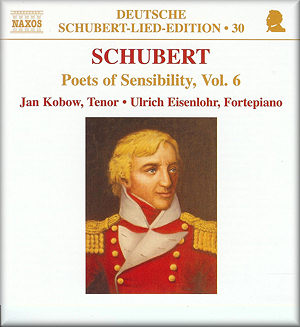
The first fourteen songs are settings of poems
by Johann Gaudenz von Salis-Seewis (1762–1834). This is the
man on the cover painting. He was a Swiss nobleman who had
met Goethe and Schiller and other literary greats but his
own poetry was hardly on their level. Still Schubert obviously
was inspired by it and some of them exist in more than one
version. There are no less than four versions of Ins stille
Land, the first and last of which are performed here.
They differ very little but the fourth version is more melancholy
in atmosphere and sung here much slower. Fischerlied
is heard in two widely different settings. The earlier, D.351,
is jolly and carefree and has a la-la-la refrain; the
later, D.562, more elaborate and rather melismatic. Melisma
is when one sings more than one note on each syllable. Die
Einsiedelei is also preserved in two different settings,
where the earlier, D.393, is lighter in tone the later, D.563,
is darker but at the same time more lively. The more mature
composer sees different things in the poem than the teenager
does.
Apart from Der Jüngling an der Quelle,
which deservedly is counted among the great Schubert songs,
Der Entfernten, is an attractive strophic song with
quite elaborate accompaniment. Abschied is dark and
solemn with the fortepiano producing a much more realistic
harp sound than a modern concert grand. These are possibly
the finest of the Salis-Seewis settings.
Among the six settings of Johann Peter Uz (1720–1796)
Die Nacht D.358 has the deepest emotions and should
undoubtedly be heard more often. Die Liebesgötter is
more or less a rococo pasticcio, sung and played with great
enthusiasm, and the manuscript to An Chloen is damaged
– the opening having only the bass line of the piano accompaniment.
For the recording the musicians have tried to fill in a suitable
beginning. To my ears it sounds convincing.
Of the remaining songs Heimliches Lieben
to a text by Karoline Louise von Klenke (1754–1802) is a substantial
piece, harmonically brave and with a dark intensity that places
it on a par with Schubert’s late masterpieces. He was given
the poem by his hostess during a stay in Graz in 1827 and
its Deutsch number tells us that it was completed just after
Winterreise.
Though the songs in themselves may be of variable
interest the singing is definitely constantly on the high
level I expected from Jan Kobow. Excellently accompanied on
fortepiano by Ulrich Eisenlohr the readings are exquisite
in an early 19th century manner. There is no breast-beating
and superimposing of heavy accents. On the contrary what first
strikes the listener is the superb legato, the beautiful tone
and the fine sensitivity to nuance. I think it’s wrong to
call them small-scale readings since that term implies – sometimes
at least – facelessness. Kobow sings with a lot of face but
the expressive compass is within a subtle range – there are
no grimaces. Add to this his clear enunciation of the texts
and his sensitive shadings of voice colour. This disc is ample
proof of Jan Kobow being one of the most accomplished Lieder
singers of his generation.
Göran Forsling

























 Jan Kobow (tenor);
Ulrich Eisenlohr (fortepiano)
Jan Kobow (tenor);
Ulrich Eisenlohr (fortepiano) 
