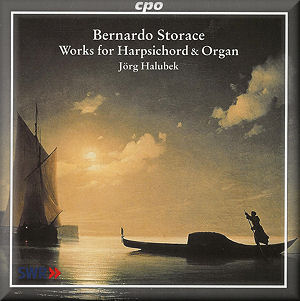
Comparison: Fabio Bonizzoni (Glossa GCD921506)
Bernardo Storace is a bit of a mystery. Very little is known of his
life: we only know what is printed at the title-page of his
only collection of music, the 'Selva di varie compositioni d’intavolatura
per cimbalo ed organo', which was published in Venice in 1664.
It says: "Vice-maestro di cappella of the Illustrious Senate
of the Noble and Exemplary City of Messina". This is part
of the mystery: why did a composer who lived in Messina in Sicily
publish his music in Venice? And as his compositions have more
in common with the North Italian keyboard music than with the
southern style from Rome or Naples it is suggested he may have
been born and educated in the North of Italy. But we just don't
know.
It is especially the Ciaccona from this collection which is part of
the standard repertoire of today's keyboard players. Because
of its virtuosic and dramatic character it is often used as
a show-stopper, preferably to end a harpsichord recital. It
is remarkable that Jörg Halubek starts his programme with this
work rather than save it for the end. But this disc shows there
is more in this collection of music which deserves attention.
Not that Halubek is the first to record Storace's music: the
recording by Fabio Bonizzoni - pupil of Ton Koopman - which
I used as comparison, is the only one I had access to, but Rinaldo
Alessandrini also devoted a whole disc to Storace's music (Astrée).
Many of Storace's keyboard works are based on ostinato basses. Apparently
the composer had a strong preference for this form of composition.
They can be divided into two groups: on the one hand variations
on passamezzo, romanesca, spagnoletta. monica and Ruggiero patterns,
on the other hand passacaglias and a ciacona. Although the passacaglias
are divided into 'partite' - like many variation works by Frescobaldi
- Storace aims at a stronger formal unity. The various partite
are each characterised by different keys, metres and affetti.
An example is the 'Passagagli sopra f' which consists of three
sections, in f minor, B flat minor (grave) and E flat (allegro)
respectively.
The Follia was very popular in the 17th century. Storace's composition
with this title is divided into two groups of nine variations
each. In each group every variation increases the virtuosity
and speed, creating a kind of crescendo effect. The ninth variation
has the character of a lamento. Also popular in Storace's time
was the Battaglia: many composers wrote battle scenes for keyboard
or for instrumental ensembles. Jörg Halubek plays it on the
organ, whereas Bonizzoni has chosen the harpsichord.
It is one of the pieces which can be played on either instrument. The
Ciaccona is definitely a work for harpsichord and just doesn't
fit the organ. The Recercar is an example of Storace's contrapuntal
skills and fares best on the organ. The same is true for the
Toccatas, which in fact consist of a Toccata and a Canzona.
These clearly belong together and are a prefiguration of the
later prelude and fugue combination.
Jörgen Halubek has chosen two splendid instruments, both historical.
The harpsichord was probably built around 1600 in Venice and
the organ, which has no date nor the name of the builder, is
probably from the mid-18th century. As very little changed in
the way Italian organs were built in the 17th and 18th centuries
this is a perfect choice for a programme like this. Especially
important is the tuning: mean-tone temperament as applied here
is a necessary prerequisite to bring this music to life. Otherwise
the many harmonic peculiarities would pass by almost unnoticed.
Jörgen Halubek is giving very decent and stylish performances of this
fine repertoire. But I think his playing is far too introverted
and lacks emotion and passion. The comparison with the recording
by Fabio Bonizzoni is very revealing. The Ciaccona is a very
exciting piece with strong contrasts between its various sections.
That is barely noticeable in Halubek's performance. Bonizzoni's
performance is much more incisive and passionate, thanks to
a faster tempo - which is varied now and then to increase the
tension -, a sharper articulation, more ornamentation and a
much stronger rhythmic characterisation. That is also the case
in other pieces which both artists play on the harpsichord,
for instance the Balletto. In general I rate Bonizzoni higher
in the harpsichord items as he comes closer to the true character
of Storace's music. He plays the organ pieces well, but here
Halubek has a strong case. I think Bonizzoni adds too many trills,
something he has copied from Ton Koopman. But what works on
the harpsichord doesn't necessarily work on the organ. Even
though I think Halubek could have been a bit more extraverted
here as well in the end I probably slightly prefer his interpretations.
The counterpoint comes out really well in his performances,
for instance in the Recercar.
As both recordings contain pieces which don't appear on the other disc
I would recommend both. But if you want to purchase one disc
which gives you a really good impression of the brilliance of
Storace's keyboard music you should go for Bonizzoni.
Johan van Veen