Flotow was born near Rostock in North Germany. His family was
musical but considered the profession unbefitting the family’s
aristocratic status. Young Friedrich was intended for the civil
service. After tribulations he managed to secure the family’s
support to study in Paris with Pixis and Rejcha. It was there
that he met Wilhelm Riese, the Hamburg-born poet. who provided
the librettos for several of his operas including the one work
that has kept Flotow's name prominent: the 1847
Martha.
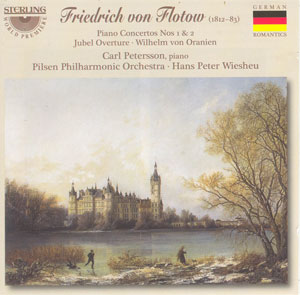
His First Piano Concerto runs to only 14 minutes. It has a chivalric
Allegro,
a bejewelled
Adagio recalling Chopin and Beethoven’s
Fourth Piano Concerto and a bobbing and gallant
Rondeau with
heroic cross-currents. Schumann and Bellini can be discerned
among these pages. The Second Concerto is scarcely longer at
approaching 18 minutes. It is in four movements: a noble lapidary
Andantino may
remind you of the slow movement of
The Emperor. After
a very brief skipping and bowing
Scherzo we have an unhurriedly
unfurling and luxurious
Adagio. Proceedings close with
a hop and jump
Rondo which has something of early Tchaikovsky
about it. The
Jubel Overture with its decidedly fairy-delicate
second subject must have had Mendelssohn as an influence. It's
an attractive overture with just a surfeit of bombast at the
close. As for the incidental music to
Wilhelm von Oranien
in Whitehall the introduction is stiff and stormy with some
stagy Hungarian bagpipe music. The Act II
Andante unfolds
a long slow Tchaikovskian strand of melancholy. I mentioned bombast
earlier - you can hear it again in the brassy strut of the Act
III
Maestoso where
Rule Britannia is played
verbatim.
After this we get a Rossinian skittishness, a dignified
Andante and
a grand final
Moderato.
There’s really good playing by the Pilsen orchestra and
the lustre of their string choir - often a weakness in orchestras
outside the greats - is excellent. No problems at all. Wiesheu
who also provides the liner-notes has included the 1992 premiere
of Kempff's last orchestral piece
Un Giorno a Positano and
the first German performance of Donizetti's cantata
Parafrasi
del Christus in his honours list.
There you have it. Premiere recordings of music by a romantic
era composer. Will appeal to anyone who know they will enjoy
music in the thrall of Schumann, the showier sentimental Chopin
and the lyrical Beethoven. It’s all done with style, documented
deeply, and performed and recorded with commitment and skill.
Rob Barnett