D’Indy wrote piano - and organ - music throughout
his life and it constitutes a substantial fraction of his
output. On this disc we have two works which chart the progress
of his approach to the instrument. The first, Poème des
Montagnes, shows the young composer as he seeks to consolidate
the lessons of his early efforts and to expand the range of
his pianistic writing. The Sonata is the work of the established
and fully developed composer, seeking to express his own well-developed
musical philosophy.
The Poème des Montagnes is the
first substantial piano work of the composer’s maturity. It
shows him using the cyclical procedures learnt from his master
Franck to bind together five pieces portraying different sections
of his own area of south-eastern France. But there is another
programmatic element: the theme that provides the material
for all five sections is one that the composer associated
with his wife Isabelle and which he titled “la Bien-aimée”
(the Well-beloved). This is the same theme that the composer
used as the basis for his Souvenirs Op. 62 written
in 1906 as a memorial to her. The introduction, Harmonie,
not only presents the basic material, but demonstrates a charm
and tenderness one does not always associate with this composer
and which is frequently found throughout the piece. Chant
des Bruyères is also charming, with a simple but elegant
development of the main theme and an orchestral use of the
piano. The middle section shows a clever manipulation of the
basic material through a series of dances with a slow central
interlude. The final section is perhaps the highlight of the
entire work. Unfortunately, Plein air begins in a
somewhat disappointing fashion, but the middle section is
more impressive and leads to a touching coda, which connects
to the second Harmonie, with its elaboration of the
original motif finally dying away to the original mood of
the work.
Interestingly, the Sonata was written
directly after the above-mentioned Souvenirs, but,
while serious, is not tragic. The basic material is a very
Franckian theme, which is varied in many ways, some quite
inventive, in the first Modéré movement,. D’Indy is
especially clever when he extends the variants of his material
and this leads to many beautiful passages as well as a few
turbulent ones. Towards the end of the movement his love of
Bach makes itself felt in some of the most impressive thematic
manipulation. The second movement sounds a little like Debussy
rhythmically as the jaunty theme goes through a wide variety
of tempi, also developing thematically as it repeatedly slows
down and speeds up. The third movement is a Modéré
like the first and is a complicated cyclic summation of what
has gone before both thematically and rhythmically. It also
shows more charm than the previous movements, as well as having
meditative episodes. Again the extensions of already existing
material are masterly. Most impressive is the bell-like passage
towards the end which dies away, over the hills of the Ardèche
as it were, before there is a final development of the opening
material. In both its construction and development this work
can compete with that other giant French sonata, of Dukas,
and is perhaps more immediately appealing.
At present there is no other recording available
of the Sonata and only one of the Poème des Montagnes -
by Michael Schäfer on Genuin Musikproduktion. This is not
a problem, however, as Diane Andersen delivers luminous, crystal-clear
playing of both pieces. Her phrasing and especially touch
are so well suited to this music that it is hard to imagine
even the composer having any criticism to make. The recording
is very lifelike and a good counterpart to the playing. My
major reservation is with the text. First, the Poème
is listed both as Op. 15 and Op. 150 and the third movement
of the sonata is timed at 8:09 when in reality it is ten minutes
longer. Secondly, the actual text is extremely eccentric in
its description of the two works, which at first I thought
was a translation problem. But the eccentricity is there in
both French and English. However, it’s the music that counts
and because of this the disc rates very highly indeed.
William Kreindler
























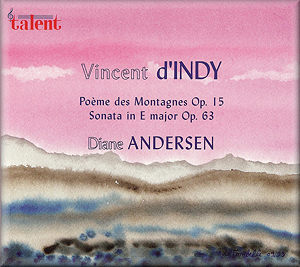
 Diane Andersen
(piano)
Diane Andersen
(piano) 
