Alexandër Peçi is an Albanian composer who
has an impressive list of works to his credit. This is the
second CD devoted to his music and the first to come my way.
Peçi studied at the National Conservatory in Tirana, graduating
in 1974, and in the early 1990s travelled to Amsterdam and
Paris to work with Ton de Leeuw and Paul Mefano. With the
political upheavals in the early 1990s, European influences
started to be felt at home, while, at the same time, the country’s
own heritage was retained. Thus, modernism came to Albania.
You can imagine the excitement with which artists tried to
embrace styles which hitherto had been denied them. What we
have here is a composer, and an obviously successful one in
his own country, flexing his international compositional muscles.
Unfortunately, what we also have here is a composer hopelessly
out of touch with what is happening in much contemporary music,
and using styles which seem old hat and outmoded.
Dasma e Sakos, for soprano, saxophone
and strings, comes from the film of the same name – where
a servant is promised a bride only to discover that the bride
is a man and what should have been an happy event turns into
a tragedy. The voice has a high vocalize whilst the sax embellishes
ideas below it, all to the accompaniment of a rich, quasi–Hollywood
style string background. Think of Kancheli with Jan Gabarek
and you’ve got the idea, except that with Kancheli there’s
a deep and meaningful dramatic background. This piece verges
on the edge of kitsch with its cliché-ridden gestures and
language. Even so, it’s one of the best pieces on the disk.
Dubel Valle, for solo piano, has moments
which could have come out of a watered down Sacre du Printemps,
mixed with some quite mumblings and early Boulezian chordal
attacks. Një vërshëllimë ere, for solo flute,
is a piece which manages to mix the mysticism of Syrinx
with Berio and Boulez. The music is monochromatic, slow and
ponderous, it seems to have no purpose for it goes nowhere
and I feel no progression in the music – no growth. Kënga
e thyer, for cello and piano, is a one movement structure
which begins with the kind of piano music we have already
heard elsewhere on this disk. Despite the rather dour piano
writing, the cello line is quite interesting, in the main,
and there is the beginning of a potentially good piece here.
Karusel structure, for flute, clarinet,
cello and piano, is yet another slow piece – one thing which
seemed to typify so many contemporary compositions for a long
time was a predilection for slow tempi – with little movement,
little harmonic interest and is supposed to represent “…a
mythical voyage between earth and sky with…a zone of dark
clouds in between.” For me, a voyage to the sky, even if
there was cloud cover, would be a very exciting and happy
occasion and one which elicited excitement and joy, not disjointed
“meditation”. A slightly faster section brings the piece to
a close but it’s all too similar to what has gone before and
there is insufficient contrast to make the material interesting.
Gjeneral Gramafoni, for solo piano,
comes from the film of the same name, and the plot is irrelevant
to the piece played here. The notes tell us that, “…only the
ominous little flourishes that punctuate this peaceful scene
suggest the drama that is being played out in the background.”
Actually nowhere is there the feel that a drama is being enacted
anywhere. This is a slightly Hollywood piano solo which has
a grand gesture about half way through – but drama? Not to
my ears.
Dialog Liturgijk is the biggest piece
here, in playing time and its scoring is rather interesting
– soprano, clarinet, speaker, electronics and the recorded
voice of Mother Teresa. We’re back in Kancheli country again,
and when the speaker enters we could be listening to one of
Galina Ustvol’skaya’s Symphonies. There was even, at one point,
electronic sounds which were reminiscent of Ross Harris’s
wonderfully inventive electronic score for the children’s
TV series The Games Affair.
You might think that I am being ungenerous
in what I write, and I have no doubt whatsoever that Alexandër
Peçi has done his best in creating these pieces, but when
compared to the best in composition from the same period –
and I’m thinking of such works as Peter Sculthorpe’s 11th,
12th, 13th and 14th
String Quartets, Harrison Birtwistle’s Harrison’s Clocks,
Alun Hoddinott’s Wind Quintet and John Adams’s Road
Movies, to name but a few chamber works contemporary with
Peçi’s pieces – these works seem empty and without interest.
The main problem is that if you’re putting
yourself, or being put out, on the world stage, you’ve got
to have work which will stand comparison with the very best
of your contemporaries and Peçi’s work simply isn’t in that
league. Despite what appear to be excellent performances,
and with marvellously clear sound, I cannot bring myself to
recommend this disk for there is insufficient musical interest
here, and nothing which would compel one to play the disk
a second time.
Bob Briggs
























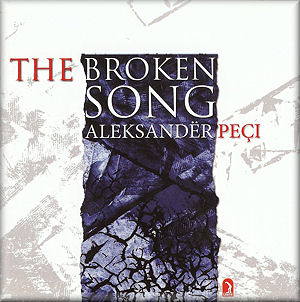
 Mariana Leka (soprano);
Rovena Kureta (soprano); Rikard Ljarja (speaker); Besnik Doshlani
(flute); Fatos Qerimaj (clarinet); Brikel Guga (alto saxophone);
Peter Guralumi (cello); Rudina Ciko (piano); Merita Rexha (piano);
Ensemble Spectrum; AMRA Ensemble/Zhani Ciko
Mariana Leka (soprano);
Rovena Kureta (soprano); Rikard Ljarja (speaker); Besnik Doshlani
(flute); Fatos Qerimaj (clarinet); Brikel Guga (alto saxophone);
Peter Guralumi (cello); Rudina Ciko (piano); Merita Rexha (piano);
Ensemble Spectrum; AMRA Ensemble/Zhani Ciko 
