Editorial Board
MusicWeb International
Founding Editor Rob Barnett Editor in Chief
John Quinn Contributing Editor Ralph Moore Webmaster
David Barker Postmaster
Jonathan Woolf MusicWeb Founder Len Mullenger
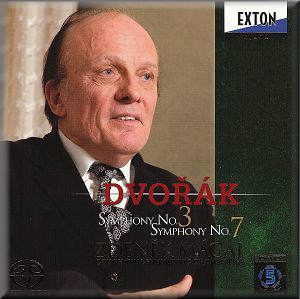
Antonín DVOŘÁK (1841-1904)
Symphony No. 3 in E-flat, Op. 10 (1873) [32:36]
Symphony No. 7 in D minor, Op. 70 (1884-5) [34:41] Czech Philharmonic
Orchestra/Zdeněk Mácal
rec. Dvořák Hall, Rudolfinum, Prague, August-September
2004 EXTON OVCL-00280 [67:24]
Zdeněk Mácal has been one of my favorite
conductors since New Year's Day, 1976, when I heard him coax
the normally indifferent
New York Philharmonic of the late Boulez era into involved
performances of late-Romantic blockbusters. I didn't get
to see him again until 2003 - twenty-seven years later!
- when his New Jersey Symphony account of Beethoven's Ninth
evinced a similarly natural-sounding feel for shaping and
tempo, along with a similar refusal, even in standard repertoire,
to take things for granted.
The present brace of Dvořák symphonies, too, gives the impression
of fresh thinking. The D minor symphony can be problematic:
its heavy scoring and busy textures tempt conductors into
bombast and melodrama. Mácal avoids these problems, taking
a sort of neo-Toscaninian approach to the music that emphasizes
its tensile line. In the first movement, he doesn't punch
up the brass punctuations, nor does he linger over the
brief pastoral episode at 1:19; keeping the bigger picture
in mind, he integrates these details into larger musical
arcs, thus reserving full impact for the main theme's tutti statement
at 1:43. The well-organized development maintains the overall
tension - even in the quieter passages: the flute solo
at 4:51 sounds haunted - building up inexorably to the
resounding arrival of the recapitulation (6:10). The coda
winds down with impeccable control -- the little 'cello
interjections, which the composer displaces by a beat here
and there, sound utterly right as the music's energy spends
itself.
Similarly, the conductor shapes the Poco adagio patiently,
in a single broad arc, so that the brassy climaxes - Dvořák
uses the brass more liberally in his slow movements than
you might expect - feel logical and inevitable. Some will
want more repose in the closing chords, but they fit in
with the conductor's approach to the rest of the movement,
rounding it off nicely.
In the Scherzo, the main theme retains its customary graceful
lilt, but here the segmented "tail" section and
the little string decorations on the repetitions provoke
a mild unease. Mácal departs from convention at the Trio,
strictly maintaining the tempo, and the taut line, where
others relax more generously. But it doesn't quite work:
the flute soloist doesn't have time to make sense of the
two-against-three business, and the textures otherwise
sound unsorted, if not quite unkempt. No complaints about
the finale, however: less episodic than some, affectionate
but not indulgent in the folk-like second theme, its climaxes
erupt with an almost Beethovenish volatility.
It doesn't hurt to have the Czech Philharmonic on board: their "traditional," affectionate
phrasing provides a firm grounding for Mácal's insights
- you might consider this the best of both worlds. Some
listeners will find the dynamic scheme a bit relentlessly
extroverted: there's room for greater light and shade in
the clarinet solos and duets, for example, but there's
no denying their eloquence.
The three-movement E-flat symphony - one of the four whose
discovery precipitated the renumbering of all Dvořák's
symphonies in the mid-twentieth century - has its special moments,
particularly in the central Adagio molto, where
Mácal taps into a previously unsuspected epic vein: it
becomes the dramatic heart of the symphony. In the more
lightly scored passages, the airy textures are appealing,
and the conductor shapes and rounds off cadential phrases
with a lovely plasticity. At the central Tempo di marcia -
which usually goes just slightly faster - Mácal steps up
the pace significantly, to stirring effect. The vigorous
downward string unison at 9:12, with its irregular scansion,
is again in perfect control; the cellos at 12:09 sing vibrantly,
but with a hint of desolation, ushering in an abbreviated
version of the main subject to round off the movement.
The outer movements don't reach that level. The first movement has
an appealing buoyancy and sweep here, but it sounds unvaried
in both volume and texture. Not only is this aurally fatiguing,
but it undercuts what should be great moments: the unexpected tutti recap
of the second subject, especially, goes for naught by lack
of contrast. The triumphal finale is not one of Dvořák's
subtler conceptions. The twinkling main theme, spankingly
played, here sounds rather earnest, but otherwise Mácal's
reading is sprightly.
Exton's engineers incorporates some of the Rudolfinum's ambience into
the recorded sound - as many of Supraphon's own productions
haven't - nicely complementing the Czech orchestra's lean,
tapered sonorities. Several splices could have been better
concealed, but only that at 12:14 in the E-flat's Adagio
molto is distracting.
Despite my reservations, a flawed performance from a conductor like
Mácal offers more substance than a journeyman interpreter's
success. That Trio notwithstanding, this Seventh
goes on the short list for this difficult but rewarding
work, just below Rowicki (also Philips), Kertész (Decca),
Szell (Sony) and Colin Davis (Philips). Rowicki and Kertész,
on their respective labels, offer more consistent realizations
of the Third, but neither of them approaches Mácal's uniquely
moving Adagio molto.
Stephen
Francis Vasta
Please support our advertisers below by clicking on the logos for further information.

























 Czech Philharmonic
Orchestra/Zdeněk Mácal
Czech Philharmonic
Orchestra/Zdeněk Mácal  [67:24]
