Rejigging has enabled Lyrita to issue these three symphonies
on one disc. It ensures that the works of these two British
composers, born five years apart, has fine representation on
the revivified Lyrita rostrum. It might also serve to pique
interest in works that are still for the most part completely
overlooked in the symphonic pantheon.
Still's Third Symphony was written in 1960, in three movements.
From its brassy fanfares and strongly ebullient rhythmic profile
one begins to question its invisibility and indeed inaudibility
in the musical landscape. The high spirited writing, the clever
patterns Still unfolds are all indicative of a significant craftsman
at work and one whom, as the Largo shows, can unveil a refulgent
elegy without recourse to exaggeration or mordant self-pity.
Burnished and wistful - do I detect hints of Elgar's A minor?
- the movement may not plumb the most cavernous of depths but
in its way it cuts deep. When the brass and percussion open
the Moderato finale they do so in a much expanded and tougher
mirror of the first movement. This symmetry thus set up Still
works his mini magic with it. Tension is maintained, the writing
is resourceful and not opaque - and those little moments of
colourful reprieve add immeasurably to the schematic and emotive
success of a fine work, unjustly overlooked.
The Fourth Symphony followed in 1964 but is cast in a single
movement. There's an arresting, angular persistence to the
opening that remains pretty well unremitting for much of the
time. The strings bring their own layer of tension, and the
flaring march themes are powerful, unavoidable and impressive.
There's real vehemence here, real grip too. When, eventually,
an Elgarian theme does emerge it is assailed and defeated. It's
a less easy work than the Third to assimilate, but that's
because the earlier work is, relatively speaking, the more conventional.
The two Still symphonies are coupled with the Second Symphony
of Humphrey Searle, which was written in 1958. It shares with
Still's Third a three movement schema and with the Fourth
an implacable control, though it's couched in a more contemporary
idiom. Searle exercises vivid control over his material and
in the Lento he develops a musical profile that is at once stoic
and yet organic. The taut outbursts and drama of the lucid finale
are embedded in a schema that draws on earlier thematic material
and the work ends, characteristically, with a Lento, solenne
passage of power and authority.
The Searle was in the (unlikely?) hands of Josef Krips and the
LPO. Lyrita hero Myer Fredman directed the Still Fourth with
the RPO. And a third London orchestra, the LSO, was conducted
by Eugene Goossens in the Third.
The engineering is really first class and the disc makes a strong
kind of sense for all sorts of reasons, not merely exigency.
Jonathan Woolf
see also review by Rob
Barnett
























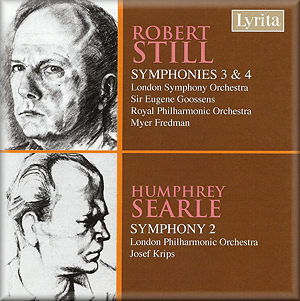
 London Symphony Orchestra/Eugene
Goossens (3); Royal Philharmonic Orchestra/Myer Fredman (4); London
Philharmonic Orchestra/Josef Krips
London Symphony Orchestra/Eugene
Goossens (3); Royal Philharmonic Orchestra/Myer Fredman (4); London
Philharmonic Orchestra/Josef Krips 
