|
Making
a Donation to MusicWeb
About MWI
Site
Map
More
Reviews
How to find a review
Books
Film
Music
Nostalgia
Records Of The Year
Recommendations
Comment
Arthur Butterworth Writes
Phil
Scowcroft's Garlands
Classical
blogs
Reviewers
Logs
Announcements
Don't
Go Here!
Community
Bulletin Board
Web
Ring
Reviewers
Helpers
invited!
Resources
How
Did I Miss That?
British
Composers
British
Light Music Composers
Other
composers
Indexes
Label
Masterwork
Discographies
Composer
National
Themed
Review pages
Complete Books
Programme
Notes
External sites
British Music Society
The BBC Proms
Performers
Orchestra Sites
Recording Companies & Retailers
Online Music
Agents & Marketing
Publishers
Other links
Newsgroups
Web News sites etc
Editorial
Board
Classical Editor
Rob Barnett
Seen & Heard
Editor and Webmaster
Bill Kenny
MusicWeb Webmaster
Len Mullenger
Assistant Webmaster
David Barker
PotPourri
A
pot-pourri of articles
MW
Listening Room
MW
Office
Helping
MusicWeb
Advice
to Windows Vista users
Questionnaire
Site
History
What
they say about us
What
we say about us!
Where
to get help on the Internet
CD
orders By Special Request
Graphics
archive
Currency
Converter
Dictionary
Magazines
Newsfeed
Web Ring
Translation Service
Rules
for potential reviewers :-)
Do
Not Go Here!
April Fools
|

 |
 |
|
AVAILABILITY
BuyWell.com
|
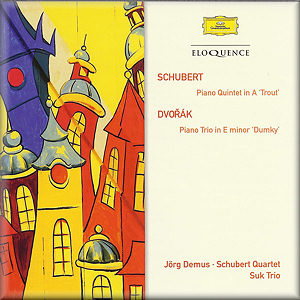
Franz SCHUBERT (1797-1828)
Piano Quintet in A, D667 The Trout (1819) [34:36]
Antonín DVOŘÁK (1841-1904)
Piano Trio in E minor, Op. 90 Dumky* (1891) [32:19]
Jörg Demus
(piano); Schubert Quartet (Anton Kamper (violin); Erich Weis (viola);
Ludwig Beinl (cello); Josef Hermann (double bass)); Josef Suk (violin)*;
Milos Sadlo (cello)*; Jan Panenka (piano)*
rec. Herkules Saal, Munich, September 1959 (Schubert); Beethoven
Saal, Hanover, June 1958 (Dvořák). ADD
DEUTSCHE
GRAMMOPHON ELOQUENCE 4800489 [67:00] 
|
|
|
The Vienna Konzerthaus Quartet was formed by members of the Vienna
Philharmonic in 1934. It consisted of violinists Anton Kamper
and Karl Maria Titze, violist Erich Weis and cellist Franz Kvarda.
The Quartet gave concerts throughout Europe under the auspices
of the Wiener Konzerthausgesellschaft (Vienna Concert House Society).
After the Second World War in 1945, it toured internationally
and was regarded as one of the first quartets to establish an
extensive LP discography.
In the early 1950s, members of the Konzerthaus
Quartet joined forces with pianist Paul Badura-Skoda and Vienna
Philharmonic bassist Josef Hermann for concert performances and
a recording of the Schubert ‘Trout.’ The result be equivalent
to a ‘grand slam’ by today’s standard and went to the top of the
then classical charts. In 1957-1958 health reasons forced Kvarda
to step down to be replaced by Ludwig Beinl. Two further recordings
of the ‘Trout’ made a lasting impression in the ensuing
years. One of these was with the British pianist Denis Matthews.
The other was this present DG recording. Kamper, Weis, Beinl and
Hermann were scheduled for a recording session in Munich with
the then thirty-one year old Austrian pianist, Jörg Demus. According
to Tully Potter’s liner-notes, the string members had to hide
behind the pseudonym ‘Schubert Quartet’ for contractual reasons.
The resulting recording went through several LP editions and a
brief CD release in 1992 as part of DG’s “Compact Classics” series.
This Trout is a musical treat with a life-enhancing
outdoors quality. Demus shows no signs of nervousness, and all
five players rise to a thrilling climax towards the end of the
opening Allegro. The ruminative and brooding Andante
at times builds to an intensity that gives the impression
one is listening to a full string ensemble rather than four players.
Demus takes more of a supporting role here, and the Quartet's
tonal colours and dynamic range soars. The next two movements
make the listener very much aware of the double-bass. Josef Hermann’s
instrument finds the lilt and melody behind the grand-fatherly
sound. Balance within the group alternates amongst the members
with finely judged skill; the ear is logically drawn to whoever
is leading the critical musical idea right up to the spiritedly
exciting conclusion. This is indeed a true marriage of minds.
According to Potter, this performance of the ‘Dumky’
owes its existence to a brief recording session that took place
in June 1958. At this time, two of the finest Czech string players,
violinist Josef Suk and cellist Milos Sádlo, and the esteemed
pianist Jan Panenka made up the Suk Trio. Their interpretation
of the ‘Dumky’ has come to be regarded as the definitive
version; thanks to Eloquence, newcomers can begin to understand
why.
The players balance control and passion to integrate
the work’s Bohemian rhythms, folksy melodies, pungent harmonic
progressions and Beethovenian conflagration. Suk’s affecting tone
in the Lento pierces the heart, whereas Sádlo’s lovely
burnished tone in the Adagio remains irresistible. The
crystalline Allegretto scherzando shimmers and ripples.
Throughout Panenka is vital yet introspective. He strikes a just
balance with the expressive voices of his colleagues. His are
skilled hands, capable of a wide spectrum of power and inflection.
If I could take just one Dvořák disc to a deserted island
this would be my top choice.
Patrick P.L. Lam
see also review
by Rob Barnett
|
|
Advertising
Rates
Visitor
stats
MusicWeb
International
has over 25,000 Classical CD reviews on offer
Gerard
Hoffnung Concerts &
The
Bricklayer Story

New
Releases

New
Releases


MusicWeb
sells the Polish
catalogue CDAccord
£10.50 post free W-W

MusicWeb sells the
Arcodiva catalogue
£12.00 post free W-W

£11.50
post-free world-wide
Try
it and see - Sale or Return
MusicWeb
can now offer you discs from the following catalogues:
Prices include postage
Musicweb
Special
Offers
Google Ads - for information about privacy matters, click here.
|