This release is enlightening on two fronts, one
aesthetic, one discographic. Aesthetically, it reminds us that,
despite the image of Rachmaninov propagated by academics and
miscellaneous avant-gardistes as an unregenerate reactionary,
his music incorporates novel and imaginative elements within
its admittedly Romantic idiom. Much of the D minor symphony
has an unsettled air contradicting the stereotype of self-satisfied
lushness; the orchestration of the A minor symphony, particularly
in its central Adagio ma non troppo, is unexpectedly
pointillistic, rather than conventionally rich. Even the E minor
Symphony encompasses a real innovation in its assignment of
quick, legato motifs to the horns; those short, whooping phrases
add a new weight and dynamism to the orchestral textures.
Additionally - and importantly, for younger listeners,
or those with short memories - these performances remind us
that Walter Weller, whose "day job" was co-concertmaster
of the Vienna Philharmonic, was quite the distinctive conductor
as well. His recording activity, for Decca and later Chandos,
was unfortunately sporadic; Stateside, at least, he was hardly
a household word.
The D minor symphony shows what we've missed.
I'm not sure why Decca chose to record this piece in Geneva
- perhaps the orchestra, which had previously documented lovely
if unambitious readings of the other two symphonies under Paul
Kletzki, had been contracted for this one as well. Weller's
intense performance of the first movement finds this musical
but generally second-tier ensemble playing well "above
its head." Certainly this bold, brazen brass playing wasn't
a hallmark of the Ansermet era; neither were these tensile,
bristling strings, opening in a moment into full-throated lyrical
outpourings. The sparkling woodwinds, conversely, are a familiar
quantity.
In the remaining movements, Weller gives every
phrase due consideration, taking nothing for granted, but ensemble
is less keen. The scherzo isn't so tautly etched, but the conductor
captures its churning Angst, with tender woodwind phrases
providing only a brief respite. The conductor builds the slow
movement inexorably, but one expected a more strongly profiled,
eventful journey -- the climax at 9:02, for example, wants fuller
tone than this -- so the concluding major-key resolution feels
unearned. The finale recovers somewhat: Weller has both the
fanfare-festooned marziale theme and the rhythmically
off-kilter second group well in hand, though the playing doesn't
regain the dazzling heights of the first movement.
In the E minor symphony, Weller's tempi as such
aren't extreme, but the conductor draws sharp contrasts between
them, playing off agitation and lushness against each other.
Thus, after a purposeful, deliberate introduction, with the
separate phrases distinctly marked off, the pace steps up conspicuously
for the exposition proper at 5:24; the airy second subject (7:02)
begins quietly, but keeps on moving. In the development, which
correctly returns to the impulsive manner; Weller's grip is
a bit less sure -- there's a lot going on here -- but he keeps
the textures reasonably well sorted, and the little brass fanfares
are unusually bracing. The incisive scherzo similarly allows
for a pronounced, expansive relaxation for the contrasting subject
at 1:11; Weller perhaps maintains the momentum a bit too rigidly
for the coda, where the clarinet seems hasty. In the spacious
slow movement, the sustained clarinet notes maintain a clear
sense of direction; the mood moves through nostalgia and regret
before the positive though strangely un-reposeful resolution.
The finale maintains a forthright bustle through the coda, though
Weller finds time for some expansive surges along the way.
With the A minor symphony, Rachmaninov steps
somewhat away from the E minor's "cosmopolitan" stance,
tapping instead into a familiar Russian strain of melancholy,
though presenting it in posh orchestral garb. In the first movement,
surging strings parlay the melancholy into full-blown nostalgia;
the second subject - the "lonesome cowboy" theme -
begins with dark, resonant 'cellos, building steadily in affirmation
through the brass restatement. Once past the exposition repeat
-- which, after so convincing a journey through the exposition,
feels oddly redundant -- the development ratchets up the anxiety
level, and this is reflected in the recapitulation. The first
theme has become desolate, answered with a consoling sweetness;
the second theme isn't allowed its optimism unimpeded - all
the little harmonic and motivic disruptions pose obstacles,
and the upward harmonic shift in the tutti distinctly
undermines it. Throughout, Weller's keen dynamic control shapes
the music in compelling arcs.
The second movement - Adagio ma non troppo,
though with an edgy, undulating faster episode - is unusually
ambivalent. The opening horn solo over harp chords is soft-edged,
and we can't tell where it's headed; it unexpectedly settles
into the major, with a sweet and searching violin solo. At 3:12,
the mood is anxious; unstable harmonies belie the ascending
strings' Romantic sheen. The crisp, pointed finale fittingly
rounds off an intrepid, exploring score.
The engineering, from the heyday of Decca analog,
is breathtakingly pellucid in Geneva, as impressive in the quiet
passages as in the big, juicy ones. The rich Kingsway Hall sound
is excellent in its way - note the deep, focused basses at the
start of the E minor - but an elusive interference, not even
tangible enough to be called "white noise," compromises
the quiet background. Listen to the sparkling woodwinds at 4:05
of the D minor's first movement, crisply defined against pristine
silence, and then compare the English horn solo at 5:02 of the
E minor - there's definitely "something" there. Additionally,
the mixing board has been applied to the E minor with a heavy
hand: the pumped-up sonics become claustrophobic when everyone's
going, and, while the full-throated interplay of parts at 6:50
of the Adagio is impressive, there's nowhere to build
for the climax at 7:47 - the textures have already reached saturation
point.
These performances, like most of Weller's others,
unfailingly command attention, and the set is inexpensive enough.
Still, depending on your particular interest, it might be worth
picking and choosing from among the separate Eloquence issues
of the individual symphonies, which come with fillers. Note
also that to accommodate the three symphonies on two discs necessitates
splitting one symphony - here, the A minor - between them. Meanwhile,
I'm holding on to my LP of Weller's E minor - the rich-sounding
vinyl proves more forgiving of the mix-down's excesses.
Stephen Francis Vasta
























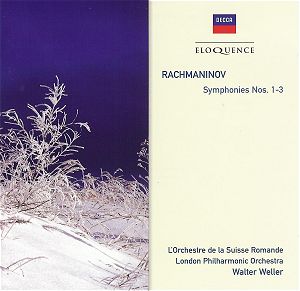
 L'Orchestre de la Suisse
Romande (1), London Philharmonic Orchestra (2, 3)/Walter Weller
L'Orchestre de la Suisse
Romande (1), London Philharmonic Orchestra (2, 3)/Walter Weller 
