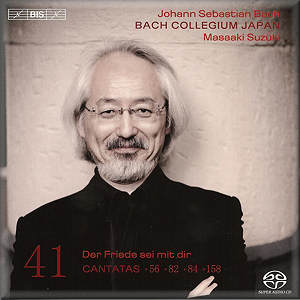
This is the first of Masaaki Suzuki’s Bach series I have reviewed
for MusicWeb International, but not the first to find its way
onto my shelves. Each volume I have heard has brought great pleasure,
and this, a superb disc in every way, even more than most.
When the authentic
performance movement began to go beyond what one might call
a kind of awareness and the use of period instruments became
widespread, I was amongst those who remained unconvinced. The
standard of playing has since improved enormously and the feeling
that Bach would surely have preferred the sound of today’s trumpets,
say, occurs to me much more rarely now. But what bothered me
most, and particularly in Bach, was the near-total abandonment
of legato playing and singing. Without doing the necessary
research myself, I held the view that if, in Bach’s time, crispness
of attack and rhythmic rigour were practised at the expense
of legato, it was something we should do well not to
emulate. Thankfully, this too has gradually been reviewed, and
the present disc is evidence of that. Even in rapid passages
the musicians here produce a beautiful, singing line, whether
it be vocal or instrumental, which, I feel sure, comes nearer
to the immense humanity of Bach’s music than did previous practice.
This volume groups
together four solo cantatas, three of which were composed during
1726 and 1727, Bach’s fourth year working as Cantor at Leipzig,
and the fourth, BWV158, of uncertain date. They are works of
extraordinary richness and each receives an outstanding performance
here.
Though the libretto
makes no direct reference to it, BWV56 deals with the incident
in St. Matthew’s Gospel where Christ heals a man “sick of the
palsy”. The cantata is thus an affirmation of faith after a
life of “torments”. In the long opening aria, Bach seizes on
this word, underlining the idea of suffering with music at once
noble and humble. Peter Kooij is magnificent: rich of voice
and with an exemplary control of line, he manages to invest
the text with all its meaning. In the second aria, a lighter
affair, he is in duet with Masamitsu San’nomiya, whose solo
oboe sings with a voice no less human and no less moving.
The
provenance of Cantata BWV158 is problematical; it may in fact
be a collection of cantata movements assembled into one work by
someone other than Bach. New to me, it is a real find, in particular
the bass aria which is the heart of the work. In this remarkable
piece the bass sings in duet with a highly intricate solo for
violin. These two voices weave in and out of each other without
sharing much in the way of musical material, and there is yet
more, as a solo soprano – beautifully sung here by Hana Blažíková
– doubled by the oboe, intones, line by line, a chorale. The opening
recitative is a prayer for peace at the end of which Bach has
the soloist repeat several times the final “Peace be with you”
to most touching effect. Peter Kooij is just as persuasive here
as he is in the first cantata.
BWV82 takes as
its starting point a story from St. Luke, concerning Simeon,
who has been told that death will only take him once he has
encountered the Messiah. This duly takes place in the temple
where the infant Christ has been brought, whereupon Simeon sings
his “Lord, now lettest thou thy servant depart in peace”, which
we now refer to as the Nunc dimittis. Bach’s cantata
based on this story is a miracle of tranquil contentment, and
Carolyn Sampson’s singing is fully worthy of it. Listen to the
captivating piano singing in the final paragraph of the
second aria, Schlummert ein, for example. She is equally
at home in the rapid coloratura of the final aria, in
which Simeon, still radiant, explains that he is now actively
looking forward to death. And how sensitively managed is the
first aria duet with flute player Kiyomi Suga, a wonderful player
who does not in the least make us long for a modern instrument.
Readers may well know this cantata in its original form for
bass, but it is equally affecting here in the transposed version
for soprano.
The parable on
which Cantata 84 is based, that of the workers in the vineyard
who are all paid the same regardless of how many hours they
have worked – the last shall be first, and the first last –
is not the only one whose message is difficult to swallow nowadays.
But Bach and his librettist make of it a wonderful pastoral
idyll, with, in particular, the second aria a folk dance (complete
with fiddle) transmuted into sacred cantata. No praise can be
too high for Carolyn Sampson’s singing here, assuming the simplicity
of the protagonists whilst not losing sight of the work’s sacred
purpose. The solo playing is once again of exceptional quality,
from the orchestra’s leader Natsumi Wakamatsu as well as the
oboist previously mentioned.
To these names
should be added those of Hiroya Aoki, alto, Robin Blaze, alto,
Yusuke Fujii, tenor and Gerd Türk, tenor, who join the soloists
in the closing chorales of three of these cantatas. The disc
is blessed with excellent insert notes by Klaus Hofmann. He
is particularly strong on the biblical context of these cantatas,
and I indebted to him for much of the foregoing descriptive
information. Mention should also be made of the exemplary English
translation by Andrew Barnett: in fact one has no feeling of
reading a translation at all. The recording is of the usual
BIS quality, rich, and close enough to be immediate and vivid
without sacrificing the beautiful ambience of the chapel acoustic.
I listened to this SACD in normal stereo, but so beautiful does
it sound it made me impatient to hear it in a surround sound
setup. However you listen, the high quality presentation and
the outstanding quality of the music making come together to
create over an hour’s worth of sheer bliss.
William Hedley

























 Carolyn Sampson
(soprano) (BWV82, 84); Peter Kooij (bass) (BWV56, 158)
Carolyn Sampson
(soprano) (BWV82, 84); Peter Kooij (bass) (BWV56, 158)  [64.04]
