Both these symphonies were new to me, and
the composers almost were. I'd never even heard of Staehle,
and the only Burgmüller I'd previously heard was some ballet
music that Richard Bonynge recorded years ago. The booklet represents
both composers as part of a "Kassel School", trained
in composition by Louis Spohr during his stint as court conductor
and opera director in that city, from 1822 to 1857.
This is also beautiful stuff. Some people will call it "derivative"
- there are clear echoes of Mendelssohn and Schumann, and the
shadow of Beethoven hangs over everything. But if we hear the
period's higher-profile composers in this music, that's simply
because their music is already familiar to us, and this music
isn't. Besides, the quest for originality is very much a modernist
fetish; nineteenth-century composers weren't expected to reinvent
the wheel with each new creation. So don't judge the music -
just enjoy it.
Burgmüller's symphony certainly sounds more substantial
than did those ballets. In the first movement, the themes aren't
really distinctive, but the composer's use of the orchestra
is striking: even the quieter passages - in the slow introduction,
for example - always sound fully fleshed-out. The
Adagio,
with its segmented phrases, is simple and wistful; a few episodes
of brief turbulence - the longest, at 3:33, introduced by peremptory
horn fanfares - don't prove serious. The rambunctious, volatile
Scherzo, punctuated with Beethovenian eruptions, unexpectedly
scales down to a baby-hunting-horn Trio. The
Finale's
edgy, dramatic first theme, unfortunately, is too quickly allowed
to bang away in
tutti. The woodwinds' airy second subject
provides a respite, spinning out more expansively on its reappearances;
still, the overall effect remains bombastic.
The first influence we hear in the
Hugo Staehle symphony
isn't Germanic at all: the dark, ominous unison of horns, bassoons,
and clarinets, answered by tremolos, is straight out of early
Verdi! The tremolos continue to feature prominently in the
Presto
proper, where the first subject suggests Mendelssohn's more
dramatic side. The oboe's broad contrasting theme seems static,
but proves useful in the development, where bits of it are layered
with the whirling accompaniment figures from the first group.
The
Adagio cantabile begins with a sweet chorale intoned
by the strings. As the woodwinds take up the theme with string
support, the textures gradually fill out, with a nice interplay
of colors as woodwind strands weave in and out of the string-based
sonorities. Harmonic shifts bring an unexpected note of disquiet,
and later restore serenity. Short upbeat motifs give the
Scherzo
its forward-pushing impulse; the cheerful Trio, introduced by
a little horn-and-clarinet fanfare - did Spohr give both composers
this idea? - climaxes in a blaze of glory. The short, turbulent
opening motif of the
Finale segues smoothly into a tender
clarinet melody. The development's homophonic wind phrases,
in their dotted rhythm, recall Schumann's
Spring Symphony.
A diminished seventh chord abruptly stops the forward motion,
after which the music turns slower and more chorale-like, tapering
to a quiet yet full-toned conclusion.
Marc Piollet, the principal conductor of the Kassel State Theatre,
provides sympathetic leadership, maintaining rhythmic buoyancy
through the turbulent passages. He elicits beautiful sounds
from the theatre's orchestra, a tremendous improvement on the
scrappy ensembles that once documented such repertoire on Genesis,
Vox, and other LP labels. The dark, burnished tone of the string
body is particularly attractive; the violin sections aren't
huge, but their playing is clean and unanimous in exposed passages
- try 5:23 of Burgmüller's
Adagio.
The engineering is good enough that I wish it were better. Most
of the time, there's a lovely depth and warmth; but the full
orchestra acquires a hard edge when the brass dominate - underlining
Burgmüller's over-use of the
tutti in his Finale - and
sounds congested when they don't.
One wonders why we don't hear this sort of music in concert.
The Burgmüller's finale mightn't wear well, but most of what
precedes it is fetching, and the Staehle is simply lovely. Are
we so jaded that we can't appreciate well-crafted, expressive
music unless it's by the acknowledged greats? So much the worse
for us, then.
Stephen Francis Vasta
see also review by Rob
Barnett























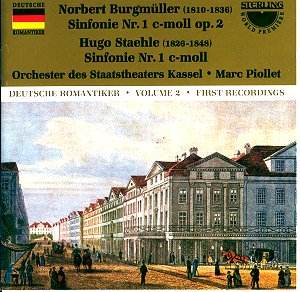

 Orchester des Staatstheaters
Kassel/Marc Piollet
Orchester des Staatstheaters
Kassel/Marc Piollet 