Pierre Danican Philidor was a member of one of the three largest
musical dynasties of the French baroque. The other two were
the Hotteterres and the Couperins. The article on the Philidor
family in New Grove mentions only five composers but these are
only the better-known members of this dynasty. The earliest
musician in the family whom we know about was Michel Danican
- as the family's original name was - who played the oboe at
the court of Louis XIII. His two sons, Michel and Jean, were
members of the Grande Écurie, one of the royal music ensembles.
It was Jean who was the first to be referred to by the name
'Philidor'. One of the best-known members of the family is Jean's
son André Danican Philidor 'le père'. In his capacity as music
librarian of Louis XIV he copied numerous compositions which
were part of the repertoire of the court's ensembles (the so-called
'Philidor-collection'). He was married twice, and got 23 children,
some of whom became musicians as well. Pierre Danican Philidor,
to whom this disc is devoted, was his nephew, a son of his older
brother Jacques Danican Philidor 'le cadet'.
Pierre
started composing at an early age, and took over his father's
position as oboist of the Grands Hautbois. Later on he became
a member of the 'chambre du roy' where Marin Marais and François
Couperin were among his colleagues. There seems to be some confusion
as to exactly what he has composed. The article in New Grove
says: "In 1717 and 1718 he published three books of suites,
half of them intended for two unaccompanied flutes, the others
for two treble instruments and continuo." But in the worklist
the only suites with basso continuo are for one treble instrument.
The present disc doesn't make things any clearer: the programme
notes don't tell us anything about exactly what Pierre Danican
Philidor wrote and the tracklist refrains from identifying any
sources either. The record company should have done a better
job in this respect.
The
programme notes are interesting, however, in clearing up some
confusing information about Philidor's position in the 'chambre
du roy'. He was referred to as 'joueur de viole' (player of
the viol). The authors in New Grove take this for granted as
they say "he became a member of the chambre du roi
as a viol player". But Antoine Torunczyk writes: "Faced
with a viol, Pierre would very likely have looked for somewhere
to blow into". He states that the post of oboist of the
'chambre du roy' did not exist, and that the title of 'player
of the viol' doesn't mean he actually played the instrument
- it's just a formal title. This is in line with all we know
about the Philidor family: they were a dynasty of wind players.
In
a short essay in the booklet the American oboist Bruce Haynes
presents Pierre Danican Philidor as one of the last representatives
of the aesthetics of the era of the Sun King. After his death
in 1715 the taste began to change, but Philidor and others who
adhered to the ideals of Louis XIV - in particular François
Couperin and Marais - were still alive and composing. Philidor
was highly appreciated by the King as the high annual pension
which Louis XIV awarded him testifies. The fact that there was
no official post of oboist of the 'chambre du roy' indicates
that before Philidor no oboist had been an official member of
the ensemble. Philidor was the first, another sign of his high
standing.
The
music on this disc amply shows the high calibre of Philidor
as a composer, and - as one may assume he wrote this music for
his own performances in the first place - as a performer. The
real character of these suites - three of them in four movements,
the other two in 6 or 7 - is revealed by the interpreters and
their approach to this repertoire. Especially interesting is
that one of the players, Alfredo Bernardini, has made two identical
copies of a historical instrument, keeping the original pitch
(a=ca. 400 Hz) and the original tuning which is close to mean
tone. The instruments used in the basso continuo are tuned likewise.
As a result the two oboes blend perfectly, but in some movements
the tuning leads to some very sharp dissonances. Examples are
the 'rigaudon en rondeau' of the 1e Suitte in g minor, the lengthy
'simphonie tendre' from the 3e Suitte de trios in C - a magnificently
expressive piece - and the 'lentement', the opening movement
of the 3e Suitte in g minor. At the other end of the scale is
the sweetly flowing 'sicilienne' from the 3e Suitte de trios
or the sarabande from the 5e Suitte in d minor which the composer
asked to be played 'très tendrement' - and that is exactly how
Antoine Torunczyk plays it. The two fast movements from this
suite are played with great verve. The disc ends on a light
note with a 'paysanne' - a kind of piece which was very popular
at the time and is characterised by a drone.
This
disc is an ear-opener for everyone who thinks French music of
the baroque era is merely to please the ear. These performances
show that composers were aiming at strong expression now and
then, and to that end were not afraid of courting even harsh
dissonances. I can't describe the interpretation in other terms
than brilliant and exciting. The use of these particular instruments,
the tuning and the way the then common ornamentation, in particular
the 'flattement', has been applied all contribute to the splendour
of the performances on this disc. I strongly recommend it -
and may I politely ask for more?
Johan van Veen
























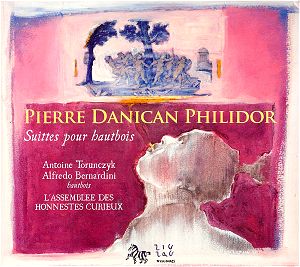

 L'Assemblée
des Honnestes Curieux (Antoine Torunczyk (oboe)*; Alfredo Bernardini
(oboe); Baldomero Barciela (bass viol); Benjamin Perrot (theorbo,
guitar); Chiaopin Kuo (harpsichord))
L'Assemblée
des Honnestes Curieux (Antoine Torunczyk (oboe)*; Alfredo Bernardini
(oboe); Baldomero Barciela (bass viol); Benjamin Perrot (theorbo,
guitar); Chiaopin Kuo (harpsichord)) 
