The front pages of
the booklets of these discs refer to
one of the remarkable aspects of this
music: "1704: a Neapolitan in Paris".
The opus 1 recorded here was the very
first collection of Italian music ever
published in France. For a long time
the French resisted the Italian influence
which had become so dominant elsewhere
in Europe. But around 1700 more and
more composers began to absorb elements
of the Italian style. The fact that
an Italian like Mascitti was not only
accepted but even highly praised tells
us much about the change in the cultural
climate at the time.
Mascitti was born in
Chieti, near Naples, and began his career
in the royal chapel, where his uncle
- who also was his first teacher in
music - acted as violinist. After travelling
through Europe he settled in Paris,
where he came under the patronage of
the Duke of Orléans. The duke
was an ardent lover of Italian music
and Mascitti was just one of the Italian
musicians he took under his wing. This
connection allowed Mascitti to play
at the royal court in Paris. He made
such an impression that in 1714 he was
granted a king's privilege to print
for 15 years "collections of sonatas
and other musical pieces, vocal as well
as instrumental". This privilege was
twice extended, in 1731 and 1740, and
- as a sign of the appreciation of Mascitti
- he was given French citizenship in
1739. It seems he was also generally
liked as a person, because of his friendly
character and his generosity. Mascitti
died in Paris at a venerable age in
1760.
Mascitti's music was
appreciated although he didn't make
any real concessions to the French taste.
These sonatas opus 1 are predominantly
Italian in character, and it is no wonder
that they were compared with the sonatas
of Arcangelo Corelli. Like Corelli Mascitti
uses both the common forms of the sonata,
the 'sonata da camera' and the 'sonata
da chiesa'. But there are also some
sonatas in this collection which are
a mixture of both forms, like the Sonata
II which contains five movements: adagio,
allegro, largo (sonata da chiesa), allemande
and giga (sonata da camera). The twelve
sonatas are divided into two groups:
six for violin and b.c. and six for
two violins with basso continuo. In
three of the trio sonatas the cello
is given some independence. In those
cases the viola da gamba joins the harpsichord
in the realisation of the basso continuo
part.
These discs offer more
than 100 minutes of music and it was
no problem at all to listen to them
in a single session; there’s not a dull
moment. I was struck by the quality
of this music, and in particular by
the variety and originality of the thematic
material. These sonatas have enough
to offer to keep the listener's attention,
like the expression in the slow movements.
A striking example is the first movement
of the Sonata V, whose character is
indicated with 'largo et affectuoso'.
In particular in the trio sonatas there
are a number of movements which contain
strong harmonic tension. In the grave
of the Sonata VII there is some chromaticism
as well. The solo sonatas are not overly
virtuosic, although several movements
contain double-stopping. Mascitti's
opus 1 is definitely more than easy-listening
stuff.
It is to the credit
of Ensemble Baroques-Graffiti that this
set of discs rapidly becomes quite captivating
and enjoyable. The fast movements are
performed with panache and great rhythmic
flexibility. The expressive moments
in the slower movements are also fully
explored. Sometimes the playing is a
bit less polished than we are used to
hear from the best ensembles in the
business - especially in some of the
solo sonatas - but that did not in any
way spoil my enjoyment and appreciation.
The basso continuo section gives both
harmonic and strong rhythmic support.
Interestingly the basso continuo of
the Sonata X is played by cello only
- a perfectly legitimate option, but
seldom practised in recordings.
The music has been
very well recorded, and the booklets
- identical for both discs - contain
an informative essay on Mascitti. There’s
also information about the players who
are from very different backgrounds,
but have grown into a very fine group.
I hope to hear more from this remarkable
composer.
Johan van Veen
























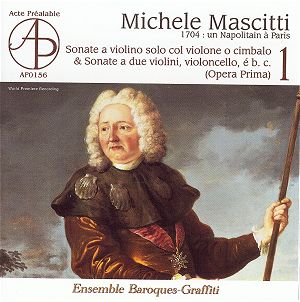
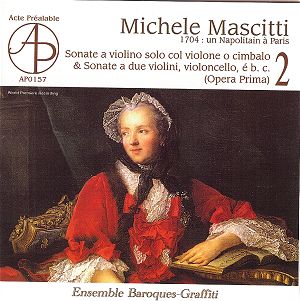
 Ensemble Baroques-Graffiti (Jaroslaw
Adamus, Sharman Plesner (violin), Frédéric
Audibert (cello), Agustina Meroño
(viola da gamba), Jean-Christophe Deleforge
(violone), Jean-Paul Serra (harpsichord))
Ensemble Baroques-Graffiti (Jaroslaw
Adamus, Sharman Plesner (violin), Frédéric
Audibert (cello), Agustina Meroño
(viola da gamba), Jean-Christophe Deleforge
(violone), Jean-Paul Serra (harpsichord))

