Having
presented
Orfeo ed Euridice in Vienna, at the
Burgtheater, Gluck followed it with his opera
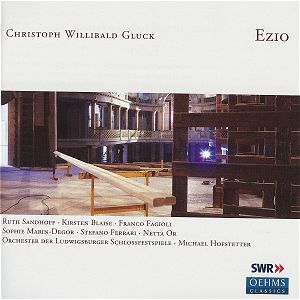
Ezio,
to a text by Metastasio, also at the Burgtheater in 1763.
It is unclear who commissioned the opera and why Gluck
ended up presenting a traditional opera seria at what
was one of the most progressive theatres in Europe. Despite
joining with Calzabigi to write reformed opera, Gluck
had by no means jettisoned the traditional opera seria
form. Early in 1763 he had presented
Il trionfo di
Clelia (also to a text by Metastasio) for the inauguration
of the new opera house in Bologna.
Gluck
had already presented a setting of Metastasio’s
Ezio libretto
in Prague in 1750. He had subsequently re-used arias
from that setting in other operas which had been presented
in Vienna. For example, Massimo’s aria
Se povero il
ruscello from the Prague
Ezio was recycled
in
Che puro ciel in
Orfeo. Though keen
to exploit material, Gluck had principles and would not
present re-used music twice in the same city. For this
reason he pruned the Prague
Ezio of any material
which had already appeared in Vienna and added seven
arias from
Il trionfo di Clelia. He wrote only
three new arias. Almost all the recitative was newly
composed. The result is noticeably shorter than Handel’s
setting of the same libretto, though Gluck uses a moderate
amount of recitative with relatively short arias.
I
am unclear as to why the Ludwigsburger Schlossfestspiele
chose to perform and record this particular version of
Ezio.
It is a good example of Gluck’s standard working method,
even when he’d started writing his reform operas.
To
us the opera seems alarmingly like a throw-back, a reversion
to old fashioned opera seria. To Gluck’s contemporaries
the Vienna
Ezio was notable for the naturalness
of its vocabulary. The CD booklet quotes an anonymous
contemporary review in the
Wienerisches Diarium.
‘… never
has any composer been truer to nature than he. Almost
all have sacrificed it to the art. ... For him [Gluck]
the poet does not count solely for what he expresses,
but his work gains new agreeability and new stimulation
from the art that it is combined with’. So we must
view
Ezio as another experiment, one where Gluck
is learning what does and does not work in terms of naturalism.
Part
of the charm of the opera lies in its attractive overture
and ritornello, given lively, almost brisk performances
by the Ludwigsburger Schlossfestspiele orchestra under
Michael Hofstetter. These are recognisably Gluckian in
form and sound. They anchor the opera firmly into the
same world as
Orfeo and the ballet
Don Juan.
The
plot is a typical Metastasian one involving family politics
and the clash between love and duty. What was important
was not the naturalism of the plot but the way the characters
were put into extreme emotional situations and tested.
The Roman general Ezio is tested by the machinations
of his fiancée’s father, Massimo. Ultimately Ezio’s fiancée,
Fulvia, is forced to choose between her father and her
lover.
Gluck’s
concern seems to have been to provide varied and suitable
arias; variety and attractiveness being the watchword
rather than involvement in the plot. On repeated listening
the commitment of the cast is impressive. They have performed
their roles on stage and this shows. The recitative sounds
something like drama rather than mere word-spinning.
And though individual arias may fail to touch the heart,
the singers draw you into the drama of the performance.
There is a great deal of plotting and understandably
not everyone will want to follow the libretto in detail.
The
cast are all creditably hard-working, giving convincing
performances of Gluck’s music. Notwithstanding the Wienerisches
Diarium’s comments about naturalism, Gluck must have
had a group of talented virtuoso singers in his cast
and the music he wrote reflects this.
Ruth
Sandhoff as Valentiniano the Roman Emperor, copes well
with the virtuoso nature of her first aria, though she
does show some strain at the top. Generally her attractive
mezzo-soprano voice is shown off well by the music.
Franco
Fazioli, as the general Ezio, displays a lovely fruity
mezzo with a good sense of line. Fulvia’s first aria
is the affecting Caro padre. It is still a tricky
piece and soprano Kirsten Blaise copes admirably. The
two get an affecting duet though Blaise does show some
pressure at the top of her voice. That said, later in
Act 2 she redeems herself with some impressive high notes
in her aria Quel fingere affetto.
Stefano
Ferrari displays an attractive tenor voice as Massimo,
Fulvia’s father, though his passage-work is a bit laboured
at times. He shows some strain at top but throws off
his first aria in a bravura manner. His final aria is
a real charmer complete with viola da gamba obbligato.
Unfortunately
soprano Sophie Marin-Degor (Onoria) also shows some strain
at the top, but copes well with her technical challenges.
Her act 2 aria Fin che per te mi palpita is particularly
elaborate. Soprano Netta Or provides an impressively
decorated da capo for her aria Nasce al bosco.
The
CD booklet provides a complete libretto in Italian, English
and German, along with an article which provides full
background to the opera. The only annoying point is that
the discs are indexed on a scene by scene basis - individual
arias are not indexed.
Although
by no means perfect, this performance is charming and
involving. Anyone interested in what Gluck did after Orfeo should
buy it.
Robert Hugill
























 Valentiniano – Ruth
Sandhoff (mezzo)
Valentiniano – Ruth
Sandhoff (mezzo) 
