In a recent interview the flautist Jed Wentz, director of the
ensemble Musica ad Rhenum, said that of all baroque music he loves
French music most, but unfortunately it doesn't sell very well.
Some record companies and ensembles seem to think differently:
over the last year or so quite a number of discs with instrumental
music of the French baroque have crossed my path. If there isn’t
a market for this kind of repertoire surely it would not be so
frequently recorded. I also note with satisfaction that some musicians
and ensembles avoid the standard repertoire, like Marais and François
Couperin, and turn their attention to the lesser-known composers
of the late 17th and first half of the 18th century. Louis-Antoine
Dornel is certainly no unknown quantity in our time, but he definitely
belongs to the more obscure echelons of French composers of the
baroque era.
Dornel was educated as an organist and held several positions in this
capacity in Paris. But very little else is known about his life
and career. Apparently we now know when he died: according to
the data on this disc it was in 1765, whereas the New Grove
only says "after 1756". Unfortunately it is not just
his life we don't know very much about. Our knowledge of his
oeuvre is also limited. It is known that he wrote several motets
which were greatly appreciated and were also performed at the
'Concert Spirituel', but as all these works have been lost we
know nothing about them.
What has been left is a handful of organ pieces, suites for the harpsichord,
some collections of chamber music, two chamber cantatas, a divertissement
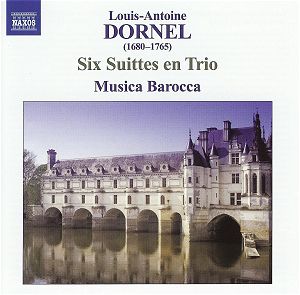
and some airs. The suites recorded by Musica Barocca were his
first collection which was published in 1709. Its title is 'Livre
de simphonies', a 'simphonie' being the general term for a piece
of music. The collection also contained a single 'quatuor',
a sonata for three treble instruments and bc which hasn't been
recorded here for reasons of space. The six suites were written
for two treble instruments and bc. Dornel was composing in a
time which saw the influence of the Italian style continually
growing, and these suites unmistakably reflect the influence
of Arcangelo Corelli and his trio sonatas.
A characteristic feature of Dornel's music, also apparent in these
suites, is his sense for polyphony. The suggestion that this
is due to his education as an organist seems very plausible.
The suites regularly move away from the traditional pattern
of allemande-courante-sarabande-gigue - as so often is the case
in French suites of the late baroque. Three of the suites open
with a (slow) prélude, the other three with an overture in two
sections (slow - fast). The courante is completely absent, instead
we find movements like menuet, fantaisie, rondeau or ritournelle.
A collection like this can't do without a chaconne (three) or
a passacaille (one). And very few composers failed to write
a 'plainte', as we find here in the Suite No. 5.
Although Dornel isn't one of the best-known composers of the French
baroque, he isn't that badly represented on disc. The Dutch
flautist Wilbert Hazelzet devoted a whole disc to his chamber
music (Glossa) and Hugo Reyne gave a good overview of his oeuvre
with his ensemble La Simphonie de Marais (Tempéraments). The
latter disc includes some organ pieces and interestingly also
contains the quatuor Musica Barocca omitted. More attention
has been given to Dornel's opus 2, so this recording of the
six suites from opus 1 is very welcome.
As far as the interpretation is concerned I am a little in two minds.
On the one hand: the playing is very good and I really enjoyed
the performances. The slow movements are played with great sensitivity,
the fast movements with verve - I can imagine some people find
it difficult to keep their feet still while listening to the
faster movements. There is also a good differentiation between
good and bad notes - something I often miss in recordings of
baroque music.
But: I am a little puzzled by the choice of instruments. True, Dornel
has left it to the performers as to which instruments his music
should be played on. In the title flutes, violins and oboes
are mentioned, but that in itself is no argument against playing
these suites on recorders, or, as here, voice flutes (a type
of recorder with d’ as its lowest note, a tone and a half lower
than its relative, the treble recorder in F). But after 1700
the recorder was clearly in decline and overshadowed by the
transverse flute. Therefore the choice of voice flutes is not
very logical, in particular as the suites have to be transposed
- a fact the programme notes fail to mention. And the sound
of the voice flute - at least in this recording - needs a bit
of time to get used to: there are some sharp edges in its sound,
especially when the full dynamic range is exploited. I would
also have liked the interpretation to be a bit more adventurous,
in particular in regard to ornamentation. The basso continuo
section could have shown more presence too. The fact that the
two treble parts are treated on equal terms isn't always reflected
by the recording: in particular in the opening Suite in e minor
the first voice flute overshadows the second.
This opus 1 is recorded here for the first time and the overall quality
of the playing of the ensemble is admirable. At the same time
I hope we shall see a recording in the original keys with a more
appropriate scoring, and, if possible, a bit more adventure and
freedom in the interpretation.
Johan van Veen