I have to confess to some surprise - bordering on disappointment
- when I first received this latest Beethoven concertos issue
from BIS. Having been greatly impressed with Ronald Brautigam’s
still unfolding traversal of the solo works, I naturally assumed
this new recording of concertos 1 and 3 would use one of the excellent
Paul McNulty fortepianos that have become stars of the cycle,
especially as his conductor is another period specialist. Not
so. In a liner-note interview that BIS obviously feel is necessary
to justify the change in policy, Brautigam gives a number of reasons
why he has chosen a modern Steinway grand now he is onto the concertos,
chief among them being that he feels ‘a lot of the passagework
is very hard to hear when it is played on period instruments’.
I cannot really accept this, given modern recording techniques
and the excellence of the tone from McNulty’s modern copies. That
said, Brautigam is the expert in this field and, as such, has
adopted an approach that is likely to please a wider number of
buyers, which is maybe BIS’s strategy.
It appears from
Brautigam’s note that the musicians and recording team have
opted to remove the lid from the Steinway and place the instrument
within the orchestra rather than out front, as in a concert.
He feels this makes for ‘a wonderfully interactive set-up…[with]
chamber musical intimacy’. He’s certainly right there, though
I feel this could also have been achieved with a period piano.
Brautigam, needless to say, plays very much in the style we’ve
become accustomed to, with superb dexterity, plenty of attack
on fortissimos, real rhythmic urgency and a wide dynamic range.
I’m not sure whether the modern piano has been voiced on the
bright side, as Andras Schiff does these days, but it sounds
splendidly alive and vivid, with none of the mushiness or ‘woolly’
quality that can afflict classical concertos on a modern grand.
It also helps that Brautigam uses the sustaining pedal judiciously
which, coupled with the same HIP approach from his conductor,
gives these performances an edge over many rivals. Indeed, Parrott
does what we now expect from a number of conductors (Mackerras,
Rattle, Norrington) in getting the Norrköping players to use
very little vibrato, shorten the phrase lengths and play with
a general liveliness that is very invigorating; wind lines are
crystal clear, brass rings out thrillingly when required, and
timpani use sticks to great effect. Tempos are on the fast side
but never overdone, except possibly in the finale to No.1, where
even Brautigam’s technique is pushed to the limit, leading me
to ponder once again whether the lighter fortepiano action would
have made it sound more convincing.
Overall, the interpretations
are very satisfying, the Mozartian heritage strongly brought
out without diminishing the grandeur of these works. They seem
broadly in line with some others I have come across, such as
the Berezovsky/Dausgaard cycle on Simax, although side by side
comparison seems to constantly favour the BIS disc, which enjoys
a more immediate sound quality alongside more penetrating playing.
Concerto No.1 is
almost all entirely successful and only that breathless finale
could give any cause for concern, though the excitement is undeniable.
Brautigam’s phrasing of the slow movement is exquisite and the
string sonority at 6:54 into the first movement the equal of
any band I’ve heard on disc, including the Concertgebouw for
Perahia/Haitink (Sony). My eyebrows were raised slightly by
one small textual point at about 4:20 in that same first movement:
the little second subject cadential phrase on the piano is altered
by lowering an upper F sharp in the right hand down to F natural.
It may be something to do with the range of Beethoven’s instrument
at the time of composition, as I’m told this happens on other
recordings, but it’s the first time I’ve heard this in practice.
The cadenza is the composer’s third one from 1809 and is a particularly
grand and adventurous one.
The long opening
tutti to Concerto No.3 is dramatically and convincingly
shaped by Parrott and Brautigam relishes the challenges it throws
up. It doesn’t necessarily displace other favourites, Perahia/Haitink
being amongst mine, but there is a wonderful inevitability about
this playing that is truly thrilling. Others may want that glorious
largo, with its odd 3/8 time signature, to stretch out even
more timelessly, but I personally prefer clean, clear phrasing
that lets the music speak naturally, to over-indulgent wallowing,
so this performance really works for me.
Overall, it’s very
hard to fault this disc but - and it’s a big one – as a ‘conventional’
performance it does enter an exceptionally crowded field, whereas
it may have become an easy front-runner if period instruments
had been used. However, even if I feel BIS may have missed an
opportunity here, I have already returned to this disc more
than any other in my collection for a while, so the sheer vitality
and magnetism of the music-making must have already worked their
spell.
Tony Haywood
























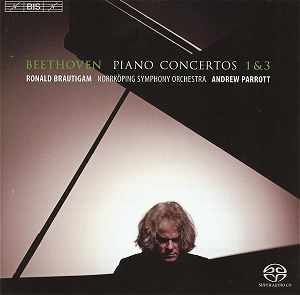

 Ronald Brautigam
(piano)
Ronald Brautigam
(piano)  [67:16]

