The name of the Polish composer, Pavel Lukaszewski, may be new
to some readers, as it was to me. He was born in Częstochowa,
the city in southern Poland, which has been for centuries a centre
of pilgrimage. The famous icon of the Black Madonna of the Virgin
Mary is kept in a monastery in the city and this has acted as
a magnet to pilgrims. Thus Lukaszewski hails from a key centre
of Polish Catholicism and perhaps this accounts for a strong bias
towards vocal and choral music, much of it on religious subjects,
in his œuvre to date. The son of a composer, Wojciech Lukaszewski
(1936–1978), Pavel Lukaszewski studied cello and composition at
the Frédéric Chopin Academy of Music in Warsaw, where since 1996
he himself has taught composition. He is also active as a conductor,
especially of choral music.
In his booklet note
Paul Wingfield suggests affinities with the music of Górecki,
Pärt and John Tavener. I’d agree with that. This is not to say
that Lukaszewski’s music is “like” that of any of these composers,
for he has his own individual voice, but Wingfield’s list is
useful to give newcomers to this composer some points of reference.
In other words, if you respond positively to any of them then
I think you’ll warm to Lukaszewski also. In my view, however,
his harmonic palette is richer and wider than any of these illustrious
peers and I think there’s also greater rhythmic variety.
Over half of Stephen
Layton’s programme is devoted to settings of the seven ‘O Antiphons’,
composed by Lukaszewski between 1995 and 1998. These are in
Latin, as are all the other pieces in this collection. Arvo
Pärt has also made a setting of these texts, though his is in
German and is somewhat briefer than Lukaszewski’s. In liturgical
usage these antiphons are said or sung before and after the
Magnificat at the service of Vespers in the week preceding Christmas.
However, both Pärt and Lukaszewski have designed their settings
for non-liturgical use. Lukaszewski’s antiphons can be performed
separately from each other but heard in sequence, as here, they
make a compelling experience.
In these antiphon
settings Lukaszewski writes music that offers a vivid and individual
response to the texts. In the first, ‘O Sapientia’, the use
of alternating sections of vigorous, dancing rhythms and more
contemplative passages makes a strong impression on the listener.
The third antiphon, ‘O Radix Jesse’, features from the start
quite dense choral textures, from which a solo soprano voice
occasionally rises. Incrementally, Lukaszewski thickens his
textures and eventually he introduces a number of special effects,
such as glissandi, parlando and susurrando. None
of these effects is overdone but they enrich the expression
significantly.
The seven antiphons, when heard sequentially,
form a kind of musical arch. At the centre of this arch is ‘O
Clavis David’. This is a very arresting setting, containing
some of the most powerful and highly charged music on the whole
disc. After this the lighter, luminous textures at the start
of ‘O Oriens’ make for a telling contrast. It’s also typical
of the composer’s responsiveness to words that his music should
suggest light when he’s setting a verse that begins “O star
of the morning, splendour of eternal light”. The last antiphon,
‘O Emmanuel’, provides a stunning conclusion in a way that vindicates
performing the antiphons as a sequence. The setting encompasses
perhaps the widest dynamic range of the seven and, from hushed
beginnings, the music rises rapidly to a full-throated acclamation
of the coming Christ. But, in a subtle twist, the ending is
quiet, which I find most effective. This is a superb set of
pieces, affording a rich and rewarding listening experience.
The remainder of
the programme is similarly impressive. The setting of Psalm
102 is vivid, offering music that is often dramatic and powerful.
The music complements the Psalmist’s words most aptly. It’s
interesting how at the beginning and end in particular Lukaszewski’s
music is clearly influenced by chant. The Two Lenten
Motets are also noteworthy. The first, Memento mei,
Domine, builds urgently but then concludes in a mood of
calm, or resigned, acceptance. Its companion, Crucem tuum
adoramus, Domine, is outstandingly beautiful, with a
melodic line that undulates almost ecstatically. The whole setting
seems to me to express humble gratitude for Christ’s sacrifice
on the cross. The piece impresses as a product of sincere, firm
faith. It’s a very lovely setting.
The recital includes
pieces from both ends of Lukaszewski’s career to date. Ave
Maria is one of his earliest works. It strikes me as
a rather feminine setting, something which is emphasised by
a pure soprano solo, winningly sung here by Rebecca Lancelot.
There is a shorter, more urgent section before the return of
the gentle, lyrical music with which the piece began. And at
the other end of the time line is a very recent piece, a setting
of the Nunc dimittis. This is a beautiful and deceptively
simple setting, which Lukaszewski has dedicated to Stephen Layton,
presumably in gratitude for his work on behalf of his music.
All I can say is that in the unlikely event that someone dedicated
such a lovely piece to me I’d feel humbled by it.
This disc confirms
the continuing excellence of the Trinity College choir. The
sound is fresh but the ensemble also has the requisite tonal
weight. The singers blend superbly and sing this demanding programme
of a cappella music with evident commitment and dedication.
Stephen Layton clearly believes in the music and directs it
with great understanding. The recorded sound is first rate.
Paul Wingfield’s notes are generally very helpful, though occasionally
a little technical for the general reader.
On the evidence of this CD Pavel Lukaszewski
is a significant voice in contemporary choral music. He manages
to write music that challenges the listener – to say nothing
of the performers – while remaining accessible at all times.
He has something fresh to say but he is respectful of and responsive
to established traditions. It’s hard to imagine his music could
be better served than it is here. This disc is an outstanding
introduction to a composer of whom I hope to hear much more.
John Quinn
























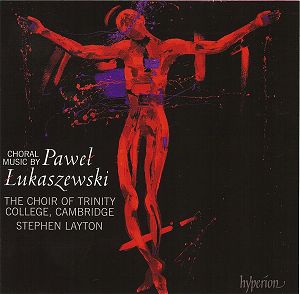

 The Choir of
Trinity College, Cambridge/Stephen Layton
The Choir of
Trinity College, Cambridge/Stephen Layton 
