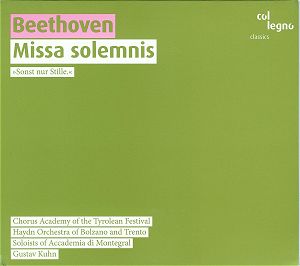
Beethoven’s Missa Solemnis was composed for the celebration
of his greatest patron Archduke Rudolph, when he was made Archbishop
of Olmütz in March 1820. In the event, however, it was not completed
until 1823. Beethoven was not overtly religious, and it is the
only major religious work of the last ten years of his life with
which he laboured from the spring of 1819 to 1823. It is arguably
one of the most difficult of his vocal works to perform.
This current
recording features the Haydn Orchestra of Bolzano and Trento,
which was founded in 1960. Gustav Kühn has been their Artistic
Director since 2003 and they have recorded a cycle of the nine
symphonies; the Missa Solemnis probably being a natural ‘next
step’ for this project. The soloists, three Austrian and one
Chinese, are from the Accademia di Montegral (www.montegral.com).
The choir is the relatively small Choir
Academy of the Tyrol
Festival who were formed in 2007.
The orchestral
introduction to the Kyrie shows a well balanced orchestra
with a pungent sound from the woodwind, typical of Beethoven.
The choral entries are strong for such a small yet well disciplined
choir. However the solo entries marked piano are sung
forte – a common problem with this work. As the movement
progresses it becomes apparent that the choir is dominated by
the sopranos who exhibit a steely tone when singing forte
or louder. This also turns very ‘acid’ when they are high
in the voice. The Criste Eleison is the first extended
passage for the soloists and individually they produce good
legato. Sadly they do not blend, and the soprano often seems
to disappear when singing in her lower register.
In the Gloria,
the opening section contains some of the most contrasting music
with the ‘Gloria in Excelsis Deo’ sung loud and high
in the voices followed by ‘Et In Terra Pax’ hushed and
low down. Kühn and his forces manage this well and the disciplined
choir give definition to the notes and words in their low registers
which can often sound like mutterings with a bigger choir. At
‘Qui Tollis’ he again shows us the detail in the woodwind
writing which is well-balanced. Even so, the soloists sound
like individuals, each trying to dominate the ensemble, and
not an integrated team. A much better sound can be heard in
the recording by Harnoncourt where his soloists blend very well
and are not afraid of singing piano. Later in the movement the
choir sing so full out in the fugue ‘In Gloria Dei Patris’
that entries by each part are obscured and the whole thing sounds
just too forced. The soloists launch the Amen, (which
is marked piano) at a good forte which is too
loud. Try comparing Harnoncourt at this point. This means that
the forte entry of the choir with ‘Amen’ loses
its impact. From there to the end the sopranos’ acid tone dominates.
Compare it with Shaw and the Atlanta Symphony Chorus on Telarc
and see how a larger choir can still be incisive but with a
much rounder tone.
And so to the
Credo - Beethoven’s great affirmation of faith. We have
a very strong opening but the sour tone of the choir’s sopranos
soon makes listening an uncomfortable experience, especially
as there are many high As and B flats. At ‘Et Incarnatus
Est’ the soloists begin to blend better than earlier and
the solo soprano’s vibrato is under much better control. Then
again, compare this passage and the later ‘Amen’, with
Harnoncourt who has a finer line-up of singers, and you can
sense a better integrated team giving a much more satisfying
performance. The choir show themselves to be excellent when
singing the ‘Et Vitam Venturi’ fugue when it starts quietly,
but again the tone becomes rasping when they venture into the
louder dynamics with excoriating high B flats from the sopranos.
Again, Shaw’s larger choir gives a much more rounded sound in
the loud passages. The quiet ending of this movement is one
of the most satisfying parts of this recording, and indeed should
be one of the most sublime pieces of music ever written, with
the orchestra carrying the prayer upward to heaven.
The Sanctus
is marked ‘Mit Andacht’ - with devotion - and begins
with a solemn tread of strings and trombones introducing the
soloists with the word ‘Sanctus’. This section becomes
‘operatic’ with the soloists trying to outdo each other with
intensity. When we get to the ‘Dominus Deus Sabaoth’
(marked pp) it is all much too loud. The Hosanna is
given to the choir who are strident and their volume is far
too high. There follows a Praeludium for lower strings
and woodwind which gives way to the Benedictus. This
starts with high solo violin and flutes where the sublime end
of the Credo is surpassed in a passage of intense beauty.
This section sounds very fine with a nice balance within the
orchestra and good playing from the leader. However compare
it directly with Harnoncourt and it sounds prosaic. With Harnoncout
it has a chamber music quality and when the solo singers enter
Kühn’s are just bland, with the soprano taxed by the high tessitura.
Eva Mei for Harnoncourt soars up to the high C effortlessly,
whereas one fears for Ingrid Kaiserfeld’s safety.
The opening
of the Agnus Dei is suffused with foreboding. The low
strings, horns and bassoons create a dark atmosphere for the
entry of the bass soloist and men of the chorus. Kühn’s soloists
soon become overwrought which distorts the music and does not
allow Beethoven’s orchestral writing to have its full effect.
Even Shaw displays this fault, but Harnoncourt’s soloists are
steadier in tone, especially Eva Mei whose singing is poised,
restrained and graceful. This is definitely a case of less is
more. The B minor ‘Agnus Dei’ gives way to the D major
of the ‘Dona Nobis Pacem’, the ‘Prayer for inner and
outer peace’ as Beethoven inscribed on the score. It is like
a shaft of sunlight breaking through the gloom. There are two
interruptions of martial music which disturb this peace. This
is handled well by Kühn so when we reach the final Dona Nobis
Pacem we feel the peace is hard fought but won.
The recording
is very clear with a natural acoustic, if a little close-miked,
which may account for the hard tone from the choir. The booklet
is in German and English but no text or translations, just an
odd description of the work that focuses on a hospice patient
who listens to Alice Cooper and communicates only by blinking.
It includes information about the orchestra, choir and conductor.
Kühn’s interpretation
of this work is good without being revelatory, but is severely
compromised by the choral singing. While accurate and well defined
especially in the quiet passages, the choir tends to raucousness
in forte and above leading to the ear becoming weary
of the sound. I feel Harnoncourt’s is a better achievement;
all the more so as his was recorded live.
Arther Smith