Rubinstein’s 1946 Carnegie Hall recording of the C minor concerto
is one of the fastest on record; I can’t say the fastest
because I’m in no position to have heard them all. It’s certainly
quicker than the composer’s own electric recording with Stokowski
though roughly on a par with the 1924 late acoustic they made
together. Even here however Rubinstein is quite a bit quicker
in the finale. The effect is one of intense excitement and engagement,
sprinkled with a number of the pianist’s own textual emendations,
and given the notorious microphone placement on which he insisted
the result is a blockbusting, visceral and very up-front traversal.
Rubinstein refuses almost all offers to linger, preferring instead
a valiant, almost defiant linearity that’s by no means finger
perfect but adds a remarkable gloss to more indulgent performers.
That said I don’t think anyone would call Moiseiwitsch sentimental
in this regard and yet he in his recordings with Goehr and Cameron
was altogether slower – three and a half minutes slower in total
with Goehr in 1937 for example – and he didn’t sound sentimental
either.
What does emerge strongly in this performance
is Rubinstein’s approach to elements of Rachmaninoff’s writing
that others can elide, especially audible – given the nature
of the recording – in the slow movement. I found his playing
here at its best, though the recording sabotages string counter
themes and wind lines rather ruinously; even the horns suffer
badly. But the compensations are once again linear and decisive,
qualities that reappear in the finale. Moiseiwitsch’s slightly
earlier performance of this clocked in at 11: 24 – and he was
no slouch; Rubinstein dispatches his finale in 9:58.
The Rhapsody is
better balanced. He also had a better orchestra than the NBC
in the form of the Philharmonia and a better accompanist than
Golschmann in Walter Susskind. Still it’s again a vivaciously
phrased and again very powerful, no prisoners type of performance.
The pianist’s chording is dynamic and ringing, the horns sound
resplendent. The winds etch their lines with powerful personality.
For all the élan things don’t sound breathless as they could
in the concerto. The tempo here is on a par with Moiseiwitsch’s.
A 1950 C sharp minor Prelude makes a formidable, if perhaps
inevitable ‘encore’ – Rubinstein’s only commercial recording
of a solo piece by the composer.
In conclusion there’s
quite a bit under an hour of well annotated and expertly transferred
Rubinstein-Rachmaninoff here. Powerful, graphically pictorial
and directional; intensely dramatic, sometimes uncomfortably
so.
Jonathan Woolf
see also Review
by Rob Maynard
























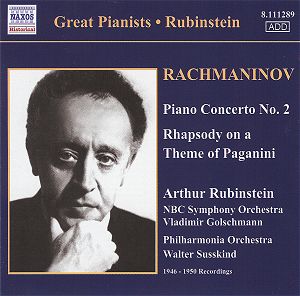
 Arthur Rubinstein
(piano)
Arthur Rubinstein
(piano) 
