I am not a great enthusiast of historical recordings. I guess
it goes back to my teenage years when it was the latest release
from the Beatles that mattered and not one of the ‘square’ hits
from five years previously. However things change. In the same
way that virtually every note performed by the ‘Fab Four’ is available
on CD – bootleg or ‘official’ - the classical world too is concerned
to preserve its heritage. But the question I ask about any historical
recording is ‘Why do I want to buy this CD as opposed to a more
recent and presumably more technically perfect recording?’ Moreover,
with this Collins disc all the tracks were ‘laid down’ when I
was either a couple of years old or not even thought of – so there
is little sentimental attraction here. In the present case the
answer is twofold. Firstly, the programme of this CD is a near
perfect introduction to the pleasures of British music - counting
Grainger as an honorary countryman - and secondly, the performance
of some of these works is eye-opening to say the least.
Let’s launch with a brief resume of the
conductor’s life and achievements. Anthony Collins was born
in 1893 and studied both violin and composition at the Royal
College of Music. He was to start his career as an orchestral
player. Between 1926 and 1936 he was the principal violist
with the London Symphony and Covent Garden Orchestras. In
1939 Collins went to Hollywood to further his composing career.
Whilst there he wrote over twenty scores for RKO Pictures
including the 1940 version of Swiss Family Robinson.
However, with the onset of war he returned to England, gave
many concerts, and made a number of recordings. Collins died
in 1963.
He is probably
best remembered today for his magisterial and one-time definitive
Sibelius cycle. However, many listeners will surely know his
attractive piece of ‘light’ music Vanity Fair. Only
recently Dutton Recordings issued a fine retrospective of
his compositions that reveals a considerable talent that had
been largely forgotten. And there is more to discover – Collins
apparently wrote four symphonies and two violin concertos!
All of the works
on this CD could be regarded as both potboilers and major
or minor masterpieces. Only a couple of these pieces are regularly
played on Classic FM – but it is fair to say that at least
three of these numbers regularly turn up on any compilation
of English Music.
Sullivan is obviously
best known for his collaboration with W.S. Gilbert, but in
recent years his achievement as a composer in his own right
has largely been re-established. However, The Overture
di ballo, which was written for the 1870 Birmingham Festival,
is almost a conspectus of Sullivan’s style that was to come
finally to fruition the following year when the first of the
Savoy Operas, Thespis, was heard in London. The Overture
simply sparkles – it is a true gem, and Collins gives one
of the best performances of this piece that I have heard.
Great stuff!
2008 is the centenary
of the first performance of Henry Balfour Gardiner’s Symphony
No.2 in D major. However this score has been lost. Nowadays,
alas, the composer is largely remembered for two works: the
present Shepherd Fennel’s Dance and his Overture
to a Comedy. The Shepherd’s Dance is based on
a short story by Thomas Hardy. Yet this work has none of the
depressing characteristics often associated with this author.
In fact it became, for a space, a Proms favourite.
Balfour Gardiner
was one of the Frankfurt Group of composers, which also included
Cyril Scott, Norman O’Neill, Roger Quilter and Percy Aldridge
Grainger. Shepherd’s Hey is a short, but quite amazing,
miniature - especially in Collins’ rendering. It was based
on the folk tune ‘The Keel Row’ and incidentally, the
score was dedicated to Edvard Grieg. It is certainly a piece
to ‘chase away care’.
The Fantasia
on a Theme by Thomas Tallis requires little introduction
to readers of these pages. In fact, it is one of the great
masterworks of the Twentieth Century and probably the finest
essay in string writing in British music. There are some eighty-two
recordings of this work shown to be available on the Arkiv
database. Therefore, it is not easy to compare. However, I
listened to Collins’ version of this piece twice for this
review. There is definitely something magical and moving here
that I have not quite heard before in this work. And this
is even allowing for the half-century plus years that have
passed since it was first recorded. Perhaps it is this version
that best explains to me what so impressed the young Herbert
Howells all those years ago at the Three Choirs Festival.
It is like a paean of praise for, and a meditation on, the
soil of the West Country and it sons.
The Fantasia
on Greensleeves is ubiquitous, with regular outings on
Classic FM and over a 180 recordings presently available.
In 1913, RVW had spent time in Stratford-upon-Avon arranging
music for some of Shakespeare’s plays – including The Merry
Wives of Windsor. For this play, he used the melody that
is believed to have been written by King Henry VIII, Greensleeves.
Vaughan Williams used the tune again in his great opera Sir
John in Love – at the point where Falstaff roars out “Let
the sky rain potatoes, let it thunder to the tune of ‘Greensleeves.’”
The actual piece that is performed on this disc and worldwide
was adapted, with the composer’s consent, by Ralph Greaves
in 1934.
For me, the Delius
pieces are old friends. I recall an old LP from the 1950s
that I found somewhere - probably the school music library.
It was Collins version of The Walk to Paradise Garden
and The Song of Summer with which I first discovered
Delius. And I guess that it is this sound-scape that I have
carried with me in my musical mind ever since: it is my touchstone
for all subsequent recordings that I have heard of these pieces.
In fact it was not until a wee while after hearing these recordings
that I discovered the wonderful Tommy Beecham records. Yet
even these did not usurp what I had heard of Collins and the
LSO.
I have never managed
to get into the opera, A Village Romeo and Juliet.
Yet I have long loved the ‘intermezzo’ from that work in its
orchestral guise. I suppose as a lovelorn teenager I used
to listen to this music as a palliative to my moods and emotions
as I struggled with the unrequited love of ‘Sylvia’. Yet some
35 years on, this music still has the power to move me, although
somehow I tend to set the musical ‘landscape’ in the English
countryside rather than that of the Swiss Alps.
The Song of
Summer is one of the pieces that Delius’s amanuensis,
Eric Fenby, helped set down on manuscript paper. And it is
surely a well-known tale that the elder composer asked the
young Fenby to imagine the view from the sea-cliffs of Yorkshire
on a hot summer’s day. To my ear this is one of the best ‘landscape’
tone-poems in the literature and certainly deserves its place
in many an anthology of English music. Collins version is
totally convincing, in both its intimate moments and the huge,
almost overpowering climaxes.
This is a fine
CD that would make a good introduction to English music for
anyone who had yet to make that step. The sound is not perfect
– but yet again I am just a little younger than these recordings
and neither am I! However, what makes it a fantastic disc
is the sheer beauty of the sound, the attention to detail
and the depth of engendered emotion – especially in the Delius.
John France
























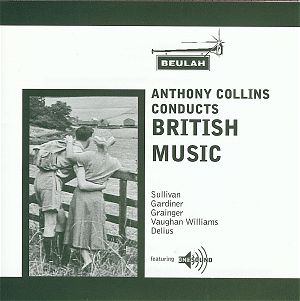

 New Symphony
Orchestra/Anthony Collins (Sullivan, Gardiner, Grainger); London
Symphony Orchestra/Anthony Collins
New Symphony
Orchestra/Anthony Collins (Sullivan, Gardiner, Grainger); London
Symphony Orchestra/Anthony Collins 
